 Globe Quest
 Human Quest · LearningSign in
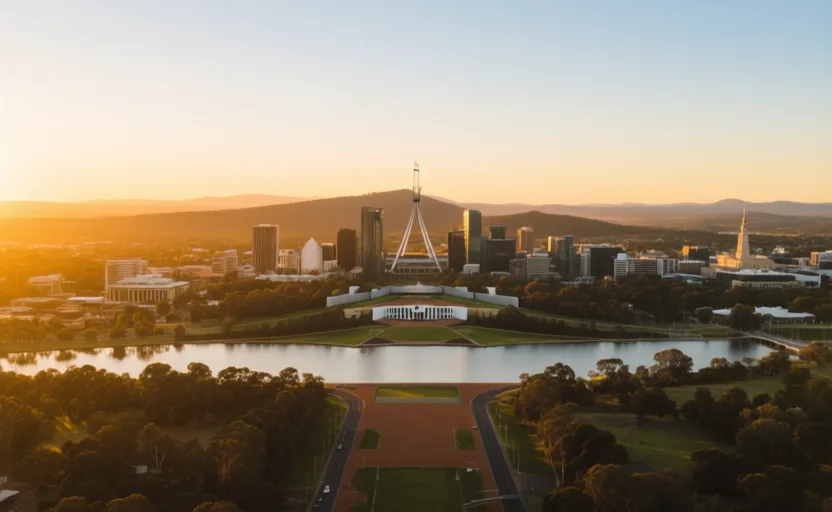 Canberra · AI city illustration · Artistic impression
City · Oceania
Canberra
Saved in this browser — no account needed. Sign in later and it comes with you.
Where it is
Australia's capital sits about 150 kilometres inland on the Limestone Plains, at an elevation of roughly 580 metres, with the Brindabella Ranges rising to the south and west as the northern end of the Australian Alps. A handful of low hills frame the centre: Black Mountain, Mount Ainslie, Mount Majura at 888 metres and Mount Taylor. The Molonglo River runs through, now widened into Lake Burley Griffin. The oceanic climate brings warm summers, frosty winters and almost no snow in the city itself, though the nearby ranges are often capped. It is the largest inland city in the country.
The land and water around it
The Brindabella Rangesmountains
The ranges south and west of the city are the northern end of the Australian Alps. Snow caps them in winter and can be seen from the city centre, though the last significant fall in the city itself was in 1968.
The Molonglo River and Lake Burley Griffinlake
Early explorers called the Molonglo the Limestone River, and the plain around it the Limestone Plains. The Griffins' plan turned the river into a lake, laid out so its parts line up with hills such as Black Mountain and Mount Ainslie.
Black Mountain and Mount Ainsliehills
Hills of similar height to the north-west and north-east of the centre. The Griffin plan aligned its geometry with them, and Ngunnawal people had held ceremonies at the base of Black Mountain.
Its history, in short
The Ngunnawal and Ngambri peoples, along with others who claim connection to the land, lived on these plains for up to 21,000 years, managing it with fire and farming yams. The Canberry or Nganbra clan had ceremonial grounds at the foot of Black Mountain, which they called Galambary. British exploration began in 1820, and Joshua John Moore's station of the mid-1820s gave the place the name Canberry. Disease and dispossession reduced the Aboriginal population to under a hundred by 1840, while about 2,500 Europeans, mostly stockmen, lived in the district by 1851. The idea of a capital grew out of federation, when Sydney and Melbourne could not agree and the compromise was a new city in New South Wales at least 100 miles from Sydney, with Melbourne as the temporary seat. After a dispute over Dalgety, the Yass-Canberra district was ceded in 1906. The capital was named in 1913, and an American couple, Walter Burley Griffin and Marion Mahony Griffin, designed it. Parliament moved in 1927, and the territory gained self-government in 1988.
Timeline
Dates are shown on a timeline rather than as changing shapes on the map. The globe draws modern boundaries only, and tinting a modern outline to stand for a historical one would state something we cannot source.
Early human world
Up to 21,000 years ago
First peoples
Rock shelters, rock art, burial places, quarries and stone tools show early human activity in the area, perhaps as far back as 21,000 years.
Industrial & imperial
1820
British exploration
Charles Throsby leads a first expedition to the plains in October, followed by Charles Throsby Smith in December. Accounts differ on which man counts as first.
1823 to 1824
A sheep station
Joshua John Moore's grant becomes a station called Canberry on what is now Acton Peninsula. The name comes from the Ngunnawal or Ngambri clan the settlers called the Canberry people.
1904 to 1906
A site for the capital
Federal parliament chooses Dalgety in 1904, but New South Wales refuses to give up the land. In 1906 it agrees to the Yass-Canberra region, which lies nearer to Sydney.
Well attestedWikipedia1913
Named Canberra
The capital city is founded and formally named. The Commonwealth buys the Yarralumla property for the Governor-General the same year.
Well attestedWikipedia9 May 1927
Parliament moves
The Provisional Parliament House opens and the national parliament moves from Melbourne. Prime Minister Stanley Bruce moves into The Lodge a few days earlier.
Well attestedWikipedia
Contemporary
December 1988
Self-government
The Australian Capital Territory is given full self-government. Rosemary Follett leads the first government and becomes Australia's first female head of government.
Well attestedWikipedia18 January 2003
Bushfires
Fires from the ranges enter the suburbs, killing four people and destroying more than 500 homes and the major research telescopes at Mount Stromlo.
Well attestedWikipedia
Places that carry meaning
Galambary (Black Mountain)Long before 1820
The base of Black Mountain was a ceremonial ground of the Canberry or Nganbra clan. Ngunnawal men still conduct ceremonies on the Murrumbidgee, travelling upstream as they receive their totems and responsibilities for caring for land.
St John the Baptist ChurchBegun 1841; consecrated 1845
The town's first purpose-built place of worship, built on land bought from Robert Campbell. Its graveyard holds many nineteenth-century pioneers, and a schoolhouse beside it shows school life of the 1840s.
The Parliamentary Triangle20th century
The area beside the lake that holds Parliament, the High Court, the National Library and museums, with Reconciliation Place and Commonwealth Park among its features. An institute for Aboriginal and Torres Strait Islander studies stands nearby.
Languages here
Places are usually multilingual. This lists what is actually spoken, not one language per border.
EnglishGermanic family
The everyday language, spoken alone at home by 71.3 per cent in 2021.
More than 28 per cent of residents were born overseas, with India, England, China and Nepal the most common countries of birth.
Ngunnawal and Ngarigo
The languages of the first peoples of the plains.
The name Canberra comes from Ngunnawal, though its meaning is unclear. Suggestions include “meeting place”, and some link it to the hollow between Black Mountain and Mount Ainslie. A Ngarigo dialect was spoken on the plains. In 2016 Malcolm Turnbull spoke Ngunnawal in Parliament, the first head of government to use an Indigenous language in that chamber.
Community languages
Mandarin, Nepali, Vietnamese, Punjabi and Hindi lead.
At home in 2021, Mandarin was spoken by 3.2 per cent, Nepali by 1.3, Vietnamese and Punjabi by 1.1 each, and Hindi by 1.0.
Learn the language here
- 1Understand which languages are spoken hereCanberra is multilingual. Start with which languages are used, by whom, and for what — the phrase list only covers one of them.Written by Globe Quest
- 2Learn 12 phrasesCurated everyday phrases for Canberra, with audio and a written form.Written by Globe Quest
- 3Say them out loudSpeaking practice with pronunciation feedback, one phrase at a time.Globe Quest material, your own additions
- 4Come back to themSpaced review, so what you learned this week is still there next month.Written by Globe Quest
Check yourself
Why was Canberra built where it is?
It was a compromise between Sydney and Melbourne, at least 100 miles from Sydney
Neither Sydney nor Melbourne would yield. The compromise was a new capital in New South Wales, inland and at least 100 miles from Sydney, with Melbourne as the interim seat.
Who designed Canberra?
Walter Burley Griffin and Marion Mahony Griffin
The American architects' plan used geometry aligned with hills and a lake, with the central roads radiating like a wheel's spokes instead of forming a grid.
Worth arguing about
- No one agrees on what “Canberra” means, and more than one Aboriginal group is linked to the land. How should a capital handle uncertain origins for its own name?
- Canberra is entirely planned. What does a city lose, and gain, when its shape is decided before most of its people arrive?
What we have not established
These are open questions, listed rather than filled in. We would rather show a gap than a plausible guess.
Which European expedition first reached the Canberra plains?
One account credits Charles Throsby Smith with the first British expedition in October 1820. Another dates the European discovery to 7 December 1820 and lists Throsby's October expedition among four separate ones.
What does the name Canberra mean, and which group's name is it?
Suggested meanings include “meeting place” and a reference to the hollow between two hills, and the name has been linked to both Ngunnawal and Ngambri clans. No agreed meaning has been recorded.
Sources
- Wikipedia · CanberraWikipedia · encyclopedia · checked 2026-11-24
- Wikipedia · History of CanberraWikipedia · encyclopedia · checked 2026-11-24
- Wikipedia · Languages of AustraliaWikipedia · encyclopedia · checked 2026-11-24
Reviewed by Globe Quest editorial on 2026-11-24. Drafted with AI assistance and checked against the sources above before publication.