 Globe Quest
 Human Quest · LearningSign in
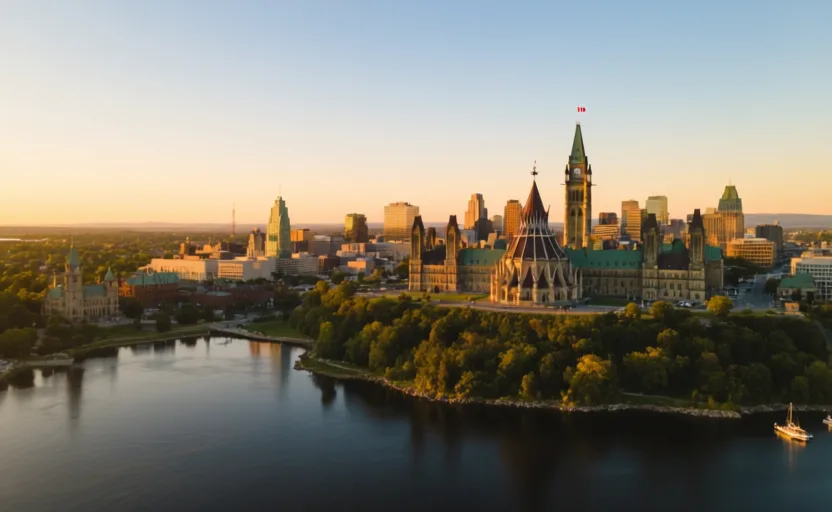 Ottawa · AI city illustration · Artistic impression
City · North America
Ottawa
Saved in this browser — no account needed. Sign in later and it comes with you.
Where it is
Ottawa is on the south bank of the Ottawa River, a short way upstream of where the Rideau and Gatineau rivers join it, so three major rivers meet within the city. The river is the provincial boundary, and on its far side lies Gatineau, in Quebec. The ground is a lowland of limestone and shale left by the Champlain Sea, which drained about 10,000 years ago, with older and rougher Precambrian rock around it. Winters are cold and long: the average January night falls to about -14 °C, and around 232 cm of snow falls in a year. The Rideau Canal, 202 km long, links the city to Lake Ontario at Kingston.
The land and water around it
The Ottawa River and Chaudière Fallsriver
The river was a trading highway long before any capital. The Algonquin met and traded at the falls, and in 1889 local industrialists received water leases there to generate electricity.
The Rideau River and Canalriver
The Rideau Canal, opened in 1832, uses 47 locks and flooded sections of the Cataraqui and Rideau rivers to bypass impassable stretches. Its northern end lies near Parliament Hill, and the pathways beside it grew out of the open-space proposals of the 1950 capital plan.
The old Champlain Sea floorplain
When the Champlain Sea drained, it left a lowland over limestone and shale, ringed by tougher Precambrian rock. People could settle it about 10,000 years ago, and the meeting of three rivers on this flat ground made it a natural place to trade.
Its history, in short
Algonquin people have lived along the river for at least fifteen centuries, meeting to trade at the Chaudière Falls, which they call Akikodjiwan. Europeans first came through in 1610, and the Algonquin kept their grip on the fur trade until Haudenosaunee attacks during the Beaver Wars drove many from the valley. A New Englander, Philemon Wright, founded a lumber town across the river in 1800, beginning the timber trade that powered the region. The town that became Ottawa began as Bytown in 1826, a construction camp for the Rideau Canal, which the British built because they feared another war with the United States. Bytown was incorporated in 1850 and renamed Ottawa in 1855. The choice of capital had been disputed for decades, with the legislature of the old Province of Canada holding more than 200 votes on the question, and Bytown's claim was pressed in the Stony Monday riot of 1849. Parliament Hill went up in the 1860s and 1870s. After the Second World War, a plan by the French planner Jacques Gréber reshaped an industrial town into a landscaped capital with a greenbelt and parkways. Amalgamation in 2001 created the single city of today, where the federal government is the largest employer.
Timeline
Dates are shown on a timeline rather than as changing shapes on the map. The globe draws modern boundaries only, and tinting a modern outline to stand for a historical one would state something we cannot source.
Post-classical world
since at least 500 CE
Algonquin gathering at the falls
Algonquin people live along the river and meet at Akikodjiwan to socialise and trade. Settlements at the mouth of the Gatineau go back 3,000 years or more.
Early modern & oceanic
1610
Brûlé on the river
Étienne Brûlé is the first documented European to travel the Ottawa River, on his way to the Great Lakes. Champlain describes the falls and the Algonquin three years later.
Well attestedWikipedia
Industrial & imperial
7 March 1800
Philemon Wright's lumber town
Wright founds a lumber town on the north side of the river, across from the future Ottawa, and begins shipping timber to Quebec City. It becomes the area's main economic activity.
Well attestedWikipedia1826
Bytown
The settlement beside the Rideau Canal works is founded. The canal itself was a response to worries about conflict with the United States.
1832
The Rideau Canal opens
The waterway from Kingston to the Ottawa River, near the future site of Parliament Hill, opens to boats using 47 locks.
Well attestedWikipedia1855
Renamed Ottawa
Bytown, incorporated as a town in 1850, takes the name of the river, which comes from an Algonquin word meaning to trade.
Well attestedWikipedia
Contemporary
1950
The Gréber Plan
The plan for the National Capital recommends a greenbelt, parkways, the removal of rail lines from the centre and the relocation of industry. It reshapes Ottawa from an industrial town into a landscaped capital.
1 January 2001
Amalgamation
The province merges the regional government and its municipalities into one city, despite opposition from political leaders in some of the merged towns.
Places that carry meaning
Parliament Hill1860s–1870s
The Parliament Buildings are in the Gothic Revival style. Their construction brought a major increase in the city's population.
The Rideau Canal1832
The city's one World Heritage Site, a 202 km waterway linking Lake Ontario at Kingston to the Ottawa River.
Chaudière Falls (Akikodjiwan)Long before European arrival
The Algonquin meeting and trading place, later the site of the hydroelectric water leases granted in 1889, and now close to federal office complexes on the Quebec side of the river.
Languages here
Places are usually multilingual. This lists what is actually spoken, not one language per border.
EnglishGermanic family
The mother tongue of most residents.
About 58 percent of residents have English as their mother tongue, and 60.6 percent know English only.
FrenchRomance family
Co-official in municipal business since 2002.
French is the mother tongue of 12.5 percent. Roughly 36 percent of Ottawans know both official languages, and in 2002 the city made English and French co-official for municipal business, which Toronto, Montreal and Vancouver have not done. The historically Francophone district of Vanier sits within the city.
Arabic, Mandarin, Spanish and other mother tongues
The first language of about a quarter of residents.
Some 23.1 percent have a mother tongue other than English or French, led by Arabic at 4.3 percent and Mandarin at 2.2 percent, then Spanish and Italian. Immigrants come most often from China, India, the United Kingdom and Lebanon.
Algonquin
The language of the original inhabitants of the valley.
The river's name comes from an Algonquin word, adawe, meaning to trade, and in modern Algonquin the city is called Odàwàg.
Learn the language here
- 1Understand which languages are spoken hereOttawa is multilingual. Start with which languages are used, by whom, and for what — the phrase list only covers one of them.Written by Globe Quest
- 2Learn 11 phrasesCurated everyday phrases for Ottawa, with audio and a written form.Written by Globe Quest
- 3Say them out loudSpeaking practice with pronunciation feedback, one phrase at a time.Globe Quest material, your own additions
- 4Come back to themSpaced review, so what you learned this week is still there next month.Written by Globe Quest
Check yourself
Why was the Rideau Canal built, and what settlement grew beside it?
To guard against possible conflict with the United States; the settlement was Bytown
The canal linked Lake Ontario and the Ottawa River by a route set back from the American border, and the settlement beside its works became Bytown, which was renamed Ottawa in 1855.
What does the Algonquin word that gives Ottawa its name mean?
To trade
Adawe means to trade, a good fit for a spot where three rivers meet and where people gathered at the Chaudière Falls for centuries.
Worth arguing about
- Ottawa was picked as capital after more than 200 votes over several decades, and it sits on the border between Ontario and Quebec. Does a capital on a provincial boundary help hold a federation together, or does it hide the division?
- The Gréber Plan cleared industry and rail from the centre to make a capital worth looking at. What is gained, and lost, when a working town is redesigned as a national symbol?
What we have not established
These are open questions, listed rather than filled in. We would rather show a gap than a plausible guess.
How many people live in Ottawa?
The 2021 census counted 1,017,449 in the city and 1,488,307 in the Ottawa–Gatineau metropolitan area, which also takes in Gatineau across the provincial border. The figure depends on where the line is drawn.
Sources
- Wikipedia · OttawaWikipedia · encyclopedia · checked 2026-11-24
- Wikipedia · History of OttawaWikipedia · encyclopedia · checked 2026-11-24
Reviewed by Globe Quest editorial on 2026-11-24. Drafted with AI assistance and checked against the sources above before publication.