 Globe Quest
 Human Quest · LearningSign in
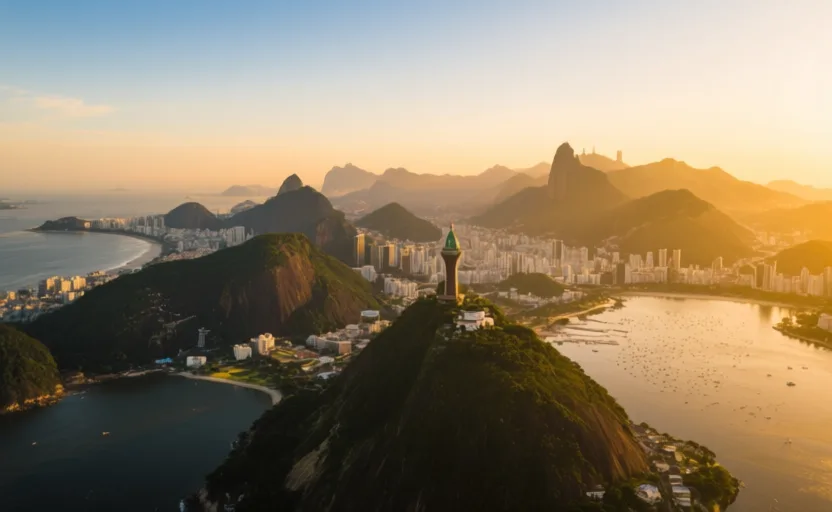 Rio de Janeiro · AI city illustration · Artistic impression
City · Latin America
Rio de Janeiro
Also known as Rio de Janeiro
Saved in this browser — no account needed. Sign in later and it comes with you.
Where it is
Rio is squeezed onto a narrow alluvial strip between Guanabara Bay and the Atlantic, with forested granite mountains rising straight from the streets. The Tijuca massif tops out at 1,021 metres, and domes such as Sugar Loaf and Corcovado frame the bay and shelter the harbour from the ocean. Because this stretch of the coast runs east and west, the city faces largely south. Land is the scarce resource: parks and avenues along Copacabana and Flamengo stand on reclaimed ground, while the hillsides are built over informally. The climate is tropical wet and dry, with hot humid summers and heavy rain from December to March.
The land and water around it
Guanabara Baybay
The bay is the reason for the city. Its entrance is marked by Sugar Loaf, and its shores took the French and Portuguese rivalries of the sixteenth century. Today it is polluted by sewage, oil and heavy metals, and has lost mangroves.
The Tijuca massifmountains
Forested granite mountains rise within the city. They hold Tijuca National Park, one of the largest forests surrounded by a city, and confine buildings to the lowlands and to the slopes where the poor settled.
Reclaimed shorelinecoast
Flamengo Park, the largest landfill in the city, and the Copacabana waterfront were built on ground taken from the sea. They shaped the outdoor living culture that outsiders now associate with Rio.
Its history, in short
Portuguese sailors reached Guanabara Bay on 1 January 1502 and took the bay for a river mouth, which gave the city its name, meaning January River. The first European settlement was French: in 1555 about 500 colonists occupied an island in the bay, and the Portuguese needed a decade of fighting to expel them. The city proper was founded in 1565 by Estácio de Sá. It became the capital of the colony in 1763, and in 1808, with Napoleon’s armies on the Iberian peninsula, the whole Portuguese court arrived, the only time a colonising power’s capital has officially moved to one of its colonies. Rio stayed the capital through the empire and the republic until 1960, when the seat of government moved to Brasília. Its harbour was also the largest port of the Atlantic slave trade in the Americas, and between 1811 and 1831 hundreds of thousands of enslaved Africans landed at the Valongo Wharf.
Timeline
Dates are shown on a timeline rather than as changing shapes on the map. The globe draws modern boundaries only, and tinting a modern outline to stand for a historical one would state something we cannot source.
Early modern & oceanic
1 January 1502
The Portuguese reach the bay
An expedition including Gaspar de Lemos enters Guanabara Bay and names it the January River.
Approximate dateWikipedia1555–1567
France Antarctique
French colonists fortify an island in the bay. The Portuguese attack from 1560 and finally defeat them in January 1567.
Well attestedWikipedia1 March 1565
The city is founded
Estácio de Sá founds São Sebastião do Rio de Janeiro, named for the patron saint of the Portuguese king.
Well attestedWikipedia
Industrial & imperial
1808
Seat of the Portuguese court
The court arrives and Rio becomes a European capital outside Europe. The new rulers create the National Library, the botanical garden and the first printed newspaper in Brazil.
Well attestedWikipedia1811–1831
Valongo Wharf
The wharf is built in 1811 to land enslaved Africans. Between 500,000 and a million people pass through it in two decades, making Rio the biggest slave port in the Americas.
1902
Pereira Passos rebuilds the centre
The new mayor demolishes tenements in the centre and builds wide avenues inspired by Paris. Displaced poor families move to the hills and begin the first favelas.
Well attestedWikipedia1910
Revolt of the Lash
Afro-Brazilian sailors in the navy mutiny against the use of corporal punishment and threaten to fire on the city from a battleship.
Well attestedWikipedia
Contemporary
1960
The capital moves
The seat of the federal government leaves Rio for Brasília, and São Paulo overtakes Rio as Brazil’s most populous city.
Well attestedWikipedia
Places that carry meaning
Valongo Wharf Archaeological Site1811 onward
Stone paving laid directly on the beach, with a ramp down to the sea. UNESCO calls it the most important physical evidence of the arrival of enslaved Africans in the Americas.
Carioca LandscapesNatural and 19th–20th century designed landscapes
UNESCO inscribed the whole ensemble of mountains, bay and parks, from the Tijuca forest to the Botanical Gardens of 1808 and the statue on Corcovado.
Passeio PúblicoHistoric centre
The first public park in the Americas, in the historic centre.
Languages here
Places are usually multilingual. This lists what is actually spoken, not one language per border.
PortugueseRomance family
The language of the city, spoken with the local carioca accent.
Rio has the largest Portuguese-born population outside Lisbon, as hundreds of thousands arrived after independence, mostly in the early twentieth century.
Indigenous and African languages
Languages of the earlier population, now historical.
At least seven indigenous peoples speaking some twenty languages lived around the bay before colonisation. Brazilian law today recognises Yoruba, Bantu and Ewe as heritage languages of the state of Rio de Janeiro, reflecting the African origin of much of the city’s population.
Learn the language here
- 1Understand which languages are spoken hereRio de Janeiro is multilingual. Start with which languages are used, by whom, and for what — the phrase list only covers one of them.Written by Globe Quest
- 2Learn 11 phrasesCurated everyday phrases for Rio de Janeiro, with audio and a written form.Written by Globe Quest
- 3Say them out loudSpeaking practice with pronunciation feedback, one phrase at a time.Globe Quest material, your own additions
- 4Come back to themSpaced review, so what you learned this week is still there next month.Written by Globe Quest
Check yourself
How did Rio de Janeiro get its name?
From the January 1502 arrival of the Portuguese at the bay they took for a river
They arrived on 1 January 1502 and took the wide bay for a river mouth, which is why the place became the January River. The city proper was founded in 1565.
What was unusual about Rio between 1808 and 1821?
It was the capital of Portugal’s empire, in a colony
When the Portuguese court moved to Rio, it became the only European capital outside Europe, and the only time a colonising power’s capital officially shifted to a colony.
Worth arguing about
- Rio stayed the capital for almost two centuries after the court arrived, then lost the title to a purpose-built city. What did it keep, and what did it lose?
- The same hills that give Rio its landscape are where the poor were pushed after the 1900s renovations. How should a city handle housing on slopes it is also trying to protect?
What we have not established
These are open questions, listed rather than filled in. We would rather show a gap than a plausible guess.
How many people live in Rio?
The 2010 census counted about 5.9 million within the city limits, while later estimates reach about 6 million, and the metropolitan area is estimated anywhere between eleven and thirteen and a half million, depending on the boundary used.
Sources
- Wikipedia · Rio de JaneiroWikipedia · encyclopedia · checked 2026-11-24
- Wikipedia · BrazilWikipedia · encyclopedia · checked 2026-11-24
- Wikipedia · Languages of BrazilWikipedia · encyclopedia · checked 2026-11-24
- UNESCO · Valongo Wharf Archaeological SiteUNESCO World Heritage Centre · intergovernmental · checked 2026-11-24
- UNESCO · Rio de Janeiro: Carioca Landscapes between the Mountain and the SeaUNESCO World Heritage Centre · intergovernmental · checked 2026-11-24
Reviewed by Globe Quest editorial on 2026-11-24. Drafted with AI assistance and checked against the sources above before publication.