 Globe Quest
 Human Quest · LearningSign in
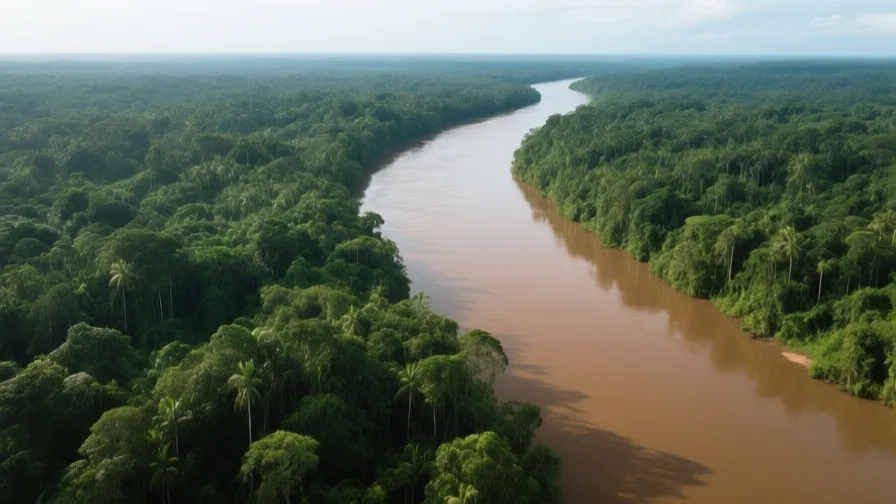 Brazil · AI landscape illustration · Artistic impression
Country · Latin America
Brazil
Saved in this browser — no account needed. Sign in later and it comes with you.
Where it is
Brazil fills almost half of South America, from the equatorial forests of the Amazon basin to the temperate south, and touches every other country on the continent except Ecuador and Chile. Its geology is old: crystalline shields, worn mountain ranges that mostly stay under 2,000 metres, and a central plateau averaging about 1,000 metres. The Serra do Mar runs close to the Atlantic coast, which stretches for about 7,500 kilometres, so the people and the ports sit on a narrow wet fringe, with an interior that is far larger and for centuries was far emptier. Most of the country lies within the tropics, but the semiarid north-east and the subtropical south are quite different from the rainforest.
The land and water around it
The Amazon basinriver
Brazil holds most of the world’s largest river system and the largest stretch of virgin tropical forest. The basin covers nearly half the country, principally the north and west, and the river’s mouth is the home of the Marajoara mound-builders.
The central plateau and the coastal rangesplateau
The Planalto Central spreads across the interior at about a thousand metres, while the Serra do Mar and the Espinhaço ranges run closer to the sea. Nearly half the territory lies below 200 metres, and barely seven per cent rises above 800.
The Atlantic coastcoast
Thousands of kilometres of beaches, mangroves, lagoons and dunes, with coral reefs offshore. The sugar towns and the first colonial capital stood here, and the sea remained the main route to the interior for centuries.
Its history, in short
Portuguese ships under Pedro Álvares Cabral reached the coast in 1500, finding people of the Tupi–Guarani language family along it. The first export was brazilwood, which gave the country its name, and then came sugar, grown on plantations worked by enslaved Africans. Colonisation began in earnest in 1534 with fifteen captaincies, and in 1549 the crown set up a governor general in Salvador. The Portuguese court itself fled Napoleon to Rio de Janeiro in 1807, turning the colony into a kingdom and opening its ports to other nations. Prince Pedro declared independence in 1822 and became emperor, and Brazil stayed a monarchy until a military coup in 1889, a year after slavery was finally abolished. Coffee from the São Paulo area drove the economy, and later an Amazon rubber boom briefly enriched Manaus. The twentieth century brought Getúlio Vargas, a military dictatorship from 1964 to 1985, and the 1988 constitution under which the country is still governed.
Timeline
Dates are shown on a timeline rather than as changing shapes on the map. The globe draws modern boundaries only, and tinting a modern outline to stand for a historical one would state something we cannot source.
Early modern & oceanic
22 April 1500
Cabral claims the coast
A Portuguese fleet under Pedro Álvares Cabral arrives and claims the land for Portugal, under the terms of the 1494 Treaty of Tordesillas.
Well attestedWikipedia1532–1549
From captaincies to a governor general
São Vicente is founded in 1532 and the crown divides the coast into fifteen captaincies in 1534. When these prove unworkable it creates a centralised Governorate General in Salvador in 1549.
Well attestedWikipedia
Industrial & imperial
1807–1808
The court moves to Rio
Threatened by Napoleonic forces, Prince Regent John moves the Portuguese royal court from Lisbon to Rio de Janeiro. He ends the Portuguese monopoly on Brazilian trade and opens its ports to other nations.
Well attestedWikipedia7 September 1822
Independence
Prince Pedro declares independence from Portugal and is proclaimed emperor a month later. Portugal recognises Brazil in 1825.
Well attestedWikipedia1888–1889
Abolition and the republic
Slavery is finally abolished in 1888, and a military coup the following year ends the empire and creates a presidential republic.
Well attestedWikipedia1930
Vargas takes power
An armed revolution ends the First Republic and brings Getúlio Vargas to power. His 1937 self-coup opens the authoritarian Estado Novo, and he is ousted in 1945.
Well attestedWikipedia
Contemporary
1964–1985
Military dictatorship
The regime hardened into a full dictatorship with the Fifth Institutional Act of 1968. Civilian rule resumed in 1985 under José Sarney.
Well attestedWikipedia1994
The Plano Real
A plan devised under Fernando Henrique Cardoso as finance minister stabilises the economy after decades of failed attempts to curb hyperinflation.
Well attestedWikipedia
Places that carry meaning
SalvadorFrom 1549
The seat of the Governorate General, the first capital of a single Portuguese colony in South America.
Marajó islandAD 400–1400
An island at the mouth of the Amazon, home to the Marajoara culture, which left large painted pottery and mounds. Archaeologists disagree about how large and complex the society was, and whether it came from the Andes or arose on the island itself.
American archaeologists Betty Meggers (Andean origin) and Anna Roosevelt (local origin)
Luzia Woman, Minas GeraisAt least 11,000 years ago
Remains found near Pedro Leopoldo, among the earliest human remains found in the Americas.
Languages here
Places are usually multilingual. This lists what is actually spoken, not one language per border.
PortugueseRomance family
The official and national language, spoken by nearly everyone.
Brazil is the only Portuguese-speaking country in the Americas. Its Portuguese has absorbed Tupi, African and European loanwords and differs from the European form about as much as American English does from British.
Indigenous languages
Spoken mostly in the north, with over 200 languages recorded.
Nheengatu, a descendant of Tupi, is co-official in São Gabriel da Cachoeira. In the first two centuries a Tupi-based Língua Geral was a common tongue for Indians, settlers and Africans until it was banned in 1758.
German and Italian dialects
Immigrant languages kept alive in the south.
Germans arrived from 1824 and Italians from 1875. Hunsrik and Talian have official or heritage status in parts of Rio Grande do Sul and Santa Catarina.
Libras
Brazilian Sign Language, recognised by law in 2002.
A language in its own right rather than signed Portuguese, shaped by French Sign Language.
Learn the language here
Check yourself
Where does the name Brazil come from?
A red dye wood called brazilwood
Sailors and merchants called the land after the brazilwood trade, even though the official Portuguese name was the Land of the Holy Cross.
Why did the Portuguese court move to Rio de Janeiro in 1807?
To escape Napoleonic forces threatening Portugal
Prince Regent John fled Lisbon when French and Spanish forces threatened Portugal. In Rio he opened Brazil’s ports to other nations and prepared the ground for independence.
Worth arguing about
- Brazil stayed a monarchy for almost ninety years after independence, when most of its neighbours became republics. How much of that difference came from the arrival of the Portuguese court?
- Most Brazilians live on a thin coastal strip while the interior holds most of the territory. What would it take for the interior to matter economically?
What we have not established
These are open questions, listed rather than filled in. We would rather show a gap than a plausible guess.
How many people live in Brazil?
The 2022 census counted about 203 million, while the official 2026 projection is about 214 million, so the answer depends on whether a census count or a projection is wanted.
Sources
- Wikipedia · BrazilWikipedia · encyclopedia · checked 2026-11-24
- Wikipedia · History of BrazilWikipedia · encyclopedia · checked 2026-11-24
- Wikipedia · Geography of BrazilWikipedia · encyclopedia · checked 2026-11-24
- Wikipedia · Languages of BrazilWikipedia · encyclopedia · checked 2026-11-24
Reviewed by Globe Quest editorial on 2026-11-24. Drafted with AI assistance and checked against the sources above before publication.