 Globe Quest
 Human Quest · LearningSign in
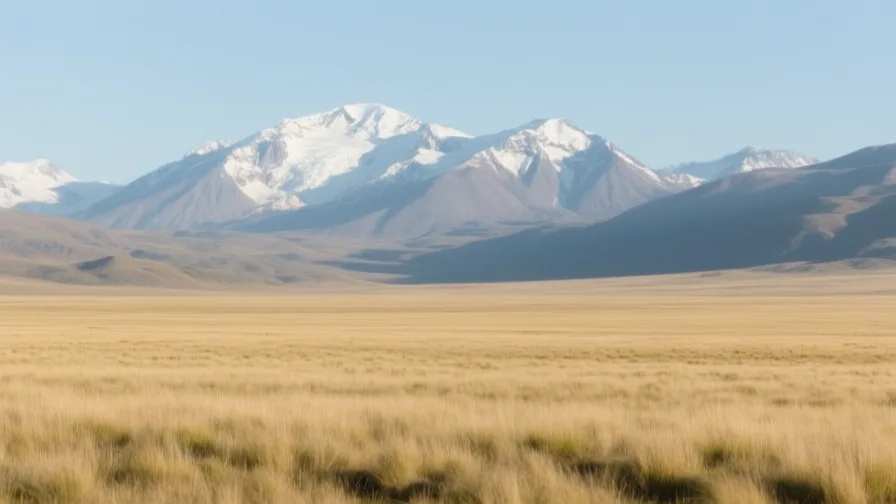 Argentina · AI landscape illustration · Artistic impression
Country · Latin America
Argentina
Saved in this browser — no account needed. Sign in later and it comes with you.
Where it is
Argentina runs down the southern end of South America, from subtropical swamps and forest in the north to cold, windswept steppe near the Drake Passage. Its western edge is the crest of the Andes, shared with Chile, and the same range holds the highest summit in the Southern and Western Hemispheres, Aconcagua, at 6,959 metres. East of the mountains the land flattens into the pampas, then into Patagonia, where rainfall in the driest parts falls to about 150 millimetres a year. The country is large, second only to Brazil on the continent, but thinly settled: about nine in ten people live in cities, and the ten largest urban areas hold half the population.
The land and water around it
The Andesmountains
The range forms the whole western frontier, a border with Chile that is more than five thousand kilometres long. It rises to Aconcagua in Mendoza province. The valleys of the north-west were the part of the country the Inca reached, and later the part the Spanish settled first, from Peru and Chile.
The Río de la Plataestuary
A wide estuary on the north-eastern coast that gave the region its early name and its capital a reason to exist. Under Spanish rules its natural ports could not be used for direct trade, which pushed commerce into contraband. When the crown reversed that policy in the eighteenth century, Buenos Aires grew quickly on leather exports and the revenues of Potosí.
The pampas and Patagoniaplain
The flat grasslands of the centre and the dry steppe of the south cover most of the country. Hunters lived on them long before the Spanish, and in the south the abundance of guanaco may be why people kept to hunting rather than farming.
Its history, in short
Argentina’s name comes from the Latin word for silver, after a legend of silver mountains that drew early explorers to the Río de la Plata. The silver itself lay elsewhere, so the Spanish crown treated the estuary as a backwater and routed shipments through Lima. That made smuggling the normal business of Buenos Aires until Madrid carved out a new viceroyalty centred on the river estuary in 1776 and gave the port its own customs house. The May Revolution of 1810 removed the viceroy, and independence was declared in 1816, but decades of civil war followed, ending only in 1880. After that, liberal governments encouraged mass European immigration, mostly from Italy and Spain, which remade the population and economy. The twentieth century brought repeated coups, the rise of Peronism after 1946, and the state terrorism of the military regime that took power in 1976. Democracy returned in 1983 under Raúl Alfonsín, who put the junta’s leaders on trial but, under military pressure, also accepted laws that stopped trials of lower-ranking officers.
Timeline
Dates are shown on a timeline rather than as changing shapes on the map. The globe draws modern boundaries only, and tinting a modern outline to stand for a historical one would state something we cannot source.
Early modern & oceanic
1516
Solís reaches the Río de la Plata
Juan Díaz de Solís leads a Spanish expedition into the estuary, the start of the written history of Spanish occupation in the region.
Well attestedWikipedia1536 and 1580
Buenos Aires founded twice
Pedro de Mendoza plants a small settlement on the estuary in 1536. It is abandoned in 1541, and Juan de Garay re-founds the city in 1580.
1776
Viceroyalty of the Río de la Plata
The Spanish crown creates a new viceroyalty covering today’s Argentina, Uruguay and Paraguay and much of Bolivia, with Buenos Aires as its customs port.
Well attestedWikipedia
Industrial & imperial
May 1810
The May Revolution
Local leaders in Buenos Aires replace the viceroy with a first junta of their own. Several territories of the old viceroyalty later split away as separate states.
9 July 1816
Declaration of independence
The Congress of Tucumán declares independence from Spain and any other foreign power, while José de San Martín prepares the crossing of the Andes.
1880 onward
Federation and mass immigration
Julio Argentino Roca’s presidency opens an era of liberal economic policy. The wave of European immigration it promoted was second only to that of the United States, and by 1908 the country counted among the wealthiest in the world.
Well attestedWikipedia
Contemporary
1946
Perón takes office
Juan Perón nationalises strategic industries, improves wages and pushes through women’s suffrage in 1947. The movement he founded becomes the most powerful party in Argentine history.
Well attestedWikipedia1976–1983
Military rule and the Dirty War
A coup in 1976 begins a military regime that persecuted and murdered thousands of political critics and activists. Raúl Alfonsín wins the 1983 election campaigning for the prosecution of those responsible.
Well attestedWikipedia
Places that carry meaning
AconcaguaNatural landmark
The summit in Mendoza province that is higher than any other peak in the Southern or Western Hemisphere. It is a reminder that the long Argentine border with Chile is a mountain wall rather than a river.
Quebrada de HumahuacaLate 15th century
A high valley in the north-west whose peoples were conquered by the Inca under Topa Inca Yupanqui to secure supplies of silver, zinc and copper. Inca rule lasted about half a century, until the Spanish arrived.
Piedra MuseoAbout 11,000 years ago
An archaeological site in Santa Cruz province that has yielded human remains and spearheads associated with extinct giant mammals, evidence of early hunters in far Patagonia.
Languages here
Places are usually multilingual. This lists what is actually spoken, not one language per border.
SpanishRomance family
The de facto official language, spoken by almost everyone.
Argentina is the largest Spanish-speaking society to use voseo everywhere, saying vos where other countries say tú. The Rioplatense variety dominates the pampas and Patagonia, while speech varies more widely across the rest of the country.
ItalianRomance family
The language of the largest immigrant wave, now mostly a heritage language.
Millions of Italians and Spaniards arrived after 1880. Their speech left a lasting mark: the Rioplatense accent is often compared with that of Neapolitan.
Learn the language here
Check yourself
Where does the name Argentina come from?
A Latin word for silver
Explorers around the Río de la Plata heard of silver mountains, and the Latin argentum gave the region its name, even though the silver was found elsewhere.
Why did Buenos Aires become a major port after 1776?
It became the customs port of a new viceroyalty
Before 1776 shipments were meant to go through Callao near Lima, so Buenos Aires lived on contraband. A new viceroyalty gave it official trade and the revenues of Potosí.
Worth arguing about
- Argentina counted among the wealthiest countries in the world in 1908, and has since swung between coups, crises and recoveries. Which explanation for that arc do you find most convincing?
- Nine in ten Argentines live in cities, in a country with some of the emptiest land on the continent. What does that do to national politics?
What we have not established
These are open questions, listed rather than filled in. We would rather show a gap than a plausible guess.
What share of Argentines are Catholic today?
Surveys disagree: one from 2008 recorded about three in four as Catholic, while other national surveys put the share lower, with a growing group reporting no religion. The answer depends on the survey and its wording.
Sources
- Wikipedia · ArgentinaWikipedia · encyclopedia · checked 2026-11-24
- Wikipedia · History of ArgentinaWikipedia · encyclopedia · checked 2026-11-24
- Wikipedia · Geography of ArgentinaWikipedia · encyclopedia · checked 2026-11-24
Reviewed by Globe Quest editorial on 2026-11-24. Drafted with AI assistance and checked against the sources above before publication.