 Globe Quest
 Human Quest · LearningSign in
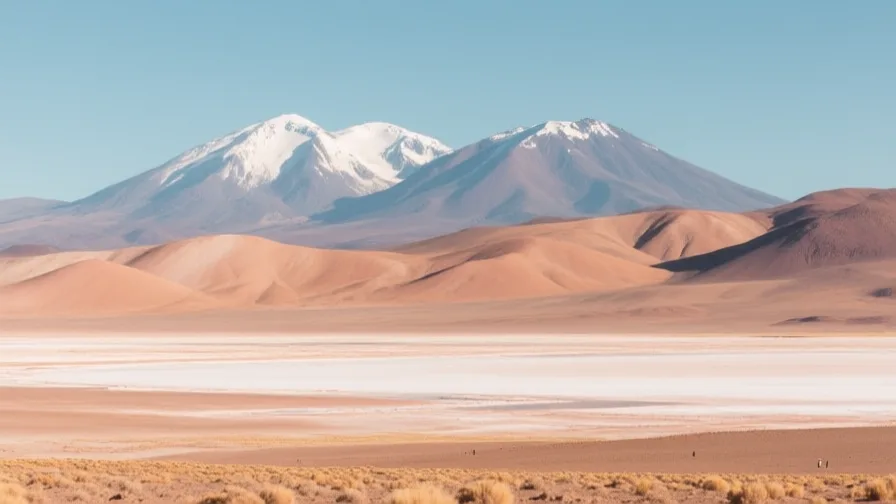 Chile · AI landscape illustration · Artistic impression
Country · Latin America
Chile
Saved in this browser — no account needed. Sign in later and it comes with you.
Where it is
A ribbon of land about 4,300 kilometres long and, on average, only 175 kilometres wide, Chile is squeezed between the Andes and the Pacific. At its narrowest it measures 64 kilometres across. That length takes it from the Atacama Desert in the north, through a Mediterranean-climate heartland in the centre, to oceanic, glaciated and fjord-cut country in the south. Roughly 80 percent of the terrain is mountainous. A coastal range and the Andes enclose a Central Valley, where most people live, and farther south the valley sinks beneath the sea into a maze of channels and islands.
The land and water around it
The Andes and the Nazca Platemountains
The Nazca Plate is pushed under South America off the Chilean coast, forming the Peru–Chile Trench and raising the Andes, which hold about 620 volcanoes in Chilean territory alone. Chile has had 478 earthquakes of magnitude 6 or greater between 1904 and 2020, including the 9.5 quake at Valdivia in 1960 and an 8.8 in 2010.
The Atacama Desertdesert
In the far north the land is largely barren of vegetation, and the country holds some of the driest ground on Earth. The desert and the Andes together act as barriers that have isolated the flora and fauna of the centre and south.
The Humboldt Currentsea
A cold current runs the full length of the coast, which keeps sea temperatures off central beaches below 15 °C in summer. The shore is rugged, and at the southern end the Central Valley dissolves into islands, channels and fjords that have long troubled sailors.
Its history, in short
People were hunting and gathering in what is now Chile at least 14,500 years ago, and by the sixteenth century more than a dozen Indigenous societies lived between the desert and Patagonia. The Inca reached only as far as the Maule river, where the Mapuche stopped them. Spanish conquest came from Peru: Diego de Almagro's party in 1535, then Pedro de Valdivia, who founded Santiago in 1541. The Mapuche kept up armed resistance against Spain and later Chile until the 1880s. Chile declared independence in 1818 after an army led by O'Higgins and San Martín crossed the Andes, and it emerged in the 1830s as a relatively stable, authoritarian republic. Victory in the War of the Pacific, from 1879 to 1883, added the northern territory, with its nitrate deposits, and left Bolivia without a coast, which Bolivian leaders such as Evo Morales have called a historical injustice. Exports of nitrate and then copper became the backbone of the economy. Political polarisation ended in the coup of 11 September 1973 and a military dictatorship under Augusto Pinochet that lasted until 1990 and left more than 3,000 dead or disappeared.
Timeline
Dates are shown on a timeline rather than as changing shapes on the map. The globe draws modern boundaries only, and tinting a modern outline to stand for a historical one would state something we cannot source.
Early human world
At least 14,500 years ago
Monte Verde
People live at Monte Verde in the south, a site that archaeologists place at least a thousand years before the Clovis culture site in New Mexico.
Approximate dateWikipedia
Early modern & oceanic
Late 15th century
The Inca stop at the Maule
The Mapuche, who had no state, fight off the Inca in a three-day battle. The Maule river becomes the southern limit of the Inca empire and the northern edge of Mapuche land.
12 February 1541
Santiago is founded
Pedro de Valdivia, a lieutenant of Francisco Pizarro, founds the city, which later becomes the capital of the colony and then of the country.
Well attestedWikipedia
Industrial & imperial
18 September 1810
First national junta
A government junta formed in the name of the deposed Spanish king begins the road to independence. Chileans celebrate their national day on this date.
Well attestedWikipedia1818
Independence
An army under Bernardo O'Higgins and José de San Martín crosses the Andes in 1817 and wins at Chacabuco. San Martín then defeats the last large Spanish force at Maipú on 5 April 1818. Fighting continues in the south until 1826, and Spain recognises Chile in 1840.
Well attestedWikipedia1879–1883
War of the Pacific
Chile defeats Peru and Bolivia and takes the northern territory it holds today. A 1904 treaty fixes the border with Bolivia, which has been landlocked since; Bolivia still presses its claim to the coast.
Well attestedWikipedia
Contemporary
11 September 1973
Coup against Allende
The armed forces overthrow the elected government of Salvador Allende as the presidential palace is bombed, and Pinochet takes power. The extent of United States involvement in the coup is still debated, though CIA documents released in 2000 acknowledge an attempt to keep Allende from taking office after his 1970 election.
1990
Return to civilian rule
After the 1988 referendum the dictatorship ends, and a centre-left coalition governs until 2010.
Places that carry meaning
Monte VerdeOver 14,000 years ago
An archaeological site in a southern valley where stone tools show people passing through as early as 18,500 years ago. Along with Cueva del Milodón and the Pali-Aike lava tube, it records the earliest human life in the country.
Rapa Nui (Easter Island)Carved statues of the Rapa Nui
A Pacific island administered by Chile, 3,600 kilometres west of the port of Caldera, known for 867 moai statues up to twenty metres high, carved from volcanic stone and thought to have been central to its religion. About 2,800 people live there.
The churches of ChiloéFrom the early 17th century
More than sixty churches survive on this southern archipelago, built after the first Jesuits arrived. Sixteen are World Heritage sites and national monuments.
Languages here
Places are usually multilingual. This lists what is actually spoken, not one language per border.
SpanishRomance family
The official and national language.
Chilean Spanish stands apart from the speech of neighbouring countries: final syllables tend to be dropped and some consonants are softened. Regional accent varies little from north to south, because the population formed in a small area of the centre and spread out in modest numbers, and radio and television flattened differences further. Class and the divide between city and country matter more.
Mapuche
The language of the Mapuche, the largest Indigenous group in South America.
The Mapuche number nearly two million, mostly in the Central Valley, with a smaller population across the border in Argentina. Many ideas about the origin of the name Chile trace to a Mapuche word, chilli, perhaps meaning 'where the land ends'.
Learn the language here
Check yourself
Roughly how long and how wide is mainland Chile?
About 4,300 km long and 175 km wide on average
The country runs more than 4,300 kilometres from north to south but averages only about 175 kilometres east to west, narrowing to 64 kilometres at one point. That shape explains the span of climates, from desert to glaciers.
What stopped the Inca advance into Chile?
Mapuche resistance at the Maule river
The Mapuche, living in scattered farming villages without a state, defeated the Inca army in a three-day battle. The Maule river marked the border between the Inca empire and Mapuche land until the Spanish arrived.
Worth arguing about
- Chile reaches farther south than any other country and lies nearest to Antarctica. How far does a long, thin territory shape the way its people see themselves?
- Chile lies on one of the most active earthquake zones, and strict building codes limit the damage. What else can a society build into its institutions after repeated disasters?
What we have not established
These are open questions, listed rather than filled in. We would rather show a gap than a plausible guess.
How old is the oldest human presence at Monte Verde?
Accounts range from stone tools showing occasional visits some 18,500 years ago to proven settlement at least 14,500 years ago. The entry uses the later, firmer figure.
How many people live in Chile?
The 2024 census enumerated 18,480,432 people. Other estimates run above 19 million, and census and projection figures are produced on different bases.
Sources
- Wikipedia · ChileWikipedia · encyclopedia · checked 2026-11-24
- Wikipedia · History of ChileWikipedia · encyclopedia · checked 2026-11-24
- Wikipedia · Geography of ChileWikipedia · encyclopedia · checked 2026-11-24
Reviewed by Globe Quest editorial on 2026-11-24. Drafted with AI assistance and checked against the sources above before publication.