 Globe Quest
 Human Quest · LearningSign in
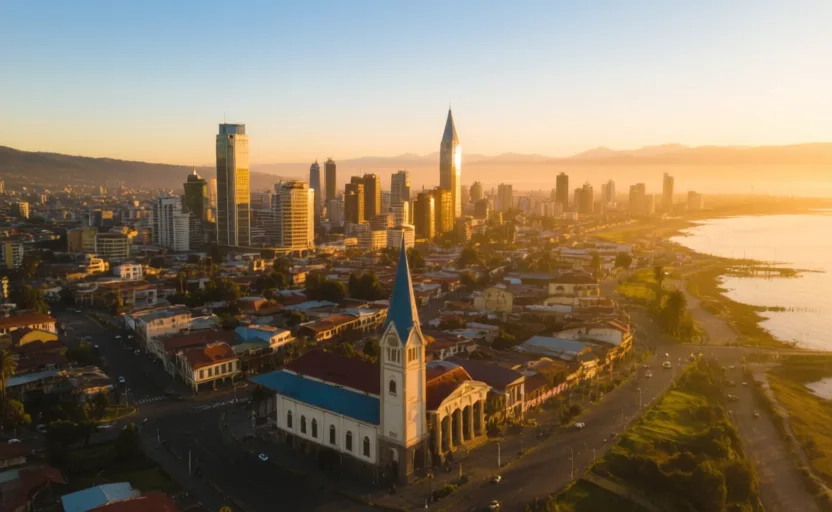 Valparaiso · AI city illustration · Artistic impression
City · Latin America
Valparaiso
Saved in this browser — no account needed. Sign in later and it comes with you.
Where it is
Steep hills drop straight to a Pacific bay here, leaving only a thin strip of flat ground at the water's edge, much of it made by filling in the sea. Ravines score the slopes, and the town climbs them in the shape of an amphitheatre facing the harbour. The city lies about 120 kilometres north-west of Santiago by road. Its climate is mild, with a gap of only about 6 degrees between the coolest and warmest months, and fog from the cold Humboldt Current hangs over it for much of the year. Rain falls mostly in winter, sometimes very heavily.
The land and water around it
The bay and its amphitheatre of hillsbay
The bay, the narrow plain and the steep hills together give the city its theatre-like layout. Much of the flat ground is artificial: from 1810 landfill pushed the shoreline five blocks out from the first pier, which stood where the El Mercurio building now stands.
The ravinesvalley
Streams in the gullies between the hills were culverted and covered when the city was rebuilt after the 1906 earthquake, creating streets such as Francia and Argentina. Hills are linked to the flat by stairways, alleys and funicular lifts called ascensores.
The Humboldt Currentclimate
The cold offshore current brings fog for much of the year and holds the average temperature at 17 °C in January and 11.4 °C in July. The Peru–Chile Trench offshore stores energy that is released in violent earthquakes, and the city has been struck by several.
Its history, in short
The bay was home to Picunche farmers when a Spanish supply ship, the Santiaguillo, arrived in 1536 and its commander named the place after his home village in Spain. Through the colonial centuries it stayed a village of a few houses and a church, raided by English privateers. Independence changed everything. After 1818 the port became the main harbour of the new Chilean navy and opened to world trade, and in the second half of the century it was a major stopover for ships moving between the Atlantic and the Pacific by way of the Strait of Magellan. Between 1848 and 1914 British, German and Italian immigrants built their own churches, schools and hillside quarters, and the city gained a stock exchange, a fire brigade, a public library and a newspaper that still appears. The 1906 earthquake killed about 3,000 people, and in 1914 the Panama Canal removed most of the shipping that had made the city rich. Many wealthy families left. Artists and cultural entrepreneurs were drawn to the hills after 2000, and the historic quarter became a World Heritage site in 2003.
Timeline
Dates are shown on a timeline rather than as changing shapes on the map. The globe draws modern boundaries only, and tinting a modern outline to stand for a historical one would state something we cannot source.
Early modern & oceanic
1536
The Santiaguillo arrives
A supply ship sent by Diego de Almagro anchors in the bay. Its commander, Juan de Saavedra, gives the place the name of his home village, Valparaíso de Arriba, in what is now Cuenca province in Spain.
Well attestedWikipedia1578
Drake sacks the village
Francis Drake raids the port in the Golden Hind, and Richard Hawkins follows in 1594. Drake's sack is the origin of the legend of the Cueva del Pirata.
Well attestedWikipedia
Industrial & imperial
12 September 1827
El Mercurio de Valparaíso
The newspaper is founded and still appears, and is said to be the longest-running Spanish-language paper anywhere.
Well attestedWikipedia1852
Running water and the telegraph
Drinkable water reaches homes, and the first telegraph line in Latin America links the port with Santiago. A first fire brigade had been formed the year before.
Well attestedWikipedia16 August 1906
The great earthquake
The quake devastates the city, then the centre of the Chilean economy, killing about 3,000 and injuring over 20,000. Reconstruction widens streets, covers streams and creates the avenues Francia and Argentina.
Well attestedWikipedia1914
The Panama Canal opens
Ship traffic drops sharply, a serious blow to an economy built on the port. The city's decline continues through the twentieth century.
Contemporary
2003
World Heritage listing
UNESCO inscribes the historic quarter, calling it an outstanding record of the first phase of globalisation through sea trade. Local activists had pressed the Chilean government to apply for it in 1998.
February 2024
Wildfire
A brush fire through Valparaíso and central Chile kills at least 131 people, a decade after a 2014 fire destroyed 2,800 homes there.
Well attestedWikipedia
Places that carry meaning
Cerro Alegre and Cerro Concepción19th century
Two hills treated as a single neighbourhood, planned and built largely by German and English immigrants, with squares, viewpoints, promenades, alleys and the upper stations of several funiculars. They are one of the five neighbourhoods of the World Heritage quarter.
The ascensoresHistoric lifts
Sixteen funicular lifts survive, fifteen of them public and national monuments. The World Monuments Fund named the system one of the world's 100 most endangered treasures in 1996.
La Matriz Church and Santo Domingo SquareLate 19th century
Between the hills and the plain, a church and a group of seaport buildings typical of the period, one of five interlaced neighbourhoods that make up the historic quarter.
Languages here
Places are usually multilingual. This lists what is actually spoken, not one language per border.
SpanishRomance family
The everyday language of the port.
Residents are called porteños, port dwellers. Immigrants make up only 4.6 percent of the commune's population, and most of them come from South America, so the city's speech is overwhelmingly Chilean Spanish.
English, German and Italian
Languages of the nineteenth-century immigrant communities.
British, German and Italian newcomers each built their own churches and schools and settled in their own hillside districts, several of which are preserved today as national historic zones.
Learn the language here
- 1Understand which languages are spoken hereValparaiso is multilingual. Start with which languages are used, by whom, and for what — the phrase list only covers one of them.Written by Globe Quest
- 2Learn 12 phrasesCurated everyday phrases for Valparaiso, with audio and a written form.Written by Globe Quest
- 3Say them out loudSpeaking practice with pronunciation feedback, one phrase at a time.Globe Quest material, your own additions
- 4Come back to themSpaced review, so what you learned this week is still there next month.Written by Globe Quest
Check yourself
What most damaged Valparaíso's shipping economy in the early twentieth century?
The opening of the Panama Canal in 1914
Before the canal, ships between the Atlantic and Pacific stopped at Valparaíso after passing the Strait of Magellan. Once they could cross at Panama, that traffic dwindled, and many wealthy families left the city.
Why is much of the flat ground in the lower city artificial?
It was reclaimed from the sea
From 1810 land was reclaimed from the sea, moving the shoreline about five blocks from the first pier. The commercial centre now stands on this made ground.
Worth arguing about
- A port that fell because a canal opened elsewhere, then revived as a place for artists and visitors. Who benefits when a decayed heritage district becomes fashionable again?
- The funiculars and the labyrinth of hillside alleys are part of Valparaíso's heritage, yet brush fires in 2014 and 2024 destroyed homes and killed people on the slopes. How should a city weigh keeping the old fabric against protecting those who live in it?
What we have not established
These are open questions, listed rather than filled in. We would rather show a gap than a plausible guess.
When was Valparaíso's golden age?
One account dates the city's boom to 1848–1914, while UNESCO places its major commercial impact from the 1880s until the Panama Canal opened in 1914. Both end in 1914; the start depends on what is measured.
Sources
- Wikipedia · ValparaísoWikipedia · encyclopedia · checked 2026-11-24
- UNESCO · Historic Quarter of the Seaport City of ValparaísoUNESCO World Heritage Centre · intergovernmental · checked 2026-11-24
- Wikipedia · ChileWikipedia · encyclopedia · checked 2026-11-24
Reviewed by Globe Quest editorial on 2026-11-24. Drafted with AI assistance and checked against the sources above before publication.