 Globe Quest
 Human Quest · LearningSign in
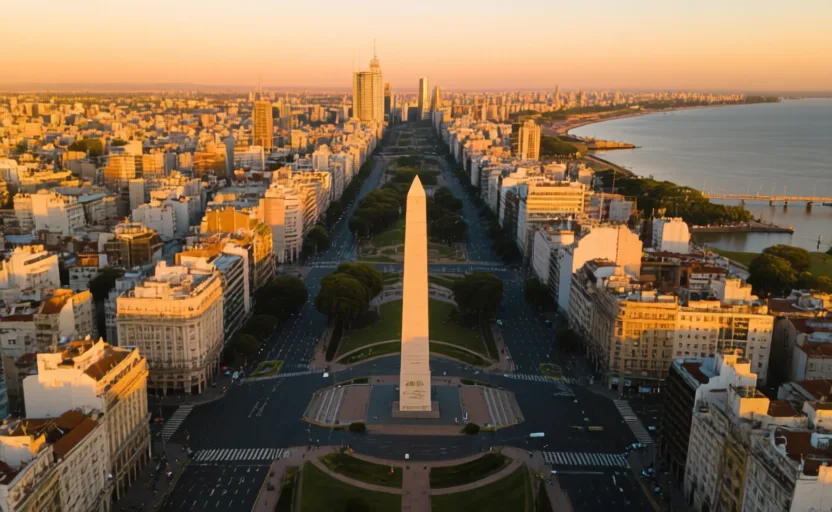 Buenos Aires · AI city illustration · Artistic impression
City · Latin America
Buenos Aires
Saved in this browser — no account needed. Sign in later and it comes with you.
Where it is
Buenos Aires lies on the south-western shore of the Río de la Plata, a river so wide that from the waterfront it looks like a brown sea. The ground is flat pampa, with no hill of any size, and the city has crept outward over reclaimed land along the shore, where Puerto Madero, the main port and the city airport now stand. Small streams once crossed the site; most were straightened after floods in 1908 and then buried, and the Maldonado now runs beneath an avenue. The climate is humid subtropical and tempered by the Atlantic, with hot summers, cool winters and sudden storms when the cold pampero wind arrives.
The land and water around it
The Río de la Plataestuary
The estuary makes Buenos Aires a port rather than a river town. The waterfront has been pushed outward on landfill, so several districts that look old stand on land that was once water.
The buried streamsriver
The Maldonado, Vega, Medrano and Cildáñez crossed the site before the city was built. Floods in 1908 led to their channelling, and from 1919 most were enclosed in pipes. The Maldonado was tubed in 1954, and Juan B. Justo Avenue now follows its course.
The pampaplain
The flat grassland behind the city produced the raw materials that flowed into its factories and the leather and meat that paid for its growth. Railways fanned out across it in the second half of the nineteenth century, all converging on the capital.
Its history, in short
The first settlement was founded in 1536 by Pedro de Mendoza in what is now San Telmo, and it was abandoned within a few years after attacks by the indigenous people. Juan de Garay refounded the city in 1580, having come down the Paraná from Asunción. For two centuries it was a minor port, because Spanish rules sent legal trade by convoy to Lima and made goods arrive late and heavily taxed. The British invasions of 1806 and 1807 were repelled by local forces led by Santiago de Liniers, and the confidence and militias they produced helped bring about the May Revolution of 1810, which removed the viceroy. Buenos Aires then spent decades quarrelling with the provinces over its status, and was even the capital of a seceded state from 1853 to 1860. Only in 1880 was it federalised as the seat of national government. Railways brought wealth from the pampas, and immigrants tripled its population between 1887 and 1915. The city gained its own elected government in 1996.
Timeline
Dates are shown on a timeline rather than as changing shapes on the map. The globe draws modern boundaries only, and tinting a modern outline to stand for a historical one would state something we cannot source.
Early modern & oceanic
2 February 1536
First foundation
Pedro de Mendoza founds a settlement named for Our Lady of Fair Winds in the area now called San Telmo. Attacks by the local people drive the settlers away and the site is abandoned by 1542.
Well attestedWikipedia11 June 1580
The permanent city
Juan de Garay founds the settlement again, arriving by boat down the Paraná from Asunción. Its port becomes the Puerto de Santa María de los Buenos Aires.
Well attestedWikipedia
Industrial & imperial
1806–1807
The British invasions
British forces take the city in 1806 and are defeated by an army from Montevideo under Santiago de Liniers, who repels a second invasion in 1807. The militarisation of local society shifts power towards the criollos.
Well attestedWikipediaMay 1810
The May Revolution
Criollo armies support the removal of the viceroy Baltasar Hidalgo de Cisneros. The revolution is now a national holiday, and Plaza de Mayo remains the centre of political life.
Well attestedWikipedia1880
Federalised
After decades of dispute, and after a spell as the capital of a seceded state, the city is made the seat of national government and split from Buenos Aires Province. The Casa Rosada becomes the president’s seat.
Well attestedWikipedia1887–1915
Immigrant boom
Waves of European immigrants cause the number of porteños to triple from 500,000 to 1.5 million. Conventillos, crowded tenement houses, house many of the poor and are blamed for the spread of tuberculosis.
Well attestedWikipedia1888
The city limits grow
A national law annexes the towns of Belgrano and Flores, along with a strip of the neighbouring district that includes Villa Devoto. All are now neighbourhoods of the city.
Well attestedWikipedia
Contemporary
1996
First elected head of government
Following the constitutional reform of 1994, the city elects its own chief of government for the first time, having previously had a mayor appointed by the president.
Well attestedWikipedia
Places that carry meaning
Plaza de Mayo1810 onward
The square where the May Revolution unfolded and still the arena of Argentine political life. The Casa Rosada, the presidential seat, stands beside it.
ESMA Museum and Site of Memory1976–1983 and after
The former Navy School of Mechanics, where navy officers kidnapped, tortured and murdered more than five thousand people during the dictatorship. Its location in the heart of the city, with detainees and officers living in the same buildings, makes it a key site for understanding state terrorism in the Southern Cone. UNESCO inscribed it for this memory.
San Telmo1536 onward
The district where Mendoza’s short-lived first settlement stood, south of today’s centre.
Languages here
Places are usually multilingual. This lists what is actually spoken, not one language per border.
Spanish (Rioplatense)Romance family
The everyday language, in a local dialect shared with Montevideo.
The porteño dialect is marked by voseo, by yeísmo and by the aspiration of s in some positions. It has strong roots in Andalusia and Murcia, and was reshaped in the twentieth century when millions of immigrants, many speaking Neapolitan, Sicilian and Genoese, arrived.
Italian dialectsRomance family
Brought by the largest group of immigrants, now largely absorbed into Spanish.
Italians from Calabria, Liguria, Piedmont, Lombardy, Sicily and Campania, along with Spaniards from Galicia, Asturias, Andalusia and the Basque Country, supplied most of the city’s population.
Learn the language here
- 1Understand which languages are spoken hereBuenos Aires is multilingual. Start with which languages are used, by whom, and for what — the phrase list only covers one of them.Written by Globe Quest
- 2Learn 12 phrasesCurated everyday phrases for Buenos Aires, with audio and a written form.Written by Globe Quest
- 3Say them out loudSpeaking practice with pronunciation feedback, one phrase at a time.Globe Quest material, your own additions
- 4Come back to themSpaced review, so what you learned this week is still there next month.Written by Globe Quest
Check yourself
What changed for Buenos Aires in 1880?
It was federalised and became the seat of national government
The city had been the capital of Buenos Aires Province, and for a time of a breakaway state, until the 1880 settlement split it from the province and made it the federal capital.
What happened to the streams that once crossed the site of Buenos Aires?
They were channelled after floods and then mostly buried in pipes
Floods in 1908 prompted the city to straighten the streams, and from 1919 most were enclosed. The Maldonado now runs underground below an avenue.
Worth arguing about
- Buenos Aires was refounded after the first settlement failed, and for two centuries was held back by trade rules made in Spain. How much of its later size owes more to its position than to policy?
- The ESMA site has been turned into a place of memory in the middle of the city rather than demolished. What are the arguments for and against keeping such a site in daily view?
What we have not established
These are open questions, listed rather than filled in. We would rather show a gap than a plausible guess.
How many people live in Buenos Aires?
The answer depends on the boundary: the city proper holds about three million people, while the wider conurbation holds more than thirteen million in the 2010 census and an estimate of about sixteen million today. Counts of the city proper have hovered near three million since 1947.
Sources
- Wikipedia · Buenos AiresWikipedia · encyclopedia · checked 2026-11-24
- UNESCO · ESMA Museum and Site of Memory – Former Clandestine Centre of Detention, Torture and ExterminationUNESCO World Heritage Centre · intergovernmental · checked 2026-11-24
Reviewed by Globe Quest editorial on 2026-11-24. Drafted with AI assistance and checked against the sources above before publication.