 Globe Quest
 Human Quest · LearningSign in
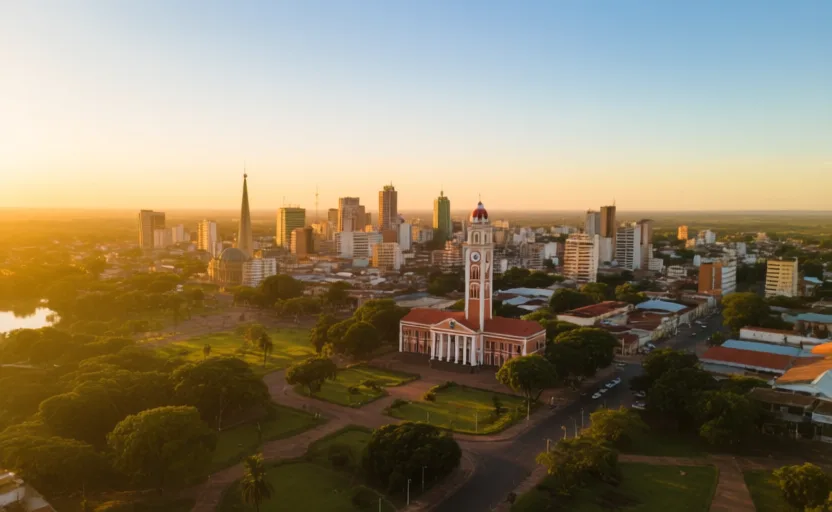 Asunción · AI city illustration · Artistic impression
City · Latin America
Asunción
Saved in this browser — no account needed. Sign in later and it comes with you.
Where it is
Facing Argentina across the water, Asunción spreads along the left bank of the Río Paraguay, just above the point where the Pilcomayo joins it. A narrow lowland peninsula, the San Miguel Bank, closes off the bay on which the old town stands from the main river. Behind the water the ground is irregular, shaped by the seven hills that early travellers saw from the boat, and several streams now run in culverts under the pavement. The climate is humid subtropical, with about 1,400 millimetres of rain a year, a January average near 28 °C and a July average near 17 °C, and the urban heat makes summer more oppressive than in the surrounding countryside.
The land and water around it
The Paraguay River and its bayriver
The river is the city’s main waterway, carrying trade and drawing visitors, and it separates the city from Argentina to the south and from the Chaco across the water to the northwest. Asunción Bay is cut off from it by the San Miguel Bank, where the Humid Chaco and the Atlantic forests of the Alto Paraná meet.
The seven hillshills
The uneven ground goes back to the hills seen from the river by those arriving by boat. Streams that once drained them, such as the Pozo Colorado and the Ycuá Satí, now flow hidden under the streets and into the river.
The lost forestforest
The interior was once covered by Humid Chaco forest, with trees over 40 metres tall, and by jaguar, tapir and harpy eagle. Remnants survive in the Botanical Garden and Zoo and around Cerro Lambaré.
Its history, in short
The Spanish fort that became Asunción was established on 15 August 1537, the Feast of the Assumption, by Juan de Salazar de Espinosa, who found friendly people on the bay. Relations with the Guaraní shaped the town: alliances sealed with gifts of women, later replaced by violent seizures, produced the mestizo society that defines Paraguay. In 1542 the settlers of Buenos Aires fled to Asunción, which made it the centre of a province that spread over parts of Brazil and Argentina as well as Paraguay; from here expeditions set out to found other cities, which is why it is called the Mother of Cities. After Buenos Aires was refounded, Asunción lost importance. Independence in 1811 was plotted in secret meetings in the city, and under Carlos Antonio López it gained schools, factories and South America’s first railway. The Paraguayan War ended with its capture by Brazilian forces on 1 January 1869, and Brazilian troops occupied it until 1876. Immigrants from Europe and the Ottoman Empire helped it recover. Since the 1980s the people moving in from the countryside have settled in the suburbs, and Asunción itself has barely grown.
Timeline
Dates are shown on a timeline rather than as changing shapes on the map. The globe draws modern boundaries only, and tinting a modern outline to stand for a historical one would state something we cannot source.
Early modern & oceanic
15 August 1537
The fort of the Assumption
Juan de Salazar de Espinosa founds a fort on the bay, naming it after the feast of the day. The cabildo’s founding document is dated 16 September 1541.
Well attestedWikipedia1542
Buenos Aires abandoned
Natives destroy Buenos Aires, and the Spaniards there flee to Asunción, which becomes the centre of a colonial province covering part of Brazil, present-day Paraguay and northeastern Argentina.
Well attestedWikipedia1603
The First Synod of Asunción
Church leaders set guidelines for evangelising Indigenous people in Guaraní, their common language.
Well attestedWikipedia1731
Antequera’s uprising
A rebellion under José de Antequera y Castro fails but is an early sign of the independent spirit of the criollos, mestizos and Indigenous people.
Well attestedWikipedia
Industrial & imperial
1811
Independence plotted in the city
Leaders of the independence movement hold secret meetings at the house of Juana María de Lara to plan an ambush against the Spanish governor.
Well attestedWikipedia1 January 1869
The city falls
Brazilian forces under General João de Souza da Fonseca Costa take Asunción during the Paraguayan War. Brazilian troops stay until 1876.
Well attestedWikipedia
Contemporary
March 1991
The Treaty of Asunción
Two years after the fall of Stroessner, the presidents of Argentina, Brazil, Uruguay and Paraguay sign the treaty that creates Mercosur.
Well attestedWikipediaAugust 2004
The Ycuá Bolaños fire
A supermarket blaze kills more than 400 people and injures about 300 more, the greatest tragedy in the country since the Chaco War.
Well attestedWikipedia
Places that carry meaning
The old town on the bay16th century onward
The historic core follows the curve of the bay, from Plaza Uruguaya down to the port. It once handled the country’s river trade, a role that has shifted to Villeta.
Palacio de los LópezToday
The seat of the executive branch, in the historic centre.
National Pantheon of the HeroesToday
A scaled-down echo of the Parisian Invalides, holding the tombs of many national heroes.
Defensores del Chaco stadium1930s onward
In the Sajonia neighbourhood. It takes its name from the army raised at this site to fight Bolivia in the Chaco War of 1932 to 1935.
Languages here
Places are usually multilingual. This lists what is actually spoken, not one language per border.
SpanishRomance family
The main language of the capital, used by most residents.
In one census count, Paraguayan Spanish was the principal language of 56.9 per cent of residents, a far higher share than in the rest of the country, where Spanish tends to dominate only in large urban areas.
GuaraníTupian family
The indigenous language of the colony, now less common at home in the capital than elsewhere.
Guaraní was the lingua franca the Church used in 1603 to reach Indigenous people. In the city itself only 11.2 per cent named it as their principal language, and a later survey found it used at home by only about 9 per cent, among the lowest anywhere in the country.
Jopará
The Guaraní–Spanish mixture that many residents speak.
A mixture of Guaraní with Spanish loanwords, it was the main language of 27.4 per cent of residents, and it reflects constant code-switching between the two official languages.
Learn the language here
- 1Understand which languages are spoken hereAsunción is multilingual. Start with which languages are used, by whom, and for what — the phrase list only covers one of them.Written by Globe Quest
- 2Learn 12 phrasesCurated everyday phrases for Asunción, with audio and a written form.Written by Globe Quest
- 3Say them out loudSpeaking practice with pronunciation feedback, one phrase at a time.Globe Quest material, your own additions
- 4Come back to themSpaced review, so what you learned this week is still there next month.Written by Globe Quest
Check yourself
Why is Asunción called the Mother of Cities?
Colonial expeditions set out from it to found Buenos Aires again and many other cities
Colonial expeditions leaving Asunción re-founded Buenos Aires and went on to found Villarrica, Corrientes, Córdoba, Santa Cruz de la Sierra and many other towns.
Why has Asunción’s own population barely grown since the 1980s?
People moving in from the countryside have settled in the cheaper suburbs of Greater Asunción
Land is cheaper and taxes lower in the neighbouring cities, so Luque, Lambaré, San Lorenzo and others absorbed most of the new arrivals while the capital’s count stayed almost flat.
Worth arguing about
- A city that was once the base for founding half a continent’s cities is now a modest capital of about 460,000. What does it mean to be a mother city that others outgrew?
- Guaraní is the language of the nation but is least used at home in its capital. What would keep it alive in a city where Spanish carries status?
What we have not established
These are open questions, listed rather than filled in. We would rather show a gap than a plausible guess.
How many people live in Asunción?
The 2022 census counts 462,241 residents in the city proper, while the metropolitan area is given as about two million, more than 2.3 million, and more than 2.4 million in different passages, depending on which suburbs are included.
Sources
- Wikipedia · AsunciónWikipedia · encyclopedia · checked 2026-11-24
- Wikipedia · Languages of ParaguayWikipedia · encyclopedia · checked 2026-11-24
Reviewed by Globe Quest editorial on 2026-11-24. Drafted with AI assistance and checked against the sources above before publication.