 Globe Quest
 Human Quest · LearningSign in
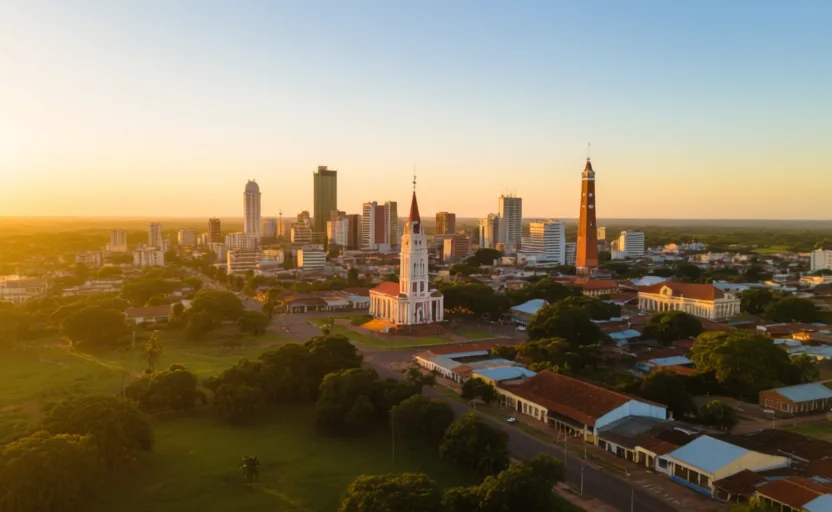 Ciudad del Este · AI city illustration · Artistic impression
City · Latin America
Ciudad del Este
Saved in this browser — no account needed. Sign in later and it comes with you.
Where it is
Ciudad del Este is a border city on the Paraná River, in the eastern tip of Paraguay where three countries meet. Across the water lies Foz do Iguaçu in Brazil, and a short way along the same border is Puerto Iguazú in Argentina. The Acaray River bounds the city on the north and the Monday on the southwest, and the Republic Lake and other small lakes fill the gaps in between. The climate is humid subtropical, with about 1,700 millimetres of rain a year, a January average near 26 °C and a July average near 16 °C. Snow fell here for the first time in the winter of 1982.
The land and water around it
The Paraná Riverriver
The river forms the eastern edge of the city and the border with Brazil. The spot was for a time the head of navigation on the river, which is why the first port was placed here.
The Triple Frontierfrontier
Ciudad del Este is the largest city of the tripoint where Paraguay, Brazil and Argentina meet. The Iguazú Falls and the Itaipú Dam, one of the largest hydroelectric plants in the world, both lie within reach.
The Acaray and Monday streamsriver
The Acaray separates the city from Hernandarias to the north, and the Monday separates it from Los Cedrales to the southwest. The Amambay and Saltito streams feed the lakes and mark the boundary with Presidente Franco.
Its history, in short
The city is a creation of a political decision. In the 1950s the Stroessner government wanted an outlet to the Atlantic across Brazil, because freight through the Río de la Plata was too costly for exports to compete. It set up a joint commission with Brazil in 1955 and had army units cut a road about 200 kilometres long from Coronel Oviedo through dense jungle. The town was decreed into existence on 3 February 1957 as Puerto Flor de Lis, close to a spot the Guaraní called Tacuru pucu, then the upper limit of navigation on the Paraná. It was renamed in honour of the dictator, and after the coup of 1989 a referendum gave it its present name, “East City”. Once a bridge to Brazil and two hydroelectric dams, Acaray and Itaipu, were built over the following two decades, the town grew fast and drew many immigrants. Its tax-free status now draws Brazilian and Argentine shoppers, and it ranks among the biggest free-trade zones anywhere.
Timeline
Dates are shown on a timeline rather than as changing shapes on the map. The globe draws modern boundaries only, and tinting a modern outline to stand for a historical one would state something we cannot source.
Contemporary
1955
A road to Brazil
A mixed Paraguayan–Brazilian commission is created to build a highway east, under Stroessner’s “March to the East”. A road about 200 kilometres long is built from Coronel Oviedo to the Paraná.
Well attestedWikipedia3 February 1957
Puerto Flor de Lis
The city is founded by decree under that name, near a place the Guaraní called Tacuru pucu, “Tall Termite Hill”. It is later renamed Puerto Presidente Stroessner.
Well attestedWikipedia1960s–1970s
Bridge and dams
The Friendship Bridge opens, and the Acaray and Itaipu dams follow, ending the isolation of a place hemmed in by jungle and bringing a rapid expansion of the city and its economy.
Approximate dateWikipedia1982
First snow
It snows in the city for the first time, only the second snowfall ever registered in Paraguay.
Well attestedWikipediaAfter 1989
The name of the dictator removed
After the coup that ended Stroessner’s rule, a referendum chooses the name Ciudad del Este.
Approximate dateWikipedia1999
The Copa América
The Estadio Antonio Aranda, home of Club Atlético 3 de Febrero, hosts matches of the Copa América. It is the third largest football stadium in Paraguay.
Well attestedWikipedia2015
The Mosque of the East
The Al-Khulafa Al-Rashidin Mosque is inaugurated, the largest in the region, serving a Muslim community of about 7,000 in the city.
Well attestedWikipedia
Places that carry meaning
The Friendship Bridge1960s–1970s
The crossing over the Paraná to Foz do Iguaçu, which turned the town into a commercial gateway between the two countries.
The downtown shopping district1960s onward
A tax-free commercial centre that draws Brazilians and Argentines. Signs and conversation here are often in Arabic, Chinese or Korean as well as Spanish, Guaraní and Portuguese.
Al-Khulafa Al-Rashidin Mosque2015
The largest mosque in the region, and a sign of the Arab community that has settled here since the 1970s.
Languages here
Places are usually multilingual. This lists what is actually spoken, not one language per border.
Spanish and GuaraníRomance family
The two official languages of Paraguay, both in daily use.
As elsewhere in the country, much of the population is bilingual in Spanish and Guaraní, and many also speak Jopará, the mixture of the two. Guaraní belongs to the Tupian family.
PortugueseRomance family
The language of commerce and farming across the border.
Thousands of people use Portuguese, mainly in trade and agriculture, and it is the common language of customers from Brazil.
ArabicSemitic family
The language of a long-established Lebanese and Middle Eastern community.
Sunni Muslim Arabs moved to the city from the 1970s, followed in the 1980s by Shia Muslims from southern Lebanon. Arabic is commonly used in conversation and on signs downtown.
Chinese and Korean
The languages of the city’s East Asian communities.
Sizeable Chinese and Korean populations, together with Taiwanese and Indian residents, have settled in the city, and both languages are used in the centre.
Learn the language here
- 1Understand which languages are spoken hereCiudad del Este is multilingual. Start with which languages are used, by whom, and for what — the phrase list only covers one of them.Written by Globe Quest
- 2Learn 12 phrasesCurated everyday phrases for Ciudad del Este, with audio and a written form.Written by Globe Quest
- 3Say them out loudSpeaking practice with pronunciation feedback, one phrase at a time.Globe Quest material, your own additions
- 4Come back to themSpaced review, so what you learned this week is still there next month.Written by Globe Quest
- 5Practise with people: Arabic practice · DohaAn in-person practice circle. It is a prepared plan and needs a host before it runs.Run by members
Check yourself
Why was Ciudad del Este founded in 1957?
To give Paraguay a route to the Atlantic across Brazil, as part of the “March to the East”
Freight through the Río de la Plata was too expensive for Paraguayan exports to compete, so Stroessner’s government pushed a road and a new river port east to the Paraná and the Brazilian border.
How did the city get its present name?
A referendum after the 1989 coup chose it to replace the name of the dictator
The first port was Puerto Flor de Lis and then Puerto Presidente Stroessner. After Stroessner’s fall, residents voted for the neutral name Ciudad del Este.
Worth arguing about
- A free-trade zone built at a tripoint makes money from the differences between three countries’ taxes and rules. Who benefits, and what does the city depend on if those differences shrink?
- A city that was named for a dictator, then renamed by referendum, has many nationalities and religions. What does it share as a common identity?
What we have not established
These are open questions, listed rather than filled in. We would rather show a gap than a plausible guess.
How many people live in Ciudad del Este?
A 2019 projection gives 301,815 inhabitants, while a later estimate for 2024 is about 350,000. The metropolitan area, which includes Hernandarias, Minga Guazú and Presidente Franco, is larger still.
Sources
- Wikipedia · Ciudad del EsteWikipedia · encyclopedia · checked 2026-11-24
- Wikipedia · ParaguayWikipedia · encyclopedia · checked 2026-11-24
Reviewed by Globe Quest editorial on 2026-11-24. Drafted with AI assistance and checked against the sources above before publication.