 Globe Quest
 Human Quest · LearningSign in
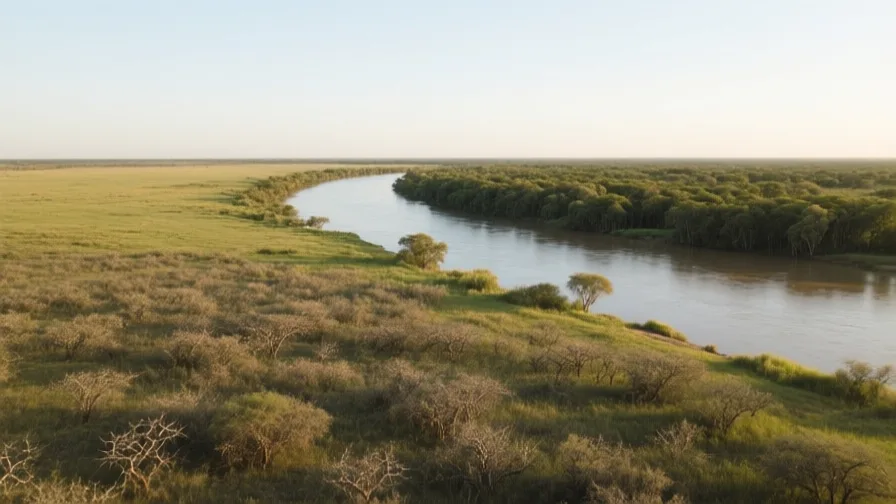 Paraguay · AI landscape illustration · Artistic impression
Country · Latin America
Paraguay
Saved in this browser — no account needed. Sign in later and it comes with you.
Where it is
Paraguay is a landlocked country in the middle of South America, and it is split in two by the Río Paraguay. East of the river, grassy plains and wooded hills hold nearly everyone. West of it lies the Chaco, a low, marshy and semi-arid plain that covers about 60 per cent of the territory and has under 4 per cent of the population. Rain falls unevenly: the far eastern forest belt receives about 170 centimetres a year, the Chaco no more than 50. No mountain range blocks the wind, so warm air from the Amazon in summer and cold air from the Andes in winter can swing the temperature sharply within hours. Boats reach the Atlantic along the Paraná–Paraguay Waterway.
The land and water around it
The Río Paraguayriver
The river divides the country into a populated eastern region and the sparsely settled Chaco. Both halves slope towards it, so it both separates and drains them, and it carries trade towards the Paraná.
The Gran Chacoplain
The western half is a low, marshy plain where rain is irregular and evaporates quickly, so that areas that are desert in winter become swamp in summer. It was the homeland of the nomadic Guaycuru peoples.
The Paraná and the Itaipu Damriver
The Paraná forms the border with Brazil in the east. Damming it at Itaipu created the third-largest hydroelectric dam in the world by energy produced, and made Paraguay a major exporter of hydroelectric power worldwide.
Its history, in short
For at least a thousand years before the Spanish arrived in 1524, the Guaraní farmed the forests east of the river, while nomadic Guaycuru peoples such as the Payaguá and Mbayá controlled the Chaco to the west. Asunción was founded as a fort in 1537 and became the base of a vast Spanish province, but the colony had little silver and was soon bypassed: Buenos Aires took over its river trade, and Paraguay turned into a remote outpost. Jesuit missions, from 1609, gathered Guaraní into planned settlements until the order was expelled in 1767. Paraguay overthrew Spanish rule on 14 May 1811 and then came under José Gaspar Rodríguez de Francia, who sealed the country off from outsiders for more than two decades. Carlos Antonio López opened it to trade, and his son Francisco Solano López led it into the Triple Alliance War (1864–1870) against Brazil, Argentina and Uruguay, which cost Paraguay a very large share of its people and about a quarter to a third of its territory. Victory over Bolivia in the Chaco War of 1932 to 1935 was followed by military rule, and by the 35-year regime of Alfredo Stroessner, ended by a coup in 1989. Today the country exports beef, soybeans and hydroelectricity from the Itaipu Dam.
Timeline
Dates are shown on a timeline rather than as changing shapes on the map. The globe draws modern boundaries only, and tinting a modern outline to stand for a historical one would state something we cannot source.
Early modern & oceanic
15 August 1537
Asunción founded
Juan de Salazar de Espinosa establishes a fort on the east bank of the river. It becomes the centre of the Spanish province of Paraguay.
Well attestedWikipedia1609
The first Jesuit reduction
The Jesuits found San Ignacio Guazú, the first of the mission settlements for the Guaraní. At their peak in 1732 they hold 141,000 people in about 30 missions, a system admirers and critics still argue over.
Well attestedWikipedia1767
Jesuits expelled
After the order is removed from Spanish territories, Paraguay becomes a peripheral colony.
Well attestedWikipedia
Industrial & imperial
14 May 1811
Independence
Paraguay overthrows the local Spanish administration. José Gaspar Rodríguez de Francia, called El Supremo, governs from 1814 until he dies in 1840, with the country largely closed to the world.
Well attestedWikipedia1864–1870
The Triple Alliance War
After Francisco Solano López takes Paraguay to war against Brazil, Argentina and Uruguay, the country is overrun and he is killed at Cerro Corá. How many Paraguayans died is disputed.
Historians’ estimates range from about 60 to 69 per cent of the population lost, to less than 18 per cent
1932–1935
The Chaco War
Paraguay fights Bolivia over the Chaco region and prevails.
Well attestedWikipedia
Contemporary
1954–1989
The Stroessner regime
Alfredo Stroessner and the Colorado Party hold power for more than three decades, with economic expansion and extensive human rights abuses. A military coup under General Andrés Rodríguez overthrows him on 3 February 1989.
Well attestedWikipedia
Places that carry meaning
Asunción1537 onward
The capital and largest city, on the left bank of the Río Paraguay, and the base from which Spanish expeditions set out to found other cities.
The Jesuit missions1609–1767
Planned settlements, called reductions, where Jesuits gathered Guaraní to Christianise them and shield them from slave raiders. Their supporters stress that protection, while their critics say they controlled and changed Guaraní life.
Supporters of the missions as protection from slavers, and critics who accuse the Jesuits of enslaving the Guaraní
Itaipu Dam20th century
A dam on the Paraná on the Brazilian border, one of the world’s biggest hydroelectric plants, whose output makes Paraguay a major energy exporter.
Ciudad del Este1957 onward
The second-largest city, on the Paraná at the Brazilian border, and home to many of the country’s consulates-general.
Languages here
Places are usually multilingual. This lists what is actually spoken, not one language per border.
SpanishRomance family
Official language and the main language of government, business, media and schools.
Spanish was introduced by the conquistadors but for centuries was a minority language, confined to the capital and to privileged families. In the late twentieth century, better schooling, urbanisation and the arrival of television made it far more widespread.
GuaraníTupian family
Co-official language, spoken at home by most Paraguayans, including many who are not indigenous.
Guaraní is the only indigenous language in the Americas with a large proportion of non-indigenous speakers. A Guaraní–Spanish mixture with code-switching, called Jopará, is also widely spoken. The 1992 constitution declares the country multicultural and bilingual.
PortugueseRomance family
The third most used language, heard along the Brazilian border.
Brazilians and their descendants, called Brasiguayos, have crossed the border in search of cheap land since the 1970s, and some 650,000 of them speak Portuguese, mostly near the frontier.
Other indigenous languages
Around 19 smaller languages, many of them threatened.
They are spoken by about 50,000 indigenous Paraguayans, including the Guaycuru and other peoples of the Chaco. Immigrant communities add German, Italian, Ukrainian, Japanese, Chinese and Arabic.
Learn the language here
Check yourself
How does the Río Paraguay shape the country?
It divides a populated eastern region from the Chaco in the west
The river splits Paraguay into two very different halves. The Chaco in the west covers about 60 per cent of the territory but has fewer than four in a hundred Paraguayans.
What is unusual about Guaraní?
It is spoken by a large share of non-indigenous people as well as indigenous people
Spanish and Guaraní are both official languages, and Guaraní is the only indigenous language in the Americas whose speakers include many people who are not indigenous.
Worth arguing about
- Colonial authorities encouraged Spanish men to marry Guaraní women, so many children learned their mothers’ language, which helped keep Guaraní alive. Modern historians describe that process as largely coercive. How should a language’s survival be weighed against how it survived?
- The Triple Alliance War remains central to the country’s memory, yet nobody agrees on how many people it killed. What does it mean for a nation when its founding catastrophe cannot be counted?
What we have not established
These are open questions, listed rather than filled in. We would rather show a gap than a plausible guess.
How many Paraguayans died in the Triple Alliance War?
One study puts the loss at about 60 to 69 per cent of the population, another at less than 18 per cent, and the pre-war population of 400,000 to 450,000 is itself an estimate. The entry gives the range and does not choose between them.
How many Paraguayans speak Guaraní?
Different surveys give very different answers: more than 90 per cent in one account, 77 per cent who understand it in another, and a sharp fall in people who speak only Guaraní between 1992 and 2012. The totals depend on whether the question asks about understanding, home use or sole use.
Sources
- Wikipedia · ParaguayWikipedia · encyclopedia · checked 2026-11-24
- Wikipedia · History of ParaguayWikipedia · encyclopedia · checked 2026-11-24
- Wikipedia · Geography of ParaguayWikipedia · encyclopedia · checked 2026-11-24
- Wikipedia · Languages of ParaguayWikipedia · encyclopedia · checked 2026-11-24
Reviewed by Globe Quest editorial on 2026-11-24. Drafted with AI assistance and checked against the sources above before publication.