 Globe Quest
 Human Quest · LearningSign in
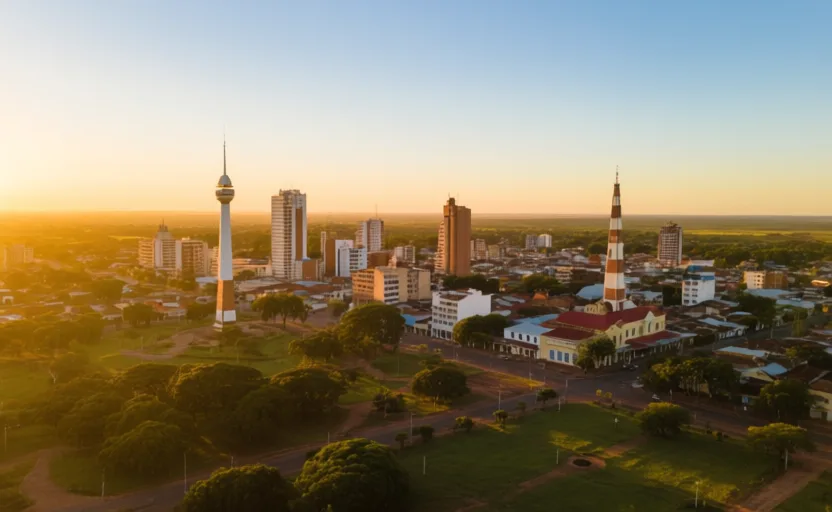 Capiatá · AI city illustration · Artistic impression
City · Latin America
Capiatá
Saved in this browser — no account needed. Sign in later and it comes with you.
Where it is
Capiatá lies about 20 kilometres from Asunción, in Paraguay’s Central Department, on the populated eastern side of the country. Its 88 square kilometres are hemmed in by seven neighbouring municipalities, among them Luque, San Lorenzo, Ñemby and Areguá, so there is little open country between it and the capital. The land around is the grassy plain and wooded hill country that makes up eastern Paraguay, the part of the country where most people live. The whole population is classed as urban.
The land and water around it
Eastern Paraguayplain
The Río Paraguay splits the country into two regions. The eastern one is grassy plains and wooded hills, and it holds the great majority of the population around the capital. Capiatá is part of that settled core, while the western Chaco, about 60 per cent of the national territory, has less than 4 per cent of the people.
The Río Paraguay corridorriver
The river that divides the country also gives the capital its position. Asunción, 20 kilometres from Capiatá, was the first capital of the Spanish governorate of the Río de la Plata, and the towns around it, Capiatá included, were organised as its dependants.
Its history, in short
Capiatá is older than its city status suggests. Documents held in the national archive in Asunción mention a Villa de Capiatá in the early seventeenth century, when the settlement answered to the council that Asunción’s founders had set up after 1537. Franciscan missionaries shaped it. It was one of several towns on the Franciscan circuit around the capital, a ring of settlements that became among the most crowded land in the region, and it grew around a chapel dedicated to the Virgin of Candelaria. Formal municipal life came late: a municipal board was set up in 1878, and Capiatá became a municipality in 1968 with its first mayor. Since then the town has been drawn into the growth of greater Asunción. By the 2022 census it was the fourth-largest city in the country, with a young population whose median age was 29.
Timeline
Dates are shown on a timeline rather than as changing shapes on the map. The globe draws modern boundaries only, and tinting a modern outline to stand for a historical one would state something we cannot source.
Early modern & oceanic
15 August 1537
Asunción is founded
The Spanish found Asunción, and its council is given charge of the surrounding settlements. The Villa de Capiatá later falls under that jurisdiction.
Well attestedWikipediaEarly 17th century
First written mention
Records in Asunción’s national archive refer to the Villa de Capiatá, showing a settlement already existed by then.
Approximate dateWikipedia1767
Jesuits expelled from Spanish territories
The expulsion ends the period in which Paraguay was the centre of the Jesuit missions, and the colony becomes more peripheral.
Well attestedWikipedia
Industrial & imperial
20 May 1878
Officially a city
A municipal board is established and Capiatá is formally recognised as a city.
Well attestedWikipedia
Contemporary
1968
Municipality
Capiatá is raised to a municipality. Luis Alberto Rachit Fiandro is its first mayor.
Well attestedWikipedia2022
Fourth-largest city
The national census counts 236,999 residents, which puts Capiatá fourth in the country. About a quarter are under 14 and under 7 per cent are over 65.
Well attestedWikipedia
Places that carry meaning
The Candelaria chapelColonial period
The town grew around a chapel dedicated to the Virgin of Candelaria.
The Franciscan circuit17th century
Capiatá was one of a ring of towns around Asunción tied to the Franciscans. The arrangement helps explain why this belt filled up with people so early.
AsunciónFrom 1537
The capital, 20 kilometres away, was the seat of the council whose jurisdiction first covered Capiatá and is the nearest large city to Capiatá today.
Languages here
Places are usually multilingual. This lists what is actually spoken, not one language per border.
SpanishRomance family
Official language and the main language of government, schooling and media.
About 87 per cent of Paraguayans spoke Spanish in 2015, and it is the language given preference in administration, business and education.
GuaraníTupi–Guaraní family
Official language, and the everyday language of most Paraguayans.
More than 90 per cent of Paraguayans speak some dialect of Guaraní, the highest rate for an indigenous language in Latin America, and most of them also speak Spanish. A city next to the capital sits in the middle of that bilingual mix.
Learn the language here
- 1Understand which languages are spoken hereCapiatá is multilingual. Start with which languages are used, by whom, and for what — the phrase list only covers one of them.Written by Globe Quest
- 2Learn 12 phrasesCurated everyday phrases for Capiatá, with audio and a written form.Written by Globe Quest
- 3Say them out loudSpeaking practice with pronunciation feedback, one phrase at a time.Globe Quest material, your own additions
- 4Come back to themSpaced review, so what you learned this week is still there next month.Written by Globe Quest
Check yourself
Where did Capiatá rank among Paraguay’s cities by population in 2022?
Fourth
With 236,999 inhabitants at the 2022 census, Capiatá was the fourth-largest city in the country, despite not being the capital or a border town.
What did the settlement of Capiatá grow around?
A chapel dedicated to the Virgin of Candelaria
The town developed around a chapel, as part of the Franciscan circuit of settlements around Asunción.
Worth arguing about
- Capiatá borders seven other municipalities and is 20 kilometres from the capital. When does a town stop being a place of its own and become part of a metropolitan area?
- Most Paraguayans speak Guaraní at home yet Spanish dominates schools and government. What would it take for a city like this to run in both languages?
What we have not established
These are open questions, listed rather than filled in. We would rather show a gap than a plausible guess.
How large is Capiatá?
The area is given as 88.2 square kilometres in the municipal description, while another reference gives about 82. The difference is likely a matter of boundary, and the larger figure is used here.
Sources
- Wikipedia · CapiatáWikipedia · encyclopedia · checked 2026-11-24
- Wikipedia · ParaguayWikipedia · encyclopedia · checked 2026-11-24
Reviewed by Globe Quest editorial on 2026-11-24. Drafted with AI assistance and checked against the sources above before publication.