 Globe Quest
 Human Quest · LearningSign in
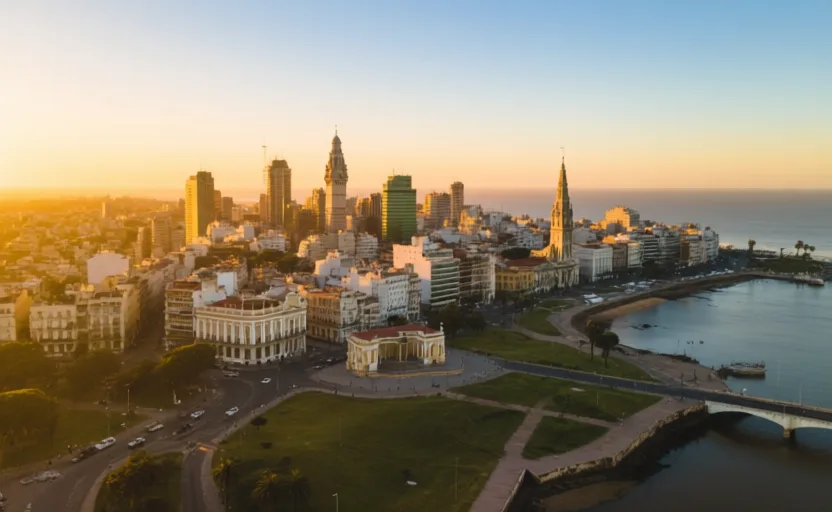 Montevideo · AI city illustration · Artistic impression
City · Latin America
Montevideo
Saved in this browser — no account needed. Sign in later and it comes with you.
Where it is
Montevideo stands on the northern shore of the Río de la Plata, where the river’s wide estuary meets the Atlantic. Buenos Aires lies 230 kilometres to the west, across the water. A hill, the Cerro, rises across the bay from the city and gave it its name. The climate is humid subtropical, with four seasons and no mountains between the city and the weather. Fronts, high winds and fog sweep in, and a cold pampero blows from the Argentine plains. It is the southernmost national capital in the Americas, and a long coastal avenue, the Rambla, runs along the whole waterfront.
The land and water around it
The Río de la Plataestuary
The wide estuary on the city’s south side. It separates Uruguay from Argentina and ties Montevideo to Buenos Aires, with which it has competed since the 1720s.
The Cerro and the baybay
The Cerro is the hill across the Bay of Montevideo from the city, and it gave Montevideo its name. The Spanish kept an observation post on it in the late 18th century, and a fortress now stands there.
Wind and weatherclimate
With no mountains in the country to stop weather, fronts and storms cross the Montevideo coast quickly and a hot northerly wind may be followed by a cold pampero from the Argentine plains. Fog and high humidity are common, and snow is almost unknown.
Its history, in short
Montevideo was founded as a military position in a contest between empires. After the Portuguese founded Colonia do Sacramento on the estuary, the Spanish began fortifying the heights around Montevideo Bay. A Portuguese fort went up in 1723 and was expelled early in 1724. The first settlers were families from Buenos Aires and the Canary Islands, joined by Galicians, Guaraní people and enslaved Africans. Within a few years the port competed with Buenos Aires for the maritime trade of the region. The British held it briefly in 1807. During the independence wars it was the centre of Spanish authority and was besieged more than once, including by Artigas. Immigration then reshaped it: Spaniards and Italians in particular arrived, so that in 1908 about 30 per cent of its 300,000 residents were foreign-born. New neighbourhoods and the Rambla followed. Economic stagnation, political violence and the dictatorship of 1973 to 1985 slowed the city, and since then it has become a regional centre of trade, higher education and the headquarters of the Mercosur trade bloc.
Timeline
Dates are shown on a timeline rather than as changing shapes on the map. The globe draws modern boundaries only, and tinting a modern outline to stand for a historical one would state something we cannot source.
Early modern & oceanic
1723–1724
A Portuguese fort, then a Spanish one
Portuguese forces build a fort at Montevideo in November 1723. Bruno Mauricio de Zabala, Spanish governor of Buenos Aires, sends an expedition that forces them out in early 1724, and the first families settle.
Approximate dateWikipedia24 December 1726
Foundation date
Zabala’s diary gives this as the foundation of the city, as San Felipe y Santiago de Montevideo. Full independence from Buenos Aires comes on 1 January 1730.
Approximate dateWikipedia
Industrial & imperial
February–September 1807
British occupation
British troops take the city in February. Forces from the Banda Oriental and Buenos Aires force their surrender by September.
Well attestedWikipedia1811
The siege by Artigas
Montevideo, still loyal to Spain, is besieged by forces from Buenos Aires and the gaucho followers of José Gervasio Artigas. The siege is lifted at the end of the year.
Well attestedWikipedia1908
A city of immigrants
The population has risen to 309,331, and about 30 per cent were born abroad, mostly in Spain and Italy. Villa del Cerro, Pocitos, the Prado and other settlements are being annexed.
Well attestedWikipedia1930
The first World Cup
The city hosts every match of the first FIFA World Cup.
Well attestedWikipedia17 December 1939
The Graf Spee
After the Battle of the River Plate, the German cruiser Admiral Graf Spee takes refuge in Montevideo’s port, then neutral, and her captain scuttles her.
Well attestedWikipedia
Contemporary
1980
The dictatorship loses a referendum
Voters reject the military’s proposed constitution by 58 per cent to 42, the first polls since 1971. The result weakens the regime, and democracy returns in 1985.
Well attestedWikipedia
Places that carry meaning
Ciudad ViejaFrom the 1720s
The old city in the south-west, the first part of Montevideo to be built and still a distinct barrio.
Fortaleza del CerroLate 18th century
A fortress above the bay on the hill that names the city, built on a Spanish observation post.
Palacio LegislativoFrom 1904
The seat of the Uruguayan parliament in Aguada, begun under President José Batlle y Ordóñez, whose reforms shaped the country.
The RamblaFrom the 1910s
A coastal avenue along the entire shoreline, built in the 1910s as the city spread around the whole bay.
Languages here
Places are usually multilingual. This lists what is actually spoken, not one language per border.
SpanishRomance family
The everyday and official language.
The city speaks Rioplatense Spanish, which uses voseo, pronounces ll and y alike, and draws heavily on Italian, including the slang called lunfardo.
ItalianRomance family
A historic immigrant language that left a deep mark on local speech.
Italians and Spaniards together made up more than 70 per cent of the foreign-born population, and Italian, like French, was a compulsory school subject until the 2000s.
EnglishGermanic family
The foreign language most widely known.
More Uruguayans know English than any other foreign language.
Learn the language here
- 1Understand which languages are spoken hereMontevideo is multilingual. Start with which languages are used, by whom, and for what — the phrase list only covers one of them.Written by Globe Quest
- 2Learn 11 phrasesCurated everyday phrases for Montevideo, with audio and a written form.Written by Globe Quest
- 3Say them out loudSpeaking practice with pronunciation feedback, one phrase at a time.Globe Quest material, your own additions
- 4Come back to themSpaced review, so what you learned this week is still there next month.Written by Globe Quest
Check yourself
Why did the Spanish found Montevideo?
As a military stronghold against the Portuguese on the estuary
The Portuguese had built Colonia do Sacramento in 1680 and a fort at Montevideo in 1723. The Spanish answered by expelling them and settling the place, and it became a port rivalling Buenos Aires.
What share of Montevideo’s people were foreign-born in 1908?
About 30 per cent
Of some 300,000 residents, about 30 per cent had been born abroad, mostly in Spain and Italy, in a city that had quadrupled since 1880.
Worth arguing about
- Montevideo was built to be a fortress and a rival to Buenos Aires, yet it grew as a city of immigrants. Which character does it show more strongly today?
- About 37 per cent of Uruguayans live in the capital and nearly two million in its metropolitan area. What does that concentration mean for the rest of the country?
What we have not established
These are open questions, listed rather than filled in. We would rather show a gap than a plausible guess.
When exactly was Montevideo founded?
A Portuguese fort dates from November 1723, the Spanish expelled it in January or February 1724 depending on the account, and a diary names 24 December 1726 as the foundation. No single founding document exists.
Where does the name come from?
All accounts agree that “Monte” is the Cerro, but explanations of “video” differ. One tells of a sailor shouting in Portuguese, another of a Latin phrase meaning “I see a hill”, and most experts reject both.
Sources
- Wikipedia · MontevideoWikipedia · encyclopedia · checked 2026-11-24
- Wikipedia · UruguayWikipedia · encyclopedia · checked 2026-11-24
Reviewed by Globe Quest editorial on 2026-11-24. Drafted with AI assistance and checked against the sources above before publication.