 Globe Quest
 Human Quest · LearningSign in
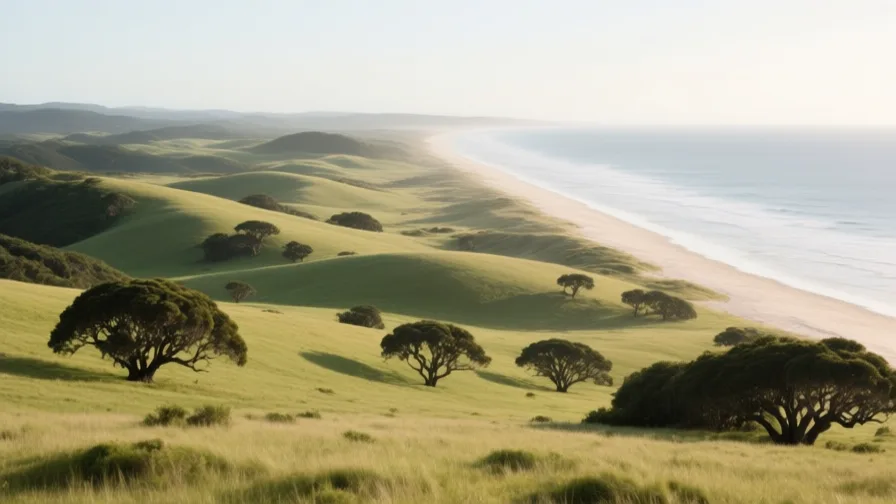 Uruguay · AI landscape illustration · Artistic impression
Country · Latin America
Uruguay
Saved in this browser — no account needed. Sign in later and it comes with you.
Where it is
Uruguay is a small country on the southeastern edge of South America, wedged between Argentina on the west and Brazil on the north and northeast. Water frames it on three sides: the Uruguay River on the west, the broad Río de la Plata estuary on the south, and 660 kilometres of Atlantic coast to the southeast. There are no mountains. Rolling plains and low ridges called cuchillas fill the interior, and the highest point, Cerro Catedral, reaches only 514 metres. Winters are damp and frosty without being severe, and winds cross the open land with nothing to stop them, including the cold pampero from the Argentine pampas. It is the only South American country lying wholly south of the Tropic of Capricorn.
The land and water around it
The Río de la Plataestuary
The estuary of the Uruguay River forms the southwestern shore, with Argentina on the far side. Spain founded Montevideo here as a military stronghold, and the contest for control of the estuary shaped the colonial period.
Cuchillas and plainsplain
The interior is rolling grassland crossed by low hill ranges. With no mountain barrier, storm fronts sweep across the whole country, and it is open ground well suited to cattle, the animal that built the colonial economy.
Río Negro and the rivers of the eastriver
Four river basins drain the country. The Río Negro, the main internal river, was dammed in 1945 and now feeds the artificial Rincón del Bonete lake at the centre of the country. Rivers flowing east end in coastal lagoons, of which Laguna Merín, on the Brazilian border, is the largest.
Its history, in short
People lived here some 13,000 years ago, but the Charrúa and other groups met by Europeans in the sixteenth century were not organised into large states, and resistance plus a lack of valuable resources kept Spanish settlement thin. Cattle, introduced in 1603, became the region’s wealth, and the land turned into a contested frontier between Spain and Portugal. Colonia del Sacramento was a Portuguese fort, Montevideo a Spanish military stronghold. The break with Spain came through José Gervasio Artigas, now the national hero, whose federalist demands were rejected by Buenos Aires. After Portuguese and then Brazilian rule, British mediation helped secure independence, and the first constitution followed in 1830. Politics split between the rural Blancos and the Montevideo-based Colorados, who drew in neighbouring powers and fought civil wars. Mass immigration from Spain, Italy and France reshaped the population, and the reforms of José Batlle y Ordóñez in the early twentieth century built an early welfare state. A military regime ruled from 1973 to 1985, and democracy has held since.
Timeline
Dates are shown on a timeline rather than as changing shapes on the map. The globe draws modern boundaries only, and tinting a modern outline to stand for a historical one would state something we cannot source.
Early modern & oceanic
1516
Juan Díaz de Solís reaches the Río de la Plata
The first European explorer to arrive, in a region that was colonised later than its neighbours.
Well attestedWikipedia1603
Cattle introduced
The Spanish bring cattle to the plains. The herds become a source of wealth for the whole region, long before towns do.
Well attestedWikipedia1680
Portuguese fort at Colonia del Sacramento
The Portuguese plant a fort across the estuary from Buenos Aires. The Spanish answer in 1726 by founding Montevideo as a military stronghold.
Well attestedWikipedia
Industrial & imperial
18 May 1811
Battle of Las Piedras
Artigas’s forces defeat the Spanish authorities and begin the independence struggle of the Banda Oriental.
Well attestedWikipedia1828–1830
Independence and the first constitution
After years of Portuguese and Brazilian rule, a peace deal mediated by Britain recognises independence in 1828, and the first constitution is promulgated in 1830.
Well attestedWikipedia1903–1915
The Batlle reforms
José Batlle y Ordóñez serves two terms as president and brings in a welfare programme, state participation in the economy and a plural executive. The country earns the nickname “Switzerland of the Americas”.
Well attestedWikipedia1918
Church and state separated
The 1918 constitution completes a long secularisation that began in colonial times, when the Church had less influence here than in most of the Spanish empire.
Well attestedWikipedia
Contemporary
1973–1985
Civic-military dictatorship
The armed forces disband parliament in 1973. One account counts around 180 Uruguayans killed or disappeared, most of them in Argentina and other neighbouring countries, and thousands more detained and tortured. A referendum in 1980 rejects the regime’s constitution, and elections in 1984 return civilian rule.
Approximate dateWikipedia
Places that carry meaning
MontevideoFrom the 1720s
The capital and largest city, with nearly 2 million people in its metropolitan area, founded by the Spanish in 1726 as a military stronghold. It is the southernmost national capital in the Americas.
Colonia del SacramentoFrom 1680
The Portuguese fort across from Buenos Aires that set off the Spanish-Portuguese contest for the estuary. It is the reason Montevideo exists.
The Cerritos de IndiosUp to about 5,000 years old
Man-made mounds in the east of the country, some of them 5,000 years old. Their builders left no written record, but excavations found traces of farming and of an extinct woolly dog.
Languages here
Places are usually multilingual. This lists what is actually spoken, not one language per border.
SpanishRomance family
The de facto national language.
Uruguayan Spanish is a form of Rioplatense, with voseo, a distinctive yeísmo and a strong Italian influence, including lunfardo vocabulary.
Uruguayan PortugueseRomance family
A border dialect in the northeast.
Along the Brazilian frontier people speak a mixture of Spanish and Brazilian Portuguese with no standard spelling and no official recognition.
Uruguayan Sign Language
Recognised as an official language in 2001.
Law 17.378 gave it official status. Guaraní and Chaná were once spoken in rural areas, but no Indigenous language is known to remain in active use. English is the foreign language most people know, and French and Italian were compulsory school subjects until the 2000s.
Learn the language here
Check yourself
What is distinctive about Uruguay’s landscape?
It is mostly rolling plains, with a highest point of 514 metres
Cerro Catedral, at 514 metres, is the highest point. With no mountains to act as weather barriers, storms and winds cross the whole country.
Why is Uruguay often called the most secular country in the Americas?
The Church had less influence from colonial times, and church and state were separated in 1918
A small Indigenous population and limited missionary success weakened the colonial Church, and anticlericalism after independence led to the separation under the 1918 Constitution.
Worth arguing about
- Uruguay was the border zone between two empires and then between two larger neighbours. How much of its identity comes from being the space in between?
- Early welfare reforms and a strongly secular state made it unusual in the region. Which of those choices depended on a small, mostly European-descended and heavily urban population?
What we have not established
These are open questions, listed rather than filled in. We would rather show a gap than a plausible guess.
How many Uruguayans hold a religious affiliation?
Surveys disagree. One estimate puts Catholics at 33 to 38 per cent and the non-religious near 47 per cent, while the last household survey to ask about religion, in 2006, recorded a much higher Catholic share.
Sources
- Wikipedia · UruguayWikipedia · encyclopedia · checked 2026-11-24
- Wikipedia · History of UruguayWikipedia · encyclopedia · checked 2026-11-24
- Wikipedia · Geography of UruguayWikipedia · encyclopedia · checked 2026-11-24
Reviewed by Globe Quest editorial on 2026-11-24. Drafted with AI assistance and checked against the sources above before publication.