 Globe Quest
 Human Quest · LearningSign in
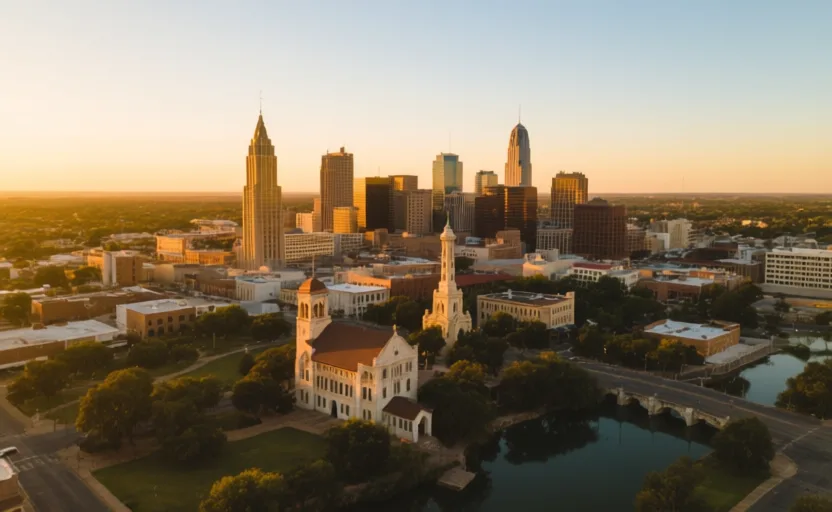 San Antonio · AI city illustration · Artistic impression
City · North America
San Antonio
Saved in this browser — no account needed. Sign in later and it comes with you.
Where it is
South-central Texas, about 190 miles west of Houston and 75 miles from Austin, is a place where gently rolling land dotted with oaks and mesquite begins to dry out toward the Mexican border. The climate sits at the edge of two types: humid subtropical to the east, hot semi-arid to the west, with very hot summers, mild winters, and cold fronts that push down from the north. The San Antonio River, and the springs along it, mattered more here than rainfall. It watered fields and settlements long before there was a city, and water is the reason this spot was chosen.
The land and water around it
The San Antonio Riverriver
The river and its springs made settlement possible. Missions diverted its water by acequia ditches to grow crops, and the modern River Walk follows its banks through downtown.
The rolling Texas plainplain
Gently rolling terrain with oak woodland, mesquite and cactus, at the point where South Texas meets Central Texas. It is the westernmost place for the cabbage palmetto and Spanish moss.
The semi-arid edgeclimate
The city lies on the line between humid subtropical and hot semi-arid, so the west side is drier than the east, and summers are long and very hot.
Its history, in short
The Payaya people called this area Yanaguana, “refreshing waters”. Spanish explorers reached the river on 13 June 1691, the feast day of Saint Anthony of Padua, and named it. A mission and fort followed in 1718, built to hold the frontier against French expansion from the east and with the labour of local Payaya and Pastia people; an irrigation ditch six miles long fed the fields. In 1731 families from the Canary Islands reached the settlement and formed the first regular civil government in Texas. San Antonio became the capital of the Spanish and then Mexican province of Tejas. Its place in the Texas Revolution came in 1836, when the Alamo fell after a siege of thirteen days. The Mexican–American War cut the population by almost two thirds, and Tejano residents lost their majority by 1850 and did not regain it until 1968. After the Civil War the city grew as a cattle centre, and today military bases, medical research and the missions’ World Heritage status shape its economy.
Timeline
Dates are shown on a timeline rather than as changing shapes on the map. The globe draws modern boundaries only, and tinting a modern outline to stand for a historical one would state something we cannot source.
Early modern & oceanic
13 June 1691
Named for Saint Anthony
A Spanish party of explorers and missionaries reaches the river and a Payaya settlement on the saint’s feast day and names both San Antonio.
1718
Mission and presidio
Mission San Antonio de Valero, later called the Alamo, and the Presidio San Antonio de Béxar are founded, along with the first irrigation ditch. The families settling around them become the Villa de Béjar.
9 March 1731
Canary Islanders arrive
Fifteen families, 56 people, reach the presidio and become the nucleus of a new villa that holds the earliest organised civil government in Texas.
Industrial & imperial
23 February to 6 March 1836
Battle of the Alamo
Texian forces under Travis and Bowie hold the old mission against Santa Anna’s army until all the defenders are killed. “Remember the Alamo” becomes a rallying cry.
Well attestedWikipedia1845 onward
Annexation and war
The United States annexes Texas, and the resulting Mexican–American War devastates San Antonio, cutting its population by almost two thirds to about 800.
Approximate dateWikipedia1850 to 1968
Tejanos lose and regain a majority
Tejano residents are no longer the majority by 1850, and Juan Seguín is the last Tejano mayor for nearly 150 years after being forced from office in 1842. They regain a majority only in 1968.
Approximate dateWikipedia
Contemporary
2015
World Heritage status
Five Spanish frontier missions of the 1700s, the Alamo among them, are inscribed together by UNESCO for their record of exchange between Spanish and indigenous cultures.
Places that carry meaning
San Antonio MissionsEarly 18th century
Five mission complexes along a stretch of about 12 kilometres of the river, each built as a self-sustaining community with fields, workshops and water systems. They show how Coahuiltecans and others became settled farmers within a generation.
The Alamo1718 onward
The first mission, Misión de San Antonio de Valero, later the site of the 1836 battle, and the reason the city is often called Alamo City.
The River Walk20th century, extended 2009 to 2013
A landscaped path along the river through downtown, extended by 13 miles in the early 2010s to reach the southern missions. It is the city’s second-most-visited attraction.
Languages here
Places are usually multilingual. This lists what is actually spoken, not one language per border.
EnglishGermanic family
The language of schooling, government and business.
Anglo-American settlers arrived after Mexican independence in 1821, and Texas joined the United States in the 1840s.
SpanishRomance family
A first language for many residents and the city’s founding language.
About 64 percent of residents identify as Hispanic, the highest share of any large American city. The city began as a Spanish mission, and its Spanish roots run through its architecture and its names.
Payaya
The language of the first known inhabitants, remembered in the place-name Yanaguana.
The Payaya called the river area Yanaguana, meaning refreshing waters, and worked with the Spanish builders of the first mission.
Learn the language here
- 1Understand which languages are spoken hereSan Antonio is multilingual. Start with which languages are used, by whom, and for what — the phrase list only covers one of them.Written by Globe Quest
- 2Learn 14 phrasesCurated everyday phrases for San Antonio, with audio and a written form.Written by Globe Quest
- 3Say them out loudSpeaking practice with pronunciation feedback, one phrase at a time.Globe Quest material, your own additions
- 4Come back to themSpaced review, so what you learned this week is still there next month.Written by Globe Quest
Check yourself
Why is the city called San Antonio?
A Spanish party arrived on the feast day of Saint Anthony of Padua in 1691
The explorers reached the river on 13 June, the saint’s feast day, and gave both the river and the place his name.
What was special about the Canary Islander families who arrived in 1731?
They helped form the first organised civil government in Texas
They joined the military community already at the presidio, and together they became the nucleus of the villa that gave Texas its earliest organised civil government.
Worth arguing about
- The Alamo is a Texan symbol, but the city around it is the most Hispanic large city in the country. How should a place tell a story that both groups claim?
- The missions are listed as an exchange between Spanish and indigenous cultures. How far was it an exchange, and how far an imposition?
What we have not established
These are open questions, listed rather than filled in. We would rather show a gap than a plausible guess.
How many people lived in San Antonio in 1860?
Accounts give 15,000 in one place and a census count of 8,235, including nearly 600 enslaved people, in another. The difference may be the boundary or the date of the estimate, so no figure is given.
Sources
- Wikipedia · San AntonioWikipedia · encyclopedia · checked 2026-11-24
- Wikipedia · History of San AntonioWikipedia · encyclopedia · checked 2026-11-24
- Wikipedia · Languages of the United StatesWikipedia · encyclopedia · checked 2026-11-24
- UNESCO · San Antonio MissionsUNESCO World Heritage Centre · intergovernmental · checked 2026-11-24
Reviewed by Globe Quest editorial on 2026-11-24. Drafted with AI assistance and checked against the sources above before publication.