 Globe Quest
 Human Quest · LearningSign in
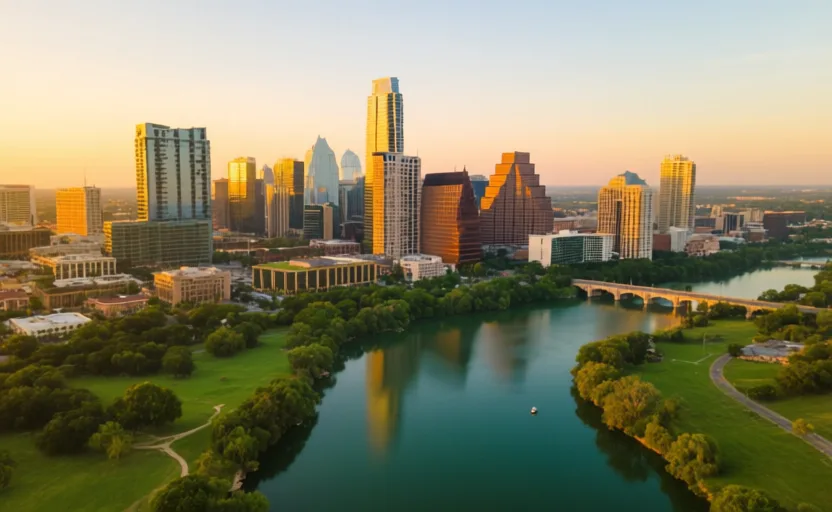 Austin · AI city illustration · Artistic impression
City · North America
Austin
Saved in this browser — no account needed. Sign in later and it comes with you.
Where it is
Central Texas narrows here into a strip between two worlds. Austin lies where the Hill Country meets the plains, on the Colorado River, in a transitional band that shares traits of the dry American Southwest and the humid Southeast. Limestone hills, spring-fed pools and creeks such as Shoal and Barton run down to the river, which has been dammed into a chain of lakes through the city. The city is about 146 miles northwest of Houston, 182 south of Dallas and, on the I-35 corridor, a short drive from San Antonio. The climate swings between drought and flood, and the weather of the 2010s and early 2020s included both a record-dry water year and a destructive winter freeze.
The land and water around it
The Colorado River and Lady Bird Lakeriver
The river made the site and then limited it. In the 1890s Austin borrowed heavily to build a dam, hoping for cheap power and cotton mills. Lady Bird Lake, once called Town Lake, is the river-like reservoir behind a later dam, and is now the city’s main recreation space.
Barton Springs and the Edwards Aquiferoasis
Spring water emerges at Barton Springs, one of four springs in the Coahuiltecan creation story. Its pool is the largest natural swimming pool in an American urban area, and protecting it and the aquifer beneath became the defining environmental fight of the 1970s and 1980s.
The Hill Country edgeplateau
Limestone cliffs line the Barton Creek greenbelt, and the surrounding hills gave the nineteenth-century nickname “City of the Violet Crown” for the glow after sunset.
Its history, in short
People were hunting here by about 9200 BCE, and the Gault Site holds Clovis-era evidence. The Spanish passed through in the early 1700s, meeting Yojuan, Simomo and Tusonibi peoples on the Colorado, and briefly placed a mission on the south bank in 1730. After Texas won independence from Mexico in 1836, its president, Mirabeau Lamar, who had hunted buffalo here, argued for a capital in the hills on the north bank, a crossroads for trade between Santa Fe, Galveston Bay and northern Mexico. A commission chose the little settlement of Waterloo in 1839 and it was renamed for Stephen F. Austin. Edwin Waller laid out a grid along the river, with Congress Avenue running up to the capitol site. Sam Houston, Lamar’s rival, called the site a remote wilderness and tried to move the government, which led to the so-called Archive War; the population shrank to a few hundred before Congress settled the question in 1845. Austin grew through its two anchors, the state government and the University of Texas, then added electronics from the 1960s and high technology, music and film since the 1990s.
Timeline
Dates are shown on a timeline rather than as changing shapes on the map. The globe draws modern boundaries only, and tinting a modern outline to stand for a historical one would state something we cannot source.
First cities & states
c. 9200 BCE
Clovis presence
Evidence at the Gault Site, between Georgetown and Fort Hood, shows people in the area in the late Ice Age. Elsewhere the dates of Paleo-Indian use are given as much later.
Approximate dateWikipedia
Early modern & oceanic
1709
The first Spanish expedition
The Espinosa-Olivares-Aguirre party reaches the Colorado hoping to meet the Tejas, and is greeted by Yojuan, Simomo and Tusonibi peoples. It is ordered not to cross the river and returns to Mexico.
Well attestedWikipedia
Industrial & imperial
1839
Waterloo becomes Austin
A site selection commission picks the settlement of Waterloo as capital of the Republic of Texas and it is renamed in honour of Stephen F. Austin. The first lots go on sale in August.
1841–1845
The capital in doubt
Sam Houston tries to move the capital, in what becomes known as the Archive War, over fears of Mexican incursions, and residents refuse to let the records go. The government is temporarily away, and the population falls to a few hundred. Congress votes in 1845 to keep Austin.
Well attestedWikipedia1893
The Austin Dam
A sixty-foot dam is completed northwest of the city, intended to make Austin “the Lowell of the South”. Flood damage later left the project unfinished, and the dam was completed in 1940 and renamed for Mayor Tom Miller.
Well attestedWikipedia1928
The city plan
A city plan recommends that East Austin be a “Negro district”. By 1930 Black residents, who had been spread across the city in 1880, are concentrated east of what is now Interstate 35, and municipal services such as schools, sewers and parks are provided there alone.
Well attestedWikipedia
Contemporary
1967
IBM arrives
A plant making Selectric typewriters begins the move from government and education to technology. Texas Instruments follows in 1969, and Motorola’s chip plant in 1974.
2005
No majority group
The non-Hispanic White share of the population falls below half. By 2014 the African American share is declining too, as Asian and Hispanic or Latino communities grow faster.
Well attestedWikipedia
Places that carry meaning
The Texas State Capitol and Congress Avenue1839 plan; 19th century building
Edwin Waller’s grid ran Congress Avenue up from the river to Capital Square, and this plan still shapes downtown.
University of Texas at Austinlate 19th century onward
One of the largest American universities, with over 50,000 students, and with the capital it made Austin a regional centre for government and higher education.
East Austin1928 onward
The part of the city east of what is now I-35, where the 1928 plan concentrated Black residents on the former plantation lands.
Languages here
Places are usually multilingual. This lists what is actually spoken, not one language per border.
EnglishGermanic family
The main language of the city, though there is no statutory national one.
English is by far the most commonly spoken language in the United States, and it is the language of Austin’s state government, university and employers.
SpanishRomance family
The second language of the United States and a historic one in Texas.
Spanish colonists and missions came through in the 1700s, Texas was part of Mexico until 1836, and the Hispanic and Latino share of the city has been rising. Nationally Spanish is spoken at home by about 14 per cent of the population.
Indigenous languages of the Colorado River
The languages of peoples met by Spain, including Coahuiltecan groups.
The Spanish recorded the Yojuan, Simomo, Tusonibi and Payaya, among others, and Coahuiltecan descendants still tell a creation story involving Barton Springs.
Learn the language here
- 1Understand which languages are spoken hereAustin is multilingual. Start with which languages are used, by whom, and for what — the phrase list only covers one of them.Written by Globe Quest
- 2Learn 12 phrasesCurated everyday phrases for Austin, with audio and a written form.Written by Globe Quest
- 3Say them out loudSpeaking practice with pronunciation feedback, one phrase at a time.Globe Quest material, your own additions
- 4Come back to themSpaced review, so what you learned this week is still there next month.Written by Globe Quest
Check yourself
What was Austin first called when it was selected as the capital in 1839?
Waterloo
The settlement of Waterloo was incorporated in January 1839 and chosen as capital that April. It was renamed Austin, after Stephen F. Austin, as an earlier law had required for any new capital.
Which company’s Austin plant in 1967 began the city’s shift toward high technology?
IBM
IBM opened a facility to produce its Selectric typewriters in 1967, and Texas Instruments came in 1969 and Motorola’s chip factory in 1974. Defence electronics firm Tracor had already begun operating in 1962.
Worth arguing about
- A city chosen as a remote capital became a technology hub. How much of Austin’s character comes from its university and government rather than from its industry?
- The 1928 plan sorted the city by race and its effects are still visible east of I-35. How should a growing city deal with that history?
What we have not established
These are open questions, listed rather than filled in. We would rather show a gap than a plausible guess.
How old is the earliest human presence at Austin?
Clovis-era finds at the Gault Site point to about 9200 BCE, while other Paleo-Indian artefacts are dated to about 9,000 years ago, so the earliest date varies by site and method.
How far is Austin from San Antonio?
Distance is given as about 80 miles in one place and 74 miles in another, so the exact road or straight-line figure is left open.
Sources
- Wikipedia · Austin, TexasWikipedia · encyclopedia · checked 2026-11-24
- Wikipedia · History of Austin, TexasWikipedia · encyclopedia · checked 2026-11-24
- Wikipedia · Languages of the United StatesWikipedia · encyclopedia · checked 2026-11-24
Reviewed by Globe Quest editorial on 2026-11-24. Drafted with AI assistance and checked against the sources above before publication.