 Globe Quest
 Human Quest · LearningSign in
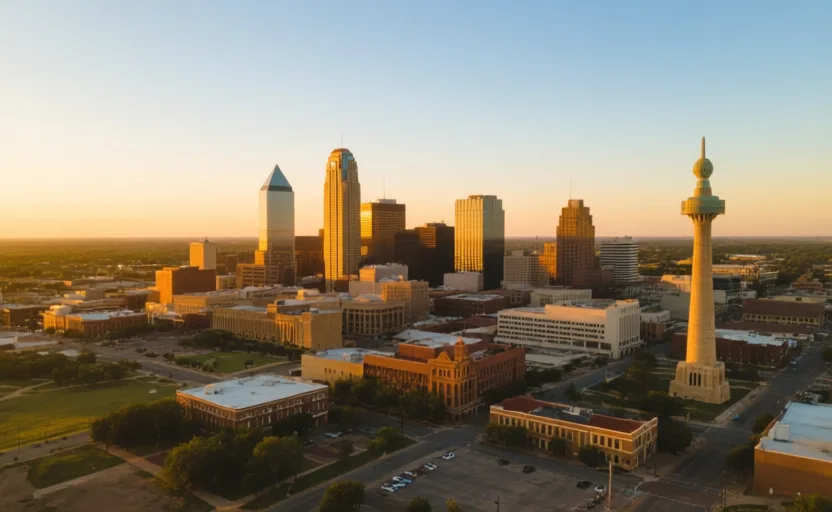 Fort Worth · AI city illustration · Artistic impression
City · North America
Fort Worth
Saved in this browser — no account needed. Sign in later and it comes with you.
Where it is
The city began on a north-facing bluff above the place where the Clear Fork joins the West Fork of the Trinity River, in North Texas. Around it lies the Grand Prairie, part of the Cross Timbers, a belt that marks the change from the forested east of the state to the rolling hills and open grassland of the centre. That position, at the line where farmland gives way to cattle country, explains most of its early history. The climate is humid subtropical, with August highs around 96 °F and January highs around 56 °F. Fort Worth now covers roughly 350 square miles and is the western half of the Dallas–Fort Worth metroplex.
The land and water around it
The Trinity River forksriver
The army chose the bluff over the junction of the Clear Fork and West Fork. The first camp on the riverbank flooded within a year, so the post moved to the top of the bluff, where the county courthouse now stands.
The Cross Timbers and Grand Prairieplain
Fort Worth lies on the boundary between wooded eastern Texas and the open central grassland. The town grew up on the open-country side of that line, in cattle country.
Its history, in short
Fort Worth started as an army post in 1849, one of a line of forts meant to cover the Texas frontier after the Mexican–American War. The soldiers left in 1853, but settlers kept the site, and the town fought and won the county seat from Birdville by 1860. The Civil War cut the population to about 175. Recovery came with cattle: the town sat on the Chisholm Trail, the last place with supplies and saloons before the long drive north, and the saloon district known as Hell’s Half-Acre earned it the name “Paris of the Plains”. When the railroad stalled outside town in the 1870s, a former resident mocked the place as so slow that a panther slept in the street. Residents adopted Panther City as their own, and the Texas and Pacific Railway arrived in 1876. By 1902 the Swift and Armour meatpackers had opened plants beside the stockyards, and the population tripled. Oil from nearby towns, military camps and airfields in two world wars, and later aircraft and airline companies broadened the economy beyond livestock.
Timeline
Dates are shown on a timeline rather than as changing shapes on the map. The globe draws modern boundaries only, and tinting a modern outline to stand for a historical one would state something we cannot source.
Industrial & imperial
1843
The Treaty of Bird’s Fort
The Republic of Texas and several Native American nations agree a line beyond which settlers may not go without permission. Trading houses are later placed at the forks of the Trinity, the site of today’s city.
1849
Camp Worth becomes Fort Worth
Major Ripley Arnold founds a camp on 6 June, moves it to the bluff in August, and the War Department officially names the post Fort Worth on 14 November.
Well attestedWikipedia1853
The army leaves
The fort is abandoned on 17 September, when a new line of forts is built further west. Settlers keep the site and no trace of the fort survives.
1875
Panther City
A Dallas newspaper prints a former Fort Worth lawyer’s jibe that a panther was sleeping in the street by the courthouse. The insult sticks, and the city adopts it as a nickname and a badge.
1876
The railway arrives
The Texas and Pacific Railway reaches the town. The stockyards become a major centre of wholesale cattle trading, and migrants from the war-damaged South add to the population.
Well attestedWikipedia1902
Meatpackers build in the Stockyards
Swift and Armour open plants in Fort Worth. The population rises from about 26,600 to more than 73,000, though Black workers were often kept out of the better jobs in segregated Texas.
Well attestedWikipedia1917
Camp Bowie and the wartime airfields
Army training camps and airfields are built around the city for the First World War. Camp Bowie Boulevard still carries the camp’s name.
Well attestedWikipedia1941
A bomber training field
The U.S. Army sets up Fort Worth Army Airfield as a heavy-bomber school. In 1948 it is renamed Carswell Air Force Base.
Well attestedWikipedia
Places that carry meaning
The Stockyards1876 onward
Once among the largest livestock markets in the country, now a National Historic District of bars, restaurants and country-music venues.
Sundance Square and downtownEarly 20th century
A district of preserved early twentieth-century façades and Art Deco buildings. The Tarrant County Courthouse, in Beaux-Arts style, stands on the bluff where the fort was.
The Cultural District museums20th century
Fort Worth’s museums are designed by well-known architects: Louis Kahn for the Kimbell, Tadao Ando for the Modern, and Philip Johnson for the Amon Carter. The Sid Richardson Museum holds Western art.
Languages here
Places are usually multilingual. This lists what is actually spoken, not one language per border.
EnglishGermanic family
The main language of daily life, school and government.
Across the United States about 77% of people speak only English at home, though Congress has never designated an official language.
SpanishRomance family
The language of the city’s large Hispanic community.
Hispanic and Latino residents made up about 35.5% of the city in 2018, up from 7.9% in 1970. Spanish is the second most spoken language in the United States by a wide margin, spoken at home by about 14% of the population.
Learn the language here
- 1Understand which languages are spoken hereFort Worth is multilingual. Start with which languages are used, by whom, and for what — the phrase list only covers one of them.Written by Globe Quest
- 2Learn 13 phrasesCurated everyday phrases for Fort Worth, with audio and a written form.Written by Globe Quest
- 3Say them out loudSpeaking practice with pronunciation feedback, one phrase at a time.Globe Quest material, your own additions
- 4Come back to themSpaced review, so what you learned this week is still there next month.Written by Globe Quest
Check yourself
How did Fort Worth get the nickname Panther City?
A newspaper article joked that a panther slept in its street
A 1875 article by a former lawyer used the image to mock the town’s slump. Fort Worth recovered the following year and kept the name, which now appears on the police badge.
Why was a fort placed where Fort Worth stands?
At the junction of the Clear Fork and West Fork of the Trinity River, on the line of the Texas frontier
After the Mexican–American War the army set up a line of posts to protect settlers, and the river junction on a bluff made a natural choice.
Worth arguing about
- Fort Worth sold itself as the place where the West begins, a few miles from Dallas. How much of that identity is geography, and how much is a brand chosen to stand apart from its neighbour?
- The cattle town’s money came from saloons and gambling as much as from cattle. How should a city remember an economy that its own leaders tried to stop?
What we have not established
These are open questions, listed rather than filled in. We would rather show a gap than a plausible guess.
Where was the Treaty of Bird’s Fort signed?
Accounts place Bird’s Fort in present-day Arlington in one version and Euless in another, so the exact site stays open.
Sources
- Wikipedia · Fort Worth, TexasWikipedia · encyclopedia · checked 2026-11-24
- Wikipedia · History of Fort Worth, TexasWikipedia · encyclopedia · checked 2026-11-24
- Wikipedia · Languages of the United StatesWikipedia · encyclopedia · checked 2026-11-24
Reviewed by Globe Quest editorial on 2026-11-24. Drafted with AI assistance and checked against the sources above before publication.