 Globe Quest
 Human Quest · LearningSign in
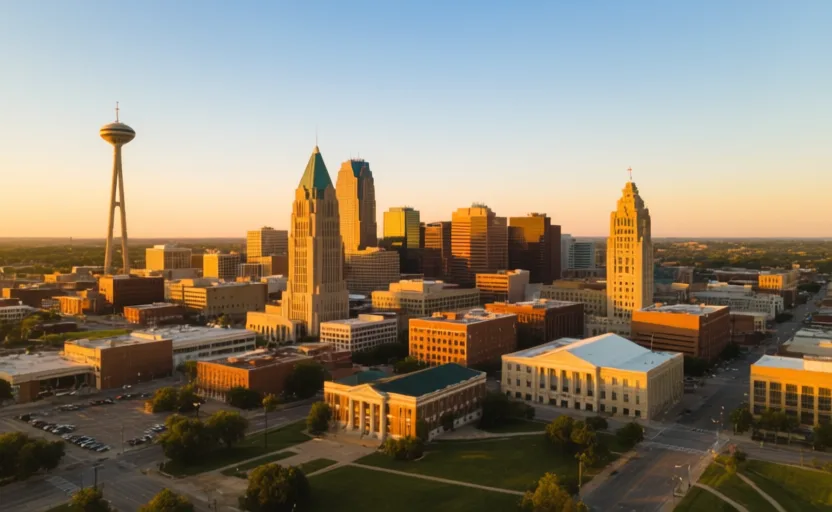 Oklahoma City · AI city illustration · Artistic impression
City · North America
Oklahoma City
Saved in this browser — no account needed. Sign in later and it comes with you.
Where it is
Central Oklahoma is open, rolling country of sandstone hills and oak woodland, and the city covers a large part of it: its limits reach into four counties, making it the second-largest city by area in the country when consolidated city-counties are excluded. The North Canadian River, renamed the Oklahoma River inside the city, divides the city into a north and a south side with different characters. The city sits in the middle of what people call Tornado Alley, and weather is part of its record: about 150 tornadoes have struck within the city limits since 1890. Summers are hot and humid and winters cool, with droughts, flash floods and ice storms all recurring.
The land and water around it
The Oklahoma (North Canadian) Riverriver
The river, renamed the Oklahoma River in 2004 inside the city, runs through the middle and divides north from south. In the 1930s a shanty town on its flood-prone south bank led to flood-control work that lowered the river’s level.
The Sandstone Hills and Cross Timbersplain
The city sits among low hills of blackjack and post oak, and its north-eastern part lies in the ecological region called the Cross Timbers.
Tornado Alleyclimate
A zone of colliding warm and cold air in which the severe-weather season runs from March to June. Thirteen violent tornadoes have struck the city since 1890, including a 1999 F5.
Its history, in short
The site was part of the “Unassigned Lands”, a block of central Indian Territory that no removed nation had been given, surrounded by Cherokee, Chickasaw, Cheyenne and Arapaho, and other territories. After years of illegal “Boomer” raids that the army turned back, the federal government opened it at noon on 22 April 1889, and more than 10,000 homesteaders arrived within hours. The city beat Guthrie, the territorial capital, to become the new state’s commercial centre by 1907 and won the capital in a 1910 vote. Stockyards and rail made it a market town, and oil found in 1928 under the city, even beneath the Capitol, made it an energy centre. Highways and an air base after the war brought growth, a 1959 annexation drive made it the largest US city by land area, and downtown declined with the move to suburbs. A 1993 programme of public investment rebuilt the centre, and the 1995 bombing of the Murrah Federal Building, which killed 168 people, is memorialised on its site.
Timeline
Dates are shown on a timeline rather than as changing shapes on the map. The globe draws modern boundaries only, and tinting a modern outline to stand for a historical one would state something we cannot source.
Industrial & imperial
1879–1888
The Boomer movement
Settlers led by David L. Payne and William Couch repeatedly occupy the Unassigned Lands illegally. A town called Ewing is set up at the site in 1880, and U.S. troops escort most of the intruders out.
Well attestedWikipedia22 April 1889
The Land Run
The Unassigned Lands open to settlement and Oklahoma City grows to over 10,000 people within hours. William Couch is elected the first mayor four days later.
1907 and 1910
Statehood and the capital
Oklahoma is admitted in 1907, with Oklahoma City already ahead of Guthrie. A popular vote makes it the capital on 11 June 1910, and rumour says a local booster took the state seal from Guthrie overnight.
4 December 1928
Oil under the city
Oil is discovered within the city limits, and derricks go up on the Capitol lawn. The oil money speeds growth and cushions part of the city from the Depression.
Contemporary
1959–1961
The Great Annexation Drive
The city annexes land until it becomes the largest US city by land area at the time.
Well attestedWikipedia1993
MAPS
The city passes the Metropolitan Area Projects package, funding a ballpark, library, canal and renovations in the centre. It has since drawn more than $3 billion in private investment.
Well attestedWikipedia19 April 1995
The Murrah Building bombing
A bomb destroys the Alfred P. Murrah Federal Building and kills 168 people, the deadliest act of domestic terrorism in U.S. history. More than 100 nearby buildings are badly damaged.
Well attestedWikipedia
Places that carry meaning
Oklahoma City National Memorial and Museum2000 to present
The memorial on the site of the Murrah Building, opened in 2000 and visited by over three million people.
Bricktown1990s redevelopment
An entertainment district in old warehouses with a canal and water taxis, one of the outcomes of the MAPS programme.
Oklahoma State Capitol1917
The capitol at Northeast 23rd Street and Lincoln Boulevard was established in 1917, and oil derricks still stand in its grounds above the oil field that lies below the city.
Languages here
Places are usually multilingual. This lists what is actually spoken, not one language per border.
EnglishGermanic family
The main language of public life.
English is by far the most commonly spoken language in the United States, which has no statutory national language.
SpanishRomance family
The language of the growing Latino community on the south side.
Hispanic or Latino residents were 21.3% of the city in 2020. South Oklahoma City, which grew around the stockyards and packing plants, is the centre of this community.
Learn the language here
- 1Understand which languages are spoken hereOklahoma City is multilingual. Start with which languages are used, by whom, and for what — the phrase list only covers one of them.Written by Globe Quest
- 2Learn 14 phrasesCurated everyday phrases for Oklahoma City, with audio and a written form.Written by Globe Quest
- 3Say them out loudSpeaking practice with pronunciation feedback, one phrase at a time.Globe Quest material, your own additions
- 4Come back to themSpaced review, so what you learned this week is still there next month.Written by Globe Quest
Check yourself
How many people did Oklahoma City have within hours of its founding in 1889?
Over 10,000
The Land Run opened the Unassigned Lands at noon on 22 April 1889, and homesteaders filled the site in a day.
What was unusual about the oil found in 1928?
It was found in the middle of the city, including under the State Capitol
The field lies below the city itself, so derricks went up in the town and on the Capitol grounds, and the oil sector became the largest part of the economy.
Worth arguing about
- The Unassigned Lands were opened to settlers in a single afternoon, on territory surrounded by the nations removed there. How should a city founded this way tell its own origin?
- The city has been rebuilt twice by public-private projects, after urban renewal and after the bombing. What does a rebuilt centre keep, and what does it lose?
Sources
- Wikipedia · Oklahoma CityWikipedia · encyclopedia · checked 2026-11-24
- Wikipedia · History of Oklahoma CityWikipedia · encyclopedia · checked 2026-11-24
- Wikipedia · United StatesWikipedia · encyclopedia · checked 2026-11-24
Reviewed by Globe Quest editorial on 2026-11-24. Drafted with AI assistance and checked against the sources above before publication.