 Globe Quest
 Human Quest · LearningSign in
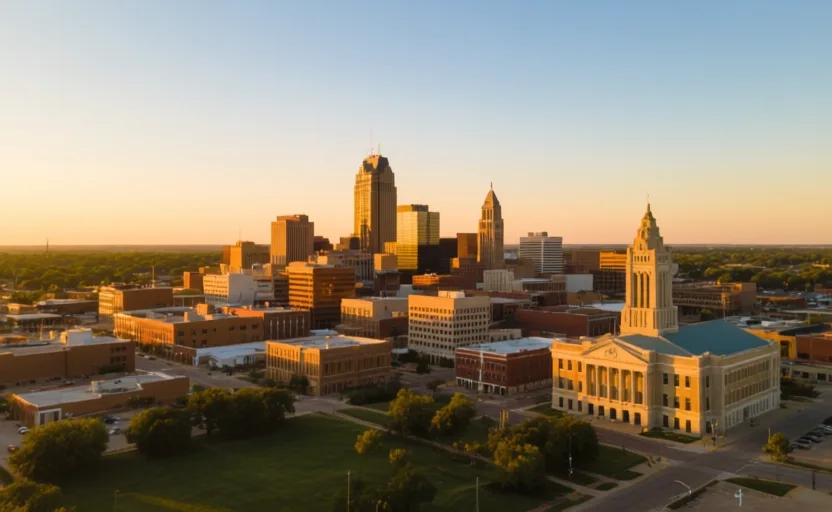 Wichita · AI city illustration · Artistic impression
City · North America
Wichita
Saved in this browser — no account needed. Sign in later and it comes with you.
Where it is
The Arkansas River comes down through south-central Kansas in a winding course, and Wichita grew where the Little Arkansas runs into it. The ground is the broad alluvial plain of the Arkansas valley, with gently rolling slopes rising on either side and the western edge of the Flint Hills not far east. Nothing on the Great Plains softens the weather: with no mountains or large water to moderate it, the city has hot, humid summers, cold dry winters, frequent spring and summer thunderstorms and a record of destructive hail and tornadoes. Rainfall is about 34 inches a year, and the summer high passes 90°F on roughly 65 days.
The land and water around it
The Arkansas Riverriver
A winding river runs south-southeast through the middle of Wichita and splits the city in two. Downtown, the Old Town district and the largest museums lie on the river's terraces, and the town of Delano grew on the far bank. Its tributaries all run generally southward.
The confluence with the Little Arkansasriver
Archaeology shows people at this junction by about 3000 BC, and the history of the city traces the spot as a meeting place and trading centre for at least 11,000 years. Jesse Chisholm's trading post stood on the Little Arkansas, and the Wichita people built a settlement on its banks in the 1860s.
The Wellington-McPherson Lowlandsplain
The city lies on this part of the Great Plains, a wide, low valley floor that the Arkansas has laid down. With no high ground or large water nearby, storms cross it unchecked.
Its history, in short
People were living at the meeting of the two rivers by about 3000 BC, and the spot was a trading and gathering place for nomadic hunters for far longer. In 1541 Coronado found it occupied by the people he called Quivira, who are identified as the Wichita. Pressure from the Osage pushed them south in the 1750s, and they came back in the 1860s while the Civil War tore through Indian Territory. Trader Jesse Chisholm set up a post here on a route running to Texas, and in 1868 a group of investors founded a town company and named the settlement after the Wichita. The railway arrived in 1872 and the town became a railhead for Texas cattle. Oil found in nearby Butler County in 1914 and 1915 financed a second boom. The oilmen's money went into aircraft, and by the 1930s Wichita made planes on a scale no other American city matched. The Second World War almost doubled its population in a few years, and aviation still defines the economy.
Timeline
Dates are shown on a timeline rather than as changing shapes on the map. The globe draws modern boundaries only, and tinting a modern outline to stand for a historical one would state something we cannot source.
First cities & states
by about 3000 BC
People at the confluence
Digs near the junction of the Arkansas and Little Arkansas rivers show human habitation by about 3000 BC. The city's own history places a trading and meeting place here for at least 11,000 years.
Early modern & oceanic
1541
Coronado meets the Quivira
The Spanish expedition led by Francisco Vázquez de Coronado finds the area held by people he called Quivira. Archaeological and historical work identifies them with the Wichita. By 1719 they had moved south into present-day Oklahoma, where they met French traders.
Industrial & imperial
1863–1867
The Wichita return
The Wichita people were driven from Indian Territory by Confederate forces and made a settlement on the Little Arkansas. Jesse Chisholm opened a trading post on the same ground, on a route to Texas that became the Chisholm Trail. In 1867 the Wichita went back to Indian Territory.
Well attestedWikipedia21 July 1870
Incorporated as a city
After the town company of 1868 named the settlement for the Wichita tribe, Darius Munger and William Greiffenstein filed the plats of the first streets in 1870. The city was formally incorporated on 21 July of that year.
Well attestedWikipedia1872
The railway and “Cowtown”
The Atchison, Topeka and Santa Fe Railway reaches Wichita. Cattle drives from Texas now end here at a railhead, which earns the city the nickname “Cowtown”. Across the river, Delano becomes the entertainment district for the cattlemen.
Well attestedWikipedia1914–1915
Oil in Butler County
Oil and natural gas are found in the nearby county. Refineries, fuelling stations and company headquarters follow, and five refineries are working in the city by 1917. The fortunes of the later oil figures Archibald Derby and Fred C. Koch start here.
Well attestedWikipedia1929
“Air Capital of the World”
Oil money paid for early aircraft firms. Clyde Cessna built the city’s first aircraft in 1917, and Stearman Aircraft (1926) and Beechcraft (1932) came out of the Swallow Airplane Company. The Aeronautical Chamber of Commerce gave the city its “Air Capital” title in 1929.
Well attestedWikipediaSecond World War
Bomber city
Wichita became a major manufacturing centre for the Boeing B-29 bomber. The wartime population grew from about 110,000 to about 184,000 as aircraft workers arrived from across the central United States.
Well attestedWikipedia
Places that carry meaning
Old Cowtown Museum1860s–1870s
A living history museum on the Arkansas River west of downtown. It keeps the cattle-railhead town of the early 1870s on show, when drovers came up the Chisholm Trail and the Santa Fe line carried their herds east.
The Keeper of the Plains and the Mid-America All-Indian Center20th century
Beside the river, a statue and its exhibit on the daily lives of Plains Indians stand next to the All-Indian Center. Both look to the Plains peoples, whose name the town company took for the city in 1868.
Old Town and downtownLate 19th century onward
Old Town is a 50-acre district of converted warehouses east of the Arkansas, now holding restaurants, shops and housing. Downtown around it also holds Century II, Intrust Bank Arena (opened 2010) and the Garvey and Epic centres.
McConnell Air Force Base and the airport1935 onward
The municipal airport southeast of the city opened in 1935 and became Wichita Army Airfield and the site of Boeing’s Plant No. 1 in the war. The Air Force took it over in 1951 to found McConnell Air Force Base. The passenger airport was renamed for Dwight D. Eisenhower in 2015.
Languages here
Places are usually multilingual. This lists what is actually spoken, not one language per border.
EnglishGermanic family
The language of daily life, government and school.
English is by far the most widely spoken and written language in the United States. The country has no law making it official for all three branches of government, although 28 states do. A 2025 executive order declared it the official language.
WichitaCaddoan family
The language of the people who gave the city its name.
The Wichita, whom Coronado called Quivira, lived at this river junction, left it under pressure from the Osage, and came back in the 1860s. The city is named for the tribe. They returned to Indian Territory in 1867.
SpanishRomance family
Spoken by the Hispanic and Latino community.
Hispanic and Latino residents were 15.3 per cent of the city in the 2010 census. The numbers who speak Spanish at home are not reported in the city’s census figures.
Vietnamese and Arabic
Spoken in immigrant communities.
Lebanese families arrived from 1895, many of them Orthodox Christians, with a second wave fleeing the Lebanese civil war. Thousands of Vietnamese came after the Vietnam War, though how many of their members still use the languages is not recorded.
Learn the language here
- 1Understand which languages are spoken hereWichita is multilingual. Start with which languages are used, by whom, and for what — the phrase list only covers one of them.Written by Globe Quest
- 2Learn 12 phrasesCurated everyday phrases for Wichita, with audio and a written form.Written by Globe Quest
- 3Say them out loudSpeaking practice with pronunciation feedback, one phrase at a time.Globe Quest material, your own additions
- 4Come back to themSpaced review, so what you learned this week is still there next month.Written by Globe Quest
Check yourself
Where does the name Wichita come from?
The Wichita tribe, whose name the 1868 town company chose
The Wichita people lived at the junction of the Arkansas and Little Arkansas rivers, and the town company took their name for the settlement in 1868.
What paid for Wichita’s early aircraft industry?
Money from the oil boom after 1914
Oil found in nearby Butler County in 1914 and 1915 made local fortunes, and entrepreneurs put some of that money into aircraft builders such as Swallow, Stearman, Beechcraft and Cessna.
Worth arguing about
- The Wichita left, came back and left again within five years in the 1860s, and the town was then named for them. What does it mean for a place to carry the name of people who were not there to keep it?
- Cattle, oil and aircraft each built Wichita and each faded in turn. Is a city built on one industry at a time better seen as resilient or as always one boom from a bust?
What we have not established
These are open questions, listed rather than filled in. We would rather show a gap than a plausible guess.
How many people in Wichita speak the Wichita language today?
No census count of home languages covers the city, and the number of speakers of the Wichita language and of the immigrant languages is not recorded in the figures available.
Sources
- Wikipedia · Wichita, KansasWikipedia · encyclopedia · checked 2026-11-24
- Wikipedia · History of Wichita, KansasWikipedia · encyclopedia · checked 2026-11-24
- Wikipedia · United StatesWikipedia · encyclopedia · checked 2026-11-24
Reviewed by Globe Quest editorial on 2026-11-24. Drafted with AI assistance and checked against the sources above before publication.