 Globe Quest
 Human Quest · LearningSign in
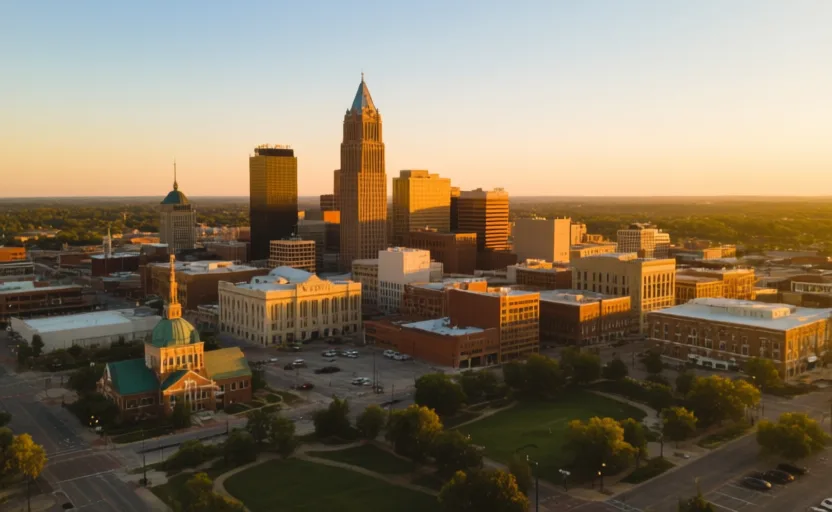 Tulsa · AI city illustration · Artistic impression
City · North America
Tulsa
Saved in this browser — no account needed. Sign in later and it comes with you.
Where it is
Northeastern Oklahoma is where the Great Plains run out and the wooded Ozark foothills begin, and Tulsa straddles that change on both banks of the Arkansas River. West of the city the Osage Hills push in from the north-west, and to the east the forest thickens, which is why the region goes by the name Green Country. The river runs through a wide, sandy channel that reservoirs upstream keep regulated. The climate is humid subtropical, with just under 41 inches of rain a year, peaking in May. About 413,000 people lived in the city in 2020 and about 1.06 million in the metropolitan area. Most of the city sits within the territory of the Muscogee (Creek) Nation.
The land and water around it
The Arkansas Riverriver
The river flows through the city in a wide, sandy channel, controlled upstream at Keystone Lake. A low-water dam at Zink Lake in downtown keeps the channel full, and it deteriorated, failed and was repaired and reopened in 2014. In 1922 oil drilling had polluted the river and sent the city to the Spavinaw Dam for its water.
The Cross Timbers and the Ozark foothillsforest
The city touches the eastern limit of the Cross Timbers, a belt of woodland and prairie where the drier western plains give way to wetter forest. Hills such as Shadow Mountain and Turkey Mountain give the south of the city its varied terrain.
A temperate, storm-prone climateclimate
Humid subtropical, with an average yearly temperature of 61.3 °F, a wet May and a secondary rainfall peak in the early autumn. Tornadoes occasionally strike, as an EF2 did in August 2017.
Its history, in short
The land around Tulsa was Indian Territory, home to the Kickapoo, Osage, Muscogee and Caddo among others. The city's name comes from the Muscogee town of Tvlahasse, “old town”, in the south-east, and in 1836 Opothleyahola and a group of Muscogee people set up a settlement called Lochapoka under the Council Oak Tree after the forced removal along the Trail of Tears. A railway crew laid a sidetrack here in 1882, and a merchant persuaded them to move it west into the Muscogee Nation, where the laws were friendlier to white businessmen. The town was incorporated in 1898. In 1901 a drilling crew struck oil at Red Fork, much of it on land whose mineral rights belonged to Osage people, and the Glenn Pool strike in 1905 brought in the big oil companies. For most of the twentieth century Tulsa was known as the Oil Capital of the World. In 1921 a white mob destroyed the prosperous Black community of Greenwood. The city then built its dam at Spavinaw for water, started the campaign for Route 66, and added aircraft to its industries in the Second World War. In 2020 the United States Supreme Court held that much of eastern Oklahoma, Tulsa included, remains Native American land for criminal law.
Timeline
Dates are shown on a timeline rather than as changing shapes on the map. The globe draws modern boundaries only, and tinting a modern outline to stand for a historical one would state something we cannot source.
Industrial & imperial
28 March 1836
Lochapoka, under the Council Oak
Opothleyahola and the Muscogee (Creek) Nation found a village named Lochapoka, meaning “place of turtles”, where Cheyenne Avenue now crosses 18th Street. The Creek had been relocated here after Indian Removal.
Well attestedWikipedia7 August 1882
The railway sidetrack
A crew building the St. Louis–San Francisco Railroad chooses the spot just north of what is now Whittier Square for a sidetrack, then is persuaded to move west into the Muscogee Nation.
Well attestedWikipedia18 January 1898
Incorporation
Tulsa is incorporated and elects Edward E. Calkins as its first mayor.
Well attestedWikipedia24 June 1901
Oil at Red Fork
A crew led by P. L. Crossman strikes oil near Red Fork. Much of the oil lies under land whose mineral rights belong to members of the Osage Nation under the headright system, and Glenn Pool follows in 1905.
Well attestedWikipedia31 May–1 June 1921
The Tulsa Race Massacre
Mobs of white Tulsans kill Black residents, loot and burn Greenwood, the prosperous district known as Black Wall Street. About 35 city blocks are destroyed, around 1,000 Black people are left homeless, and the violence stops after about sixteen hours when National Guardsmen arrive.
Well attestedWikipedia1925
Route 66 begins in Tulsa
Tulsa businessman Cyrus Avery starts a campaign for a road linking Chicago to Los Angeles by founding the U.S. Highway 66 Association, which earns the city the nickname “Birthplace of Route 66”.
Well attestedWikipedia1942
A Douglas aircraft plant opens
Voters approve a bond for a 1,000-acre plant near the municipal airport, beginning an economy that reaches beyond oil into aviation.
Well attestedWikipedia
Contemporary
July 2020
McGirt v. Oklahoma
The Supreme Court holds that, as far as criminal law goes, a large part of eastern Oklahoma, Tulsa among it, is still Native American land. Prosecutions of Native Americans fall to tribal and federal courts, and a later decision gave federal and state courts joint jurisdiction over non-Native offenders.
Well attestedWikipedia
Places that carry meaning
GreenwoodEarly 20th century
The district called Black Wall Street, among the wealthiest Black communities in the country before 1921. Efforts to win reparations for survivors have so far been unsuccessful, though the city and state re-examined the events in the early twenty-first century.
The Creek Council Oak1836
The tree under which the Muscogee settlers founded Lochapoka, at Cheyenne Avenue and 18th Street. It marks Tulsa's origin as a Native town before it was a railway or oil town.
Cain's Ballroom1935 onward
The venue where Bob Wills and the Texas Playboys based themselves from 1935 and popularised western swing, broadcast on the radio from 1934. It still operates today.
The art deco downtownEarly 20th century
A building boom in the oil years coincided with the rise of art deco, and Tulsa holds one of the largest concentrations of it in the country, among them the Philcade Building, the Union Depot and a Methodist church and a high school.
Languages here
Places are usually multilingual. This lists what is actually spoken, not one language per border.
EnglishGermanic family
The common language of the city.
Nationwide, 77 per cent of residents speak only English at home. Tulsa's culture is described as drawing on the Southwest, Midwest and South, with a historical Native American presence.
Muscogee (Creek)Muskogean family
The language of the nation on whose land most of the city stands.
The city's name comes from a Muscogee word for the old town of Tvlahasse, shortened to Tvlse, and Lochapoka means “place of turtles”. Parts of the city also lie in Osage and Cherokee territory.
OsageSiouan family
The language of the Osage Nation, whose land includes north-west Tulsa.
The Osage name for the people is Wahzhazhe Ma zha. The nation's mineral rights under the headright system made oil strikes on its land a source of wealth.
SpanishRomance family
The main immigrant language.
Hispanic and Latino residents were 14.1 per cent of the city in 2010, mostly of Mexican origin. Smaller communities from Southeast Asia, such as Hmong, Vietnamese and Burmese residents, also live in the city.
Learn the language here
- 1Understand which languages are spoken hereTulsa is multilingual. Start with which languages are used, by whom, and for what — the phrase list only covers one of them.Written by Globe Quest
- 2Learn 12 phrasesCurated everyday phrases for Tulsa, with audio and a written form.Written by Globe Quest
- 3Say them out loudSpeaking practice with pronunciation feedback, one phrase at a time.Globe Quest material, your own additions
- 4Come back to themSpaced review, so what you learned this week is still there next month.Written by Globe Quest
Check yourself
Why did Tulsa become known as the Oil Capital of the World?
Oil strikes near Red Fork in 1901 and at Glenn Pool in 1905 drew the big companies
The discoveries drew in oil firms, and from 1909 companies such as Texaco moved their headquarters to Tulsa.
Whose territory does most of Tulsa sit in?
The Muscogee (Creek) Nation
Most of the city is in the Creek Nation, with north-west Tulsa in Osage land and North Tulsa in Cherokee land.
Worth arguing about
- Much of Tulsa's oil wealth came from land whose mineral rights belonged to Osage people. Who has benefited from the city's prosperity, and who has been left out?
- The 1921 massacre destroyed one of the most prosperous Black communities in the country. What does a city owe the survivors of events that happened a century ago?
What we have not established
These are open questions, listed rather than filled in. We would rather show a gap than a plausible guess.
How many people died in the 1921 Tulsa Race Massacre?
An official report counted 23 Black and 16 white citizens killed, while other estimates put the toll as high as 300, most of them Black. Records of the dead are incomplete, and the count is still disputed.
When did the Muscogee first settle at the site of Tulsa?
One account gives a settlement of the Lochapoka band between 1828 and 1836, while another dates the founding of Lochapoka to 28 March 1836.
Sources
- Wikipedia · Tulsa, OklahomaWikipedia · encyclopedia · checked 2026-11-24
- Wikipedia · United StatesWikipedia · encyclopedia · checked 2026-11-24
Reviewed by Globe Quest editorial on 2026-11-24. Drafted with AI assistance and checked against the sources above before publication.