 Globe Quest
 Human Quest · LearningSign in
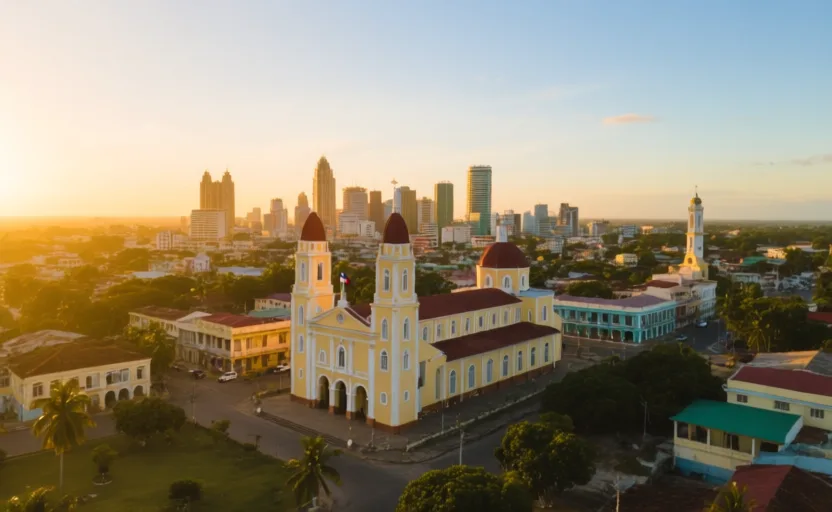 San Pedro de Macorís · AI city illustration · Artistic impression
City · Latin America
San Pedro de Macorís
Saved in this browser — no account needed. Sign in later and it comes with you.
Where it is
On the eastern side of the Dominican Republic, the city lies along the Higuamo River, whose old name, Macorix, supplied the second half of its name. A sea beach near the port supplies a candidate source for the first half. The river gave the settlement a route to the Caribbean, and seaplanes once landed on it. The climate is tropical savanna, consistently hot, with a dry season from January to March. Its nicknames, Macorís of the Sea and Sultana of the East, mark it as the main town of the east.
The land and water around it
The Higuamo Riverriver
A river once called the Macorix. Seaplanes of Pan American Airways flew in along it, and settlers moved across it in the 1840s from the west bank to the east.
The sea frontcoast
The Malecón along the shore is a gathering place for music and drinking. The city’s epithet Macorís of the Sea reflects how closely it is tied to the water.
A savanna climateclimate
Hot throughout the year, with a dry season from January to March.
Its history, in short
The riverbank first filled with refugees from Santo Domingo after 1822, when Haiti occupied the capital. The Senate declared the area a military post in 1846, and from about 1840 people moved from the west bank of the Higuamo to the east, where the city stands. The first church was founded in 1856, and in 1858 a priest proposed adding the patron saint, giving San Pedro de Macorís; the patronal festival, held between 22 and 29 June, dates from then. Sugar made the city. Cubans fleeing their country’s war of independence in the late nineteenth century brought cane-growing knowledge, and the first mill began grinding on 9 January 1879. Prices rose during the First World War, and the early twentieth century was its peak: it was cosmopolitan, with many European settlers, and at one point had more commerce than Santo Domingo. A later boom drew Afro-Caribbean workers from the Lesser Antilles, the Cocolos, and they and their descendants became the majority. Many national firsts are credited to it, from the first fire brigade and racetrack to the first national baseball championship.
Timeline
Dates are shown on a timeline rather than as changing shapes on the map. The globe draws modern boundaries only, and tinting a modern outline to stand for a historical one would state something we cannot source.
Industrial & imperial
After 1822
Refugees on the west bank
People fleeing Santo Domingo during the Haitian occupation increase the population on the west side of the Higuamo.
Well attestedWikipedia1846
A military post
At the inhabitants’ request, the Dominican Senate declares the Macorix district a military post. It is then part of the province of El Seibo.
Well attestedWikipedia1858
The name is set
The priest Elías González proposes changing Macorix to Macorís and adding the patron saint. The patronal festivals begin from this change.
Well attestedWikipedia9 January 1879
The first sugar mill
The factory founded by Juan Amechazurra mills for the first time. By 1894 there are many factories in the province.
Well attestedWikipedia1910
The cathedral opens
The San Pedro Apóstol cathedral opens. The first church, founded in 1856, had been destroyed and rebuilt several times.
Well attestedWikipediaFirst quarter of the 20th century
The sugar peak
High international sugar prices during the First World War carry production to its height, and the boom brings in Afro-Caribbean workers from the Lesser Antilles.
Approximate dateWikipedia
Places that carry meaning
San Pedro Apóstol Cathedral1910
The cathedral that succeeded the city’s first church, founded in 1856 by Pedro Carrasco Capeller.
The MalecónPresent
The seafront promenade, used as a gathering place for drinking and music.
The Cocolo communityEarly 20th century to present
Descendants of Afro-Caribbean workers from the Lesser Antilles, who came for the sugar boom and now make up much of the population. They brought with them guavaberry, a Christmas drink made from a fruit native to Hispaniola.
Languages here
Places are usually multilingual. This lists what is actually spoken, not one language per border.
SpanishRomance family
The language of the city and the country.
Spanish is the main language of the Dominican Republic, and the local variety resembles other Caribbean Spanish and has similarities to Canarian Spanish. San Pedro took in Cubans, Europeans and workers from the Lesser Antilles during its sugar years, and all of them now live in a Spanish-speaking city.
Learn the language here
- 1Understand where Spanish sits hereSan Pedro de Macorís's language situation, with sources, before any vocabulary.Written by Globe Quest
- 2Learn 12 phrasesCurated everyday phrases for San Pedro de Macorís, with audio and a written form.Written by Globe Quest
- 3Say them out loudSpeaking practice with pronunciation feedback, one phrase at a time.Globe Quest material, your own additions
- 4Come back to themSpaced review, so what you learned this week is still there next month.Written by Globe Quest
Check yourself
Who are the Cocolos of San Pedro de Macorís?
Afro-Caribbean workers from the Lesser Antilles and their descendants
They arrived during the sugar boom and soon formed the majority of the city’s population.
Where does “Macorís” come from?
An older name of the Higuamo River, the Macorix
The river appears in old documents as the Macorix, and the origin of that word, Carib, Arawakan or Ciguayo, is debated.
Worth arguing about
- A city built on sugar, with workers brought in for the boom. What obligations does a place have to the communities that its economy attracted and then outlasted?
- San Pedro claims many national firsts, from the first national baseball championship to the first boxing coliseum. Why do some small cities become so influential in a country’s culture?
What we have not established
These are open questions, listed rather than filled in. We would rather show a gap than a plausible guess.
Which languages do the Cocolo community speak?
Descendants of workers from the Lesser Antilles are described as the majority of the city, but nothing available records the languages they speak at home or how those have changed across generations.
Where does the name San Pedro come from?
Four origins have been proposed: the saint, the beach near the port, General Pedro Santana, or a wish to distinguish it from San Francisco de Macorís. None is documented as decisive.
Sources
- Wikipedia · San Pedro de MacorísWikipedia · encyclopedia · checked 2026-11-24
- Wikipedia · Dominican RepublicWikipedia · encyclopedia · checked 2026-11-24
Reviewed by Globe Quest editorial on 2026-11-24. Drafted with AI assistance and checked against the sources above before publication.