 Globe Quest
 Human Quest · LearningSign in
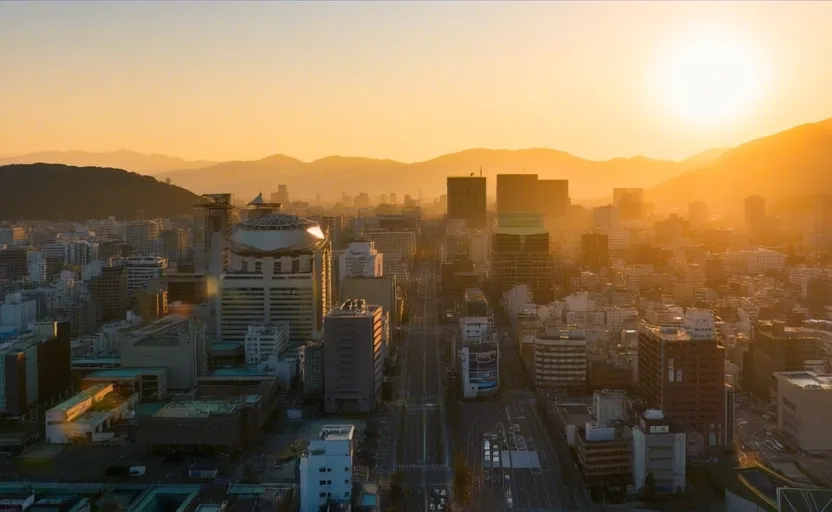 Sendai · AI city illustration · Artistic impression
City · East Asia
Sendai
Saved in this browser — no account needed. Sign in later and it comes with you.
Where it is
Few big Japanese cities reach from open sea to mountain ridge as directly as this one. The municipality runs from the Pacific coast to the Ōu Mountains, so the east is a plain, the centre hilly and the west mountainous, topping out at Mount Funagata, about 1,500 metres above sea level. The city core is built on a terrace, the Hirose River runs through it, and the Natori River reaches Sendai Bay after 55 kilometres. Winters are cool and dry with little snow, summers warm and wet, and in the rainy season the cold Yamase wind off the Okhotsk air mass holds daytime temperatures down. Offshore, a large earthquake recurs every 25 to 40 years.
The land and water around it
Hirose Riverriver
A 45-kilometre river through the city and a local symbol, the subject of a famous love song. Aoba Castle was placed beside it so that the river formed a natural moat. It flooded often until dams and levees were built in the 1960s and 1970s.
Sendai Bay coast and plaincoast
The flat eastern part of the city lies along the Pacific. In 2011 the tsunami reached as far as the ward office in Wakabayashi, 8 kilometres from the shore, and the port was closed until 16 April.
Ōu Mountains and old volcanoesmountains
The west of the city rises into the ridge that forms the border of Miyagi Prefecture. Most of the mountains in the city are dormant volcanoes, much older than the better-known Zaō and Naruko, but the many hot springs show that heat remains underground.
Its history, in short
Sendai begins as a decision. In 1600 the lord Date Masamune moved his headquarters from Iwadeyama, which sat in the north of his territory and was hard to reach from Edo, to a site in the middle of his lands on the main road from the capital. With Tokugawa Ieyasu’s permission he began a castle on Aobayama in December 1600 and laid out the town below it on a grid in 1601. He also respelled the name, replacing a character meaning a thousand generations with one meaning a hermit on a high platform. Masamune looked outward too: in 1613 he sent an embassy to the Pope aboard a galleon he had built. The railway to Tokyo arrived in 1887, the region’s first university was founded in 1907, and the city was incorporated in 1889 and became a designated city in 1989. Fire raids in July 1945 burned the historic centre. Since then earthquakes have defined the city. The Miyagi earthquake of 1978 shaped Japan’s present building standards, and the tsunami of March 2011 devastated the coast.
Timeline
Dates are shown on a timeline rather than as changing shapes on the map. The globe draws modern boundaries only, and tinting a modern outline to stand for a historical one would state something we cannot source.
Early modern & oceanic
1600–1601
Date Masamune founds the city
After the Battle of Sekigahara, Masamune is permitted to build a castle on Aobayama. Work on the castle starts in December 1600 and on the surrounding town in 1601, and the grid of streets in central Sendai still follows that plan.
Well attestedWikipedia1613
A galleon for Rome
A ship of European type is built at Masamune’s order to take Hasekura Tsunenaga’s embassy to Rome. It establishes relations with the Holy See, but the suppression of Christianity in Japan frustrates his plans.
Well attestedWikipedia
Industrial & imperial
1887
The railway to Tokyo
The first railway linking Sendai with Tokyo, today’s Tōhoku Main Line, opens and puts the city within a day’s travel of the capital for the first time.
Well attestedWikipedia1907 and 1913
A university that admits women
Tohoku Imperial University is founded in 1907 as the region’s first university. In 1913 it becomes the first Japanese university to admit female students.
Well attestedWikipedia
Contemporary
10 July 1945
Firebombing of the centre
A United States air raid burns much of the historic centre, killing 2,755 people and destroying 11,933 houses.
Well attestedWikipedia1978
Miyagi earthquake
The earthquake becomes the catalyst for Japan’s current earthquake-resistance standards for buildings.
Well attestedWikipedia11 March 2011
Tōhoku earthquake and tsunami
A magnitude 9.0 earthquake offshore sends a tsunami over the coastal plain, damaging Sendai Airport and the port and killing thousands in the region. The city’s economic growth is reported to have stabilised since.
Well attestedWikipedia
Places that carry meaning
Sendai Castle (Aoba Castle) and the grid plan1600–1601
The castle stood on Aobayama with the Hirose River as a moat, and the castle town below was drawn up on a grid. Both set the pattern of the city centre that people still walk through.
Jōzenji-dōri and Aoba-dōriTree planting from before 1868
Avenues lined with Japanese zelkova trees that give Sendai its nickname, the City of Trees. The habit of planting goes back to the time before the Meiji Restoration, when the ruling domain urged householders to put trees in their gardens. Jōzenji is the setting for the December light display and a jazz festival, and Aoba is the main business street.
Languages here
Places are usually multilingual. This lists what is actually spoken, not one language per border.
JapaneseJaponic family
The language of the city and its schools.
Japanese is the de facto national language, written with kanji and kana. With Tohoku University and many students, Sendai’s average age of 38.4 makes it one of the youngest major Japanese cities.
EnglishGermanic family
A compulsory school subject and a business link language.
English is taught to every pupil in Japan’s junior and senior high schools. At the 2000 census about 10,000 residents of Sendai did not hold Japanese citizenship.
Learn the language here
- 1Understand which languages are spoken hereSendai is multilingual. Start with which languages are used, by whom, and for what — the phrase list only covers one of them.Written by Globe Quest
- 2Learn 12 phrasesCurated everyday phrases for Sendai, with audio and a written form.Written by Globe Quest
- 3Say them out loudSpeaking practice with pronunciation feedback, one phrase at a time.Globe Quest material, your own additions
- 4Come back to themSpaced review, so what you learned this week is still there next month.Written by Globe Quest
Check yourself
Why did Date Masamune move his base to Sendai?
His old base at Iwadeyama was hard to reach from Edo
Iwadeyama lay at the northern edge of his lands. Sendai was central to his territory and on the main road from Edo, so he chose it for access.
What is Sendai’s nickname and where does it come from?
City of Trees, from the zelkovas along its main avenues and the gardens planted in the Edo period
The nickname predates the Meiji Restoration: the ruling domain urged householders to plant them, and the zelkova-lined streets are its best-known legacy.
Worth arguing about
- A city sited deliberately by a single lord for road access still follows his grid four centuries later. What does a planned layout lock in, and what can it not foresee?
- Sendai sits above a plate boundary and has been hit by repeated large earthquakes. How should a city decide how much of its coast to rebuild?
Sources
- Wikipedia · SendaiWikipedia · encyclopedia · checked 2026-11-24
- Wikipedia · JapanWikipedia · encyclopedia · checked 2026-11-24
Reviewed by Globe Quest editorial on 2026-11-24. Drafted with AI assistance and checked against the sources above before publication.