 Globe Quest
 Human Quest · LearningSign in
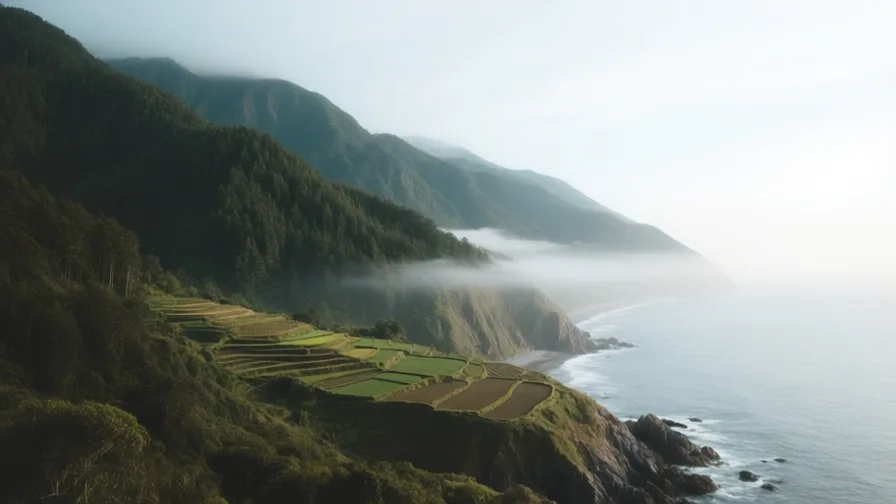 Japan · AI landscape illustration · Artistic impression
Country · East Asia
Japan
Saved in this browser — no account needed. Sign in later and it comes with you.
Where it is
Japan is an arc of 14,125 islands strung more than 3,000 kilometres along the Pacific edge of Asia, from the Sea of Okhotsk in the north to the East China Sea in the south. Four main islands plus Okinawa carry nearly all the people. About three-quarters of the land is mountain, and two-thirds is forest, so cities crowd onto coastal plains: the Kantō Plain around Tokyo is the largest, followed by the Nōbi and Osaka plains. The islands sit on the Pacific Ring of Fire, with 108 active volcanoes, frequent earthquakes and tsunamis, and typhoons. The climate runs from snowy and continental in Hokkaido to subtropical in the south.
The land and water around it
The Japanese archipelagoisland
Four main islands (Hokkaido, Honshu, Shikoku, Kyushu) and Okinawa, with thousands of smaller islands. The Sea of Japan separates the chain from the continent; Kyushu is 190 kilometres from the Korean peninsula and was for long the gateway to Asia.
Mountains and volcanoesvolcano
A mountain range runs through each main island and the highest peak, Mount Fuji, is 3,776 metres. The islands are the product of subduction at the Japan Trench, which also drives the earthquakes and volcanoes.
The coastal plainsplain
The Kantō Plain covers about 17,000 square kilometres and holds Tokyo. The Nōbi Plain (Nagoya) and the Osaka Plain are smaller. Rivers are short and swift, so floods are managed with extensive control works.
Its history, in short
People reached the archipelago some 38,000 years ago. The Jōmon hunter-gatherers made some of the world’s oldest pottery, and the Yayoi, who came from the mainland with rice farming and metal, gradually absorbed them. Chinese chronicles describe a land of many small kingdoms, and between the 4th and 6th centuries the Yamato rulers of central Japan unified them under an emperor. Buddhism and Chinese statecraft arrived through Korea and China, and the capital moved to Nara and then, in 794, to Heian-kyō, now Kyoto. From 1185 military governments, the shogunates, held real power. After a century of civil war, Tokugawa Ieyasu won at Sekigahara in 1600 and ruled from Edo, and from 1639 the country was closed to most foreign contact for over two centuries. American warships ended that in 1853 and the Meiji Restoration of 1868 industrialised the country at great speed. Empire, defeat in 1945, occupation until 1952 and rapid growth followed, and Japan is now one of the world’s oldest societies.
Timeline
Dates are shown on a timeline rather than as changing shapes on the map. The globe draws modern boundaries only, and tinting a modern outline to stand for a historical one would state something we cannot source.
Early human world
c. 14,500 BCE
Jōmon pottery
Hunter-gatherers begin making clay vessels, among the oldest known ceramics in the world. The Jōmon period lasts roughly until 1000 BCE.
Approximate dateWikipedia
Classical world
c. 1000–300 BCE
The Yayoi arrive
Wet-rice farming and bronze and iron tools spread from northern Kyushu. Recent radiocarbon work pushes the start earlier than the older date of about 400 BCE, so the dating is not settled.
Approximate dateWikipediaFrom c. 250
The Kofun period
Rulers of the Yamato state in central Japan build huge keyhole-shaped burial mounds, such as the 486-metre Daisenryō Kofun, as the country gradually unifies.
Approximate dateWikipedia
Post-classical world
794
Heian-kyō
A new imperial capital is founded at modern Kyoto, opening the Heian period, regarded as a classical golden age.
Well attestedWikipedia1185
Kamakura shogunate
After the Taira fall in the Genpei War, Minamoto no Yoritomo sets up a military government at Kamakura. Warrior rule outlasts the Mongol invasions of 1274 and 1281.
Well attestedWikipedia
Early modern & oceanic
1600–1603
Tokugawa shogunate at Edo
Tokugawa Ieyasu wins at Sekigahara in 1600 and is named shōgun in 1603. The sakoku isolation policy of 1639 frames the Edo period, which lasts to 1868.
Well attestedWikipedia
Industrial & imperial
1853–1854
Perry and the Black Ships
Commodore Perry arrives at Uraga with four ships in July 1853, and the Convention of Kanagawa follows in March 1854. Similar treaties bring crises that end the shogunate.
Well attestedWikipedia1868
Meiji Restoration
Power is centralised under the emperor and Western political, legal and military models are adopted. The Meiji Constitution follows, and Japan annexes Taiwan in 1895 and Korea in 1910.
Well attestedWikipedia
Contemporary
1945–1952
Defeat and occupation
Japan surrenders after the atomic bombings of Hiroshima and Nagasaki and is under Allied occupation until 1952. Rapid economic growth follows.
Well attestedWikipedia
Places that carry meaning
Kyoto794 onward
The imperial capital for over a thousand years, founded as Heian-kyō, and the centre of the classical court culture.
Tokyo1603 onward
Founded as Edo, the seat of the Tokugawa shogunate, and now the capital and largest city, on the largest plain in the country.
NaraBefore 794
An early imperial capital, from which the emperor’s court moved to Heian-kyō.
Languages here
Places are usually multilingual. This lists what is actually spoken, not one language per border.
JapaneseJaponic family
The de facto national language.
Written with Chinese characters (kanji) and two kana syllabaries, along with Latin letters and Arabic numerals. It is the first language of most people in the country.
Ryukyuan languagesJaponic family
Spoken in the Ryukyu Islands, south of Kyushu.
Amami, Kunigami, Okinawan, Miyako, Yaeyama and Yonaguni belong to the same family as Japanese but are distinct languages.
EnglishGermanic family
A compulsory school subject and business link language.
English is taught in junior and senior high school and used in international business.
Japanese Sign Language
The main sign language, with partial official recognition.
Its use has been hindered historically by discriminatory policies and by limited educational support.
Learn the language here
Check yourself
Why do most Japanese cities sit on a few coastal plains?
About three-quarters of the land is mountainous and forested
Steep, forested ground leaves little flat land, so the large cities of Tokyo, Nagoya and Osaka sit on the Kantō, Nōbi and Osaka plains.
What ended the Tokugawa policy of seclusion?
The arrival of American warships under Perry in 1853
Perry’s Black Ships forced the opening of the country, and the unequal treaties that followed brought down the shogunate and led to the Meiji Restoration.
Worth arguing about
- Japan went from near-total seclusion to an industrial power in about two generations. What conditions made so rapid a turn possible, and what did it cost?
- A country that is three-quarters mountain, and prone to earthquakes, packs most people onto a few plains. What does that concentration do to politics, risk and the regions left behind?
What we have not established
These are open questions, listed rather than filled in. We would rather show a gap than a plausible guess.
When did the Yayoi period begin?
The older date of about 400 BCE has been challenged by radiocarbon evidence pointing to between 1000 and 800 BCE, and scholars also debate how far the change came from migration rather than the spread of ideas.
Sources
- Wikipedia · JapanWikipedia · encyclopedia · checked 2026-11-24
- Wikipedia · History of JapanWikipedia · encyclopedia · checked 2026-11-24
- Wikipedia · Geography of JapanWikipedia · encyclopedia · checked 2026-11-24
Reviewed by Globe Quest editorial on 2026-11-24. Drafted with AI assistance and checked against the sources above before publication.