 Globe Quest
 Human Quest · LearningSign in
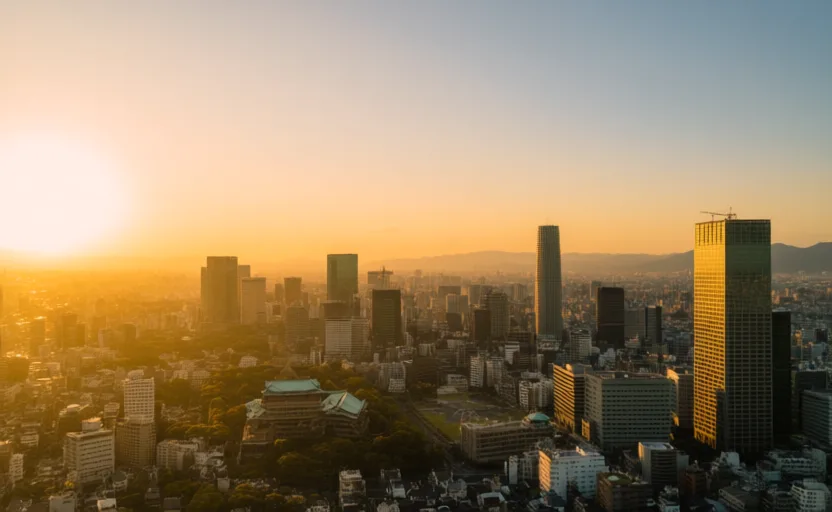 Osaka · AI city illustration · Artistic impression
City · East Asia
Osaka
Also known as Naniwa, 大阪
Saved in this browser — no account needed. Sign in later and it comes with you.
Where it is
Osaka is built on the low delta ground at the head of Osaka Bay, on the Kansai side of Honshu, with the Seto Inland Sea opening to the west. The city is very flat: its highest point is only 37.5 metres above the Tokyo reference level, and its lowest lies below it. Canals and rivers once cut the city into islands joined by bridges, and many of these waterways have since been filled in. Behind the bay the Uemachi Plateau runs north to south, and further inland mountains close in. Summers are very hot and humid, with a rainy season from early June to late July and typhoons in early autumn.
The land and water around it
Osaka Baybay
The bay on the city’s west side is the reason for Naniwa-tsu and the modern harbour. Today the waterfront holds the port and entertainment districts.
The Uemachi Plateauplateau
In Jōmon times this ridge, about 12 kilometres long and 2.5 wide, stood as a peninsula. It held fresh water and was easy to defend, which is why settlement began here.
The Osaka Plainplain
The third-largest plain on Honshu, about 1,600 square kilometres, connected to Kyoto and Nara. The Kofun-period rulers diverted the Yamato River here to stop floods.
Its history, in short
In Jōmon times most of the site lay under water, and the Uemachi Plateau jutted out as a long peninsula between an inner bay and the Inland Sea. By the Kofun period the harbour of Naniwa-tsu was the most important port in Japan, connecting the Yamato heartland with Korea and China, and the huge keyhole-shaped tombs of the nearby plain mark the power of the rulers behind it. Naniwa was briefly the imperial capital in the 7th and 8th centuries. In 1496 Buddhist monks fortified a headquarters on the old palace site; Oda Nobunaga besieged it from 1570, and Toyotomi Hideyoshi built Osaka Castle there in 1583. Through the Edo period Osaka was the merchant capital: lords took their income in rice, which merchants stored and traded, a forerunner of paper money. The Meiji move of the capital to Tokyo cost the city its commercial lead, but it turned to industry and by 1925 was the largest city in Japan, called the Manchester of the Orient.
Timeline
Dates are shown on a timeline rather than as changing shapes on the map. The globe draws modern boundaries only, and tinting a modern outline to stand for a historical one would state something we cannot source.
First cities & states
c. 7000 BCE
A peninsula in the bay
In the Jōmon period most of the present city is submerged, and the Uemachi Plateau forms a peninsula. The Morinomiya ruins hold shell mounds, graves and tools from the Jōmon and Yayoi periods.
Approximate dateWikipedia
Classical world
5th century
Naniwa port and the great tombs
Naniwa-tsu becomes Japan’s most important port, and the Mozu tombs rise in the plain to the south. The Mozu-Furuichi group, of 49 mounds, dates from the middle Kofun period.
Post-classical world
645
Capital at Naniwa
Emperor Kōtoku builds the Naniwa Nagara-Toyosaki Palace, making the city the capital until 655. It is capital again in 744–745 under Emperor Shōmu.
Well attestedWikipedia
Early modern & oceanic
1496
Ishiyama Hongan-ji
Jōdo Shinshū Buddhists set up a fortified headquarters on the site of the old palace. The name Ōsaka, meaning “large slope”, is first written down in the same year.
Well attestedWikipedia1583
Osaka Castle
After Nobunaga’s siege razes the temple, Toyotomi Hideyoshi builds the castle. It later plays a central role in the Siege of Osaka of 1614–1615.
Well attestedWikipedia
Industrial & imperial
1868
After the Restoration
With the capital at Tokyo, Osaka declines as a financial centre but becomes an industrial one. The modern municipality is created in 1889 with only 15 square kilometres.
Well attestedWikipedia1925
Largest city in Japan
An expansion of 126 square kilometres that year brings the city to most of its present area, and it is the largest in Japan and sixth in the world. The Great Kantō earthquake draws many migrants between 1920 and 1930.
Well attestedWikipedia
Contemporary
2015
Referendum on Osaka Metropolis
Voters narrowly reject a plan to replace the city’s 24 wards with five special districts. A second referendum on four wards is also narrowly lost.
Well attestedWikipedia
Places that carry meaning
Osaka Castle1583
Built by Hideyoshi on the site of the Ishiyama Hongan-ji, itself on the old Naniwa palace ground, so one site holds three eras of power.
Mozu-Furuichi Kofun Group3rd–6th centuries
A World Heritage property of 49 burial mounds in two clusters on a plateau above the plain. Some are imperial mausolea. They show how a few clans ranked themselves before a centralised state existed.
Dōtonbori and the canalsEdo period onward
A canal-side district among the waterways that gave Osaka its old phrase “808 bridges of Naniwa”. By 1925 the city had 1,629 bridges, and fewer than 900 remain after canals were filled in.
Languages here
Places are usually multilingual. This lists what is actually spoken, not one language per border.
Japanese (Osaka dialect)Japonic family
The everyday speech of the city.
Osaka-ben is a sub-dialect of Kansai-ben. Among its markers are ya for the copula and -hen for the negative verb ending.
KoreanKoreanic family
The language of the largest foreign community.
Of 144,123 registered foreigners, 60,110 were Korean. Ikuno ward and the Tsuruhashi district hold one of the largest Korean communities in Japan.
ChineseSino-Tibetan family
The second-largest group of foreign residents.
About 39,551 Chinese nationals were registered. Industrialisation drew Indian, Chinese and Korean immigrants who, the account notes, set up a life apart.
Learn the language here
- 1Understand which languages are spoken hereOsaka is multilingual. Start with which languages are used, by whom, and for what — the phrase list only covers one of them.Written by Globe Quest
- 2Learn 11 phrasesCurated everyday phrases for Osaka, with audio and a written form.Written by Globe Quest
- 3Say them out loudSpeaking practice with pronunciation feedback, one phrase at a time.Globe Quest material, your own additions
- 4Come back to themSpaced review, so what you learned this week is still there next month.Written by Globe Quest
Check yourself
What made Edo-period Osaka the merchant capital?
Lords were paid in rice, which Osaka merchants stored and traded
Daimyō drew their income in rice, and merchants who stored it for a fee built trading and receipt systems that foreshadowed paper money.
When did Naniwa, today’s Osaka, first serve as the imperial capital?
In 645
Emperor Kōtoku built his palace at Naniwa in 645, long before the castle or the modern city.
Worth arguing about
- Osaka was once larger than Tokyo, and twice voted narrowly against reorganising itself like Tokyo. What does that history say about the contest between Japan’s two big metropolitan areas?
- Canals shaped the city and many were filled in. Is a lost waterway recoverable once streets sit on top of it?
What we have not established
These are open questions, listed rather than filled in. We would rather show a gap than a plausible guess.
How many people does Osaka hold?
The city proper had an estimated 2.8 million in 2025, but the larger Keihanshin area has more than 19 million. Which figure matters depends on whether commuter cities are counted.
Sources
- Wikipedia · OsakaWikipedia · encyclopedia · checked 2026-11-24
- Wikipedia · JapanWikipedia · encyclopedia · checked 2026-11-24
- UNESCO · Mozu-Furuichi Kofun Group: Mounded Tombs of Ancient JapanUNESCO World Heritage Centre · intergovernmental · checked 2026-11-24
Reviewed by Globe Quest editorial on 2026-11-24. Drafted with AI assistance and checked against the sources above before publication.