 Globe Quest
 Human Quest · LearningSign in
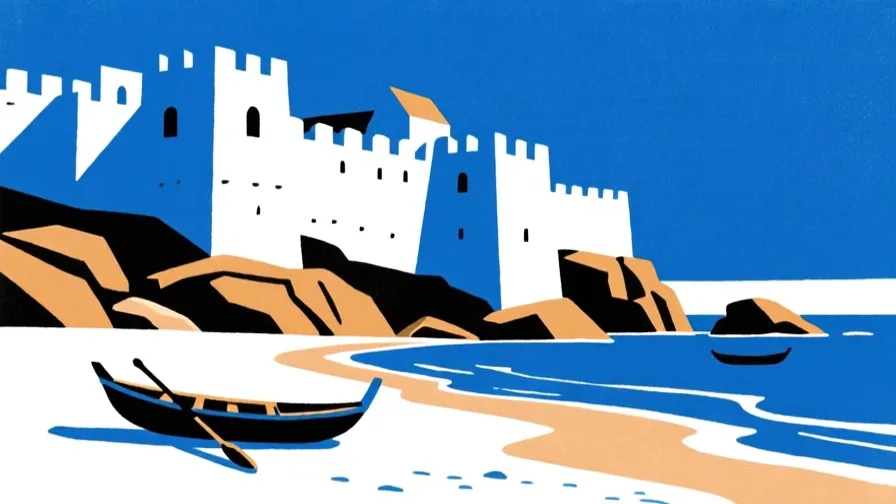 Elmina Castle · AI illustration, not a photograph
Historical place · Africa
Elmina Castle
Also known as São Jorge da Mina, Fort Elmina
A fortified trading post on the Ghanaian coast, built by Portugal in 1482 and later a centre of the Atlantic slave trade.
Saved in this browser — no account needed. Sign in later and it comes with you.
Where it is
Gold explains the location. The castle's Portuguese name, São Jorge da Mina, Saint George of the Mine, refers to the metal that merchants and miners of this coast had traded north to the Mediterranean and the Near East since medieval times. It stands on the Gulf of Guinea shore at the town of Elmina, on what Europeans called the Gold Coast, between the 15th-century Fante kingdoms of Fetu and Eguafo. The builders faced the sea, but the later danger came from behind: the Dutch added a smaller fort on a nearby hill against attack from inland. The castle is one of a string of European forts and castles spread over some 500 km of the Ghanaian coast, from Keta in the east to Beyin in the west.
The land and water around it
The Gold Coast shorecoast
More than twenty independent kingdoms lay along this coast when the Portuguese came, and its gold had long reached distant markets through trans-Saharan and coastal routes. A fortified post on the shore let a European crown reach that trade directly by sea instead of through intermediaries.
The Gulf of Guineagulf
No European trading post on the Gulf is older; it was the result of some fifty years of Portuguese voyages along the African coast that began in 1418. Later it was among the main stopping points of the Atlantic slave trade.
The hill behind the castlehills
The rise inland from the castle overlooked it, so the Dutch built Fort Coenraadsburg on it to stop attacks from the landward side.
Its history, in short
When Portuguese ships reached this coast in 1471, they found a gold trade already running between local people and visiting Arab and Berber merchants. A decade later King John II, who had made the trade a royal monopoly again, sent ten caravels and two transports carrying the castle in pre-fitted pieces, from foundation stones to roof tiles, with supplies for 600 men. Diogo de Azambuja's fleet arrived on 19 January 1482. The local chief, Kwamin Ansah, took part in a great peace ceremony with the newcomers but distrusted the idea of a permanent base. At first the Portuguese kept the castle out of slave raiding, not wanting war to disrupt the gold routes inland, and used it to pass on captives bought elsewhere, from the Slave Coast and São Tomé. By the 17th century the sale of people dominated West African commerce, and the castle became a depot where captives, usually captured inland by slave-catchers belonging to coastal peoples, were exchanged for textiles, horses and other goods. The Dutch failed to take it in 1596, succeeded in 1637, made it the capital of the Dutch Gold Coast and traded captives until 1814. Britain acquired it in 1872. Ghana has held it since independence in 1957, restored it in the 1990s and runs it as a national museum.
Timeline
Dates are shown on a timeline rather than as changing shapes on the map. The globe draws modern boundaries only, and tinting a modern outline to stand for a historical one would state something we cannot source.
Early modern & oceanic
1471
Portuguese ships reach the Gold Coast
Exploring under the trader Fernão Gomes, the Portuguese arrive at what is now Elmina and find gold already traded with Arab and Berber merchants. They are the first Europeans known to visit, though other sailors may have reached the harbour before them.
Well attestedWikipedia19 January 1482
The castle is built
Diogo de Azambuja lands with prefabricated materials, negotiates through an interpreter with Kwamin Ansah, whom the Portuguese called Caramansa, and builds São Jorge da Mina. Some historians say Christopher Columbus sailed with the fleet.
Well attestedWikipedia17th century
A depot for captives
As the trade in people overtakes gold, the castle becomes a holding place for Africans brought from many West African kingdoms and sold to European traders.
Approximate dateWikipedia1637
Dutch capture
After a failed attempt in 1596, the Dutch West India Company seizes the castle, and by 1642 holds all of the Portuguese Gold Coast. Elmina becomes the capital of the Dutch Gold Coast.
Well attestedWikipedia
Industrial & imperial
1814
The Dutch slave trade ends
Under the Anglo-Dutch Slave Trade Treaty the Dutch abolish their slave trade, ending the castle's part in the triangular Atlantic route.
Well attestedWikipedia1872
British possession
Under the Anglo-Dutch treaties of 1871 the Dutch Gold Coast, castle included, passes to the United Kingdom.
Well attestedWikipedia
Contemporary
1957
Ghana's independence
The Gold Coast becomes independent as Ghana, which takes control of the castle.
Well attestedWikipedia1979
World Heritage
The castle is inscribed with the other forts and castles of the Ghanaian coast. The government restores it extensively in the 1990s, and it becomes a place of pilgrimage for many African Americans tracing their heritage.
Places that carry meaning
São Jorge da Mina1482 onward
The oldest standing European building in sub-Saharan Africa and one of the oldest European buildings anywhere outside Europe. Built for gold and later used to hold captives for sale, it is now a Ghanaian national museum.
Fort CoenraadsburgDutch period, after 1637
The smaller fortress the Dutch built on the hill beside the castle, so that no attacker from inland could command it from above.
The forts and castles of Ghana1482–1786
Three castles, Elmina, Cape Coast and Christiansborg at Osu in Accra, and about two dozen forts and fort ruins built by traders from Portugal, Spain, Denmark, Sweden, the Netherlands, Germany and Britain. The basic plan is a square or rectangle with bastions at the corners around a courtyard. They served the gold trade of chartered companies, then the slave trade, and in the 19th century its suppression.
Languages here
Places are usually multilingual. This lists what is actually spoken, not one language per border.
FanteKwa family
Presumably the speech of Elmina's coast when the Portuguese came, and a government-sponsored language of Ghana today.
Elmina lay between the Fante kingdoms of Fetu and Eguafo when the Portuguese arrived, and the first negotiation over the castle had to go through a Portuguese trader who had lived there long enough to interpret. How these coastal people relate to the Akan who came from north of the forests is uncertain. Fante is now one of three Akan dialects, alongside Asante Twi and Akuapem Twi, that Ghana sponsors for publishing and, in some periods, primary schooling, and Akan taken as a whole is the most widely spoken language in the south of the country.
PortugueseRomance family
Historical: the builders' language, which named the castle.
Castelo de São Jorge da Mina, Castelo da Mina, or just Mina: the Portuguese names all point to the mine. Portuguese ears also reshaped local names, turning the chief Kwamin Ansah into Caramansa in their records.
DutchGermanic family
Historical: the language of the castle's rulers from 1637 to 1872.
For more than two centuries the castle was the seat of the Dutch Gold Coast, and the name of Fort Coenraadsburg on the hill above it records that period.
EnglishGermanic family
The language of the British, who took the castle in 1872, and Ghana's official language now.
British control of the fort from 1872 brought English, and Ghana kept it after independence: it is the official language and the shared tongue among the roughly 80 languages spoken in the country. In 2019 the government said it intended to make French official as well, since Ghana is ringed by French-speaking neighbours.
Learn the language here
Check yourself
Why did the Portuguese at first keep São Jorge da Mina out of slave raiding?
Wars to capture people would have disrupted the gold trade inland
The castle existed to secure gold, and slave raids meant war in the hinterland that fed the gold routes. So the Portuguese bought captives elsewhere and only passed them through, until the 17th century when the trade in people came to dominate.
What did John II's fleet of 1481 carry to the Gold Coast?
A castle in pre-fitted pieces, from foundation stones to roof tiles, with supplies for 600 men
Ten caravels and two transport ships brought everything needed to build the fort ready-fitted, so the fleet under Diogo de Azambuja, which reached Elmina on 19 January 1482, came with a building rather than a plan.
Worth arguing about
- Elmina was built to secure gold and became a depot for selling people. When a building's purpose changes like this, which history should a museum put first, and how?
- Many African Americans come to Elmina as pilgrims, while the town itself lives from fishing and tourism. Whose site is it, and who should decide how it is presented?
What we have not established
These are open questions, listed rather than filled in. We would rather show a gap than a plausible guess.
Who lived at Elmina when the Portuguese arrived?
The people of the coast around Elmina in the 15th century are thought to have been Fante, but their relationship to the modern Akan, who came from north of the forest, is not settled.
Sources
- Wikipedia · Elmina CastleWikipedia · encyclopedia · checked 2026-11-24
- UNESCO · Forts and Castles, Volta, Greater Accra, Central and Western RegionsUNESCO World Heritage Centre · intergovernmental · checked 2026-11-24
- Wikipedia · Languages of GhanaWikipedia · encyclopedia · checked 2026-11-24
Reviewed by Globe Quest editorial on 2026-11-24. Drafted with AI assistance and checked against the sources above before publication.
Related places
Themes: Trade & exchange, Migration & diaspora, Empires & independence