 Globe Quest
 Human Quest · LearningSign in
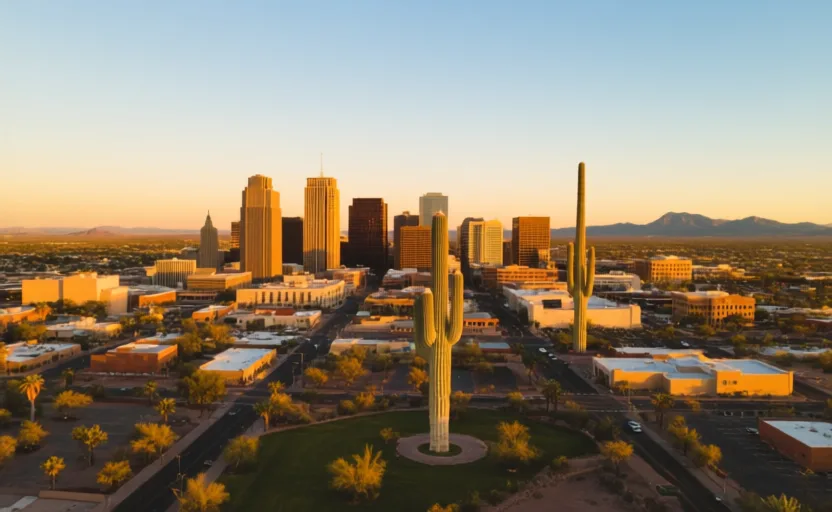 Tucson · AI city illustration · Artistic impression
City · North America
Tucson
Saved in this browser — no account needed. Sign in later and it comes with you.
Where it is
Five mountain ranges ring a wide gravel plain in the Sonoran Desert of southern Arizona: the Santa Catalinas and Tortolitas to the north, the Santa Ritas to the south, the Rincons to the east and the Tucson Mountains to the west. The city lies at about 800 metres, roughly 60 miles north of the Mexican border, and it has spread east and north because the western ranges block it. Rain averages about 10 inches a year and falls in two short seasons, winter Pacific storms and the summer monsoon. The Santa Cruz River, which crossed the plain, is what made farming possible, and the water that the desert city still draws on is the central constraint on its growth.
The land and water around it
The Santa Cruz River valleyriver
The river’s floodplain was farmed for thousands of years with canals, from the Early Agricultural Period onward. The Spanish presidio and the missions were placed along it because it carried water through the desert.
The sky-island mountain ringmountains
The Santa Catalina, Tortolita, Santa Rita, Rincon and Tucson ranges surround the city. The Tucson range on the west side effectively stopped building in that direction, so the city has expanded eastward.
The Sonoran Desert plaindesert
A hot desert climate with two seasons, a hot summer and a mild winter. Rain, about 10.6 inches a year, comes in winter storms and the summer monsoon.
Its history, in short
Farmers dug irrigation canals along the Santa Cruz here more than three thousand years ago, among the earliest in North America, and the Hohokam later built a large canal-fed society that lasted to about 1450. The Jesuit Eusebio Kino visited in 1692 and founded the mission of San Xavier del Bac in 1700. Spain built Presidio San Agustín del Tucsón in 1775 to hold the frontier against Apache raiding. Mexico took the post in 1821, and the United States bought the region south of the Gila by the Gadsden Purchase. Tucson served briefly as a Confederate territorial capital in 1861 and 1862, was the capital of Arizona Territory from 1867 to 1877, and was incorporated in 1877. The university arrived in 1885. Dry air drew veterans and tuberculosis patients early in the twentieth century. Phoenix passed it in population between 1910 and 1920, but Tucson kept growing, and with a Mexican-American population of about 40% it is still a border city whose food, language and place names descend from the Spanish and Mexican periods.
Timeline
Dates are shown on a timeline rather than as changing shapes on the map. The globe draws modern boundaries only, and tinting a modern outline to stand for a historical one would state something we cannot source.
First cities & states
c. 1200 BCE
Irrigation canals on the Santa Cruz
Farmers grow corn and beans with canals they dig. A village on the river dates back to about 2100 BCE, and the canals are among the first in North America.
Post-classical world
c. 450–1450 CE
The Hohokam
A society known for its large irrigation canal systems and red-on-brown pottery lives in the Tucson area. Sources give slightly different start dates, from 450 to 600.
Early modern & oceanic
20 August 1775
Presidio San Agustín del Tucsón
Hugo O’Conor authorises the fort that gives the city its founding date. Apache attacks on the presidio are repeated through the Spanish period.
Industrial & imperial
1821
Part of Sonora
Mexico wins independence from Spain, and Tucsón becomes part of the state of Sonora.
1853–1856
The Gadsden Purchase
The United States buys the land south of the Gila, but the American army does not formally take over Tucson until March 1856. The purchase is dated 1853 in some accounts and 1854 in others.
1861–1862
Confederate Arizona and Union capture
A Texan force took Tucson in August 1861 and proclaimed a Confederate Territory of Arizona with Tucson as its capital. After the Battle of Picacho Pass in April 1862, Union forces entered Tucson on 20 May.
1877
Incorporation
Tucson is incorporated, the oldest incorporated city in Arizona. It had served as the territorial capital since 1867.
1912
Statehood
Arizona becomes a state. Five flags have by now flown over Tucson: Spanish, Mexican, United States, Confederate and Arizona.
Well attestedWikipedia
Places that carry meaning
Mission San Xavier del Bac1700 onward
A mission founded by Eusebio Francisco Kino about seven miles upstream from the future city.
Sentinel Peak (“A” Mountain)Pre-contact onward
A basalt-covered hill whose dark base gives the city its name. The O’odham words cuk ṣon mean roughly “the base of the black hill”.
South Tucson1936
An independent one-square-mile town inside the city, incorporated in 1936. About 83% of its residents identify as Mexican American and 10% as Native American, and it is known for its Mexican restaurants.
Languages here
Places are usually multilingual. This lists what is actually spoken, not one language per border.
O’odhamUto-Aztecan family
The Native language that gave the city its name.
Tucson comes from the O’odham phrase cuk ṣon. Native Americans make up about 2.9% of the city’s population today.
SpanishRomance family
A language of the region since the Spanish and Mexican periods.
Hispanic and Latino residents made up 42.2% of the city in 2020, and people of Mexican ancestry about 40% in 2022. Mexican-American community organisations were prominent during the Second World War.
EnglishGermanic family
The main language of public life.
English is by far the most commonly spoken language in the country, with no statutory national language.
Learn the language here
- 1Understand which languages are spoken hereTucson is multilingual. Start with which languages are used, by whom, and for what — the phrase list only covers one of them.Written by Globe Quest
- 2Learn 12 phrasesCurated everyday phrases for Tucson, with audio and a written form.Written by Globe Quest
- 3Say them out loudSpeaking practice with pronunciation feedback, one phrase at a time.Globe Quest material, your own additions
- 4Come back to themSpaced review, so what you learned this week is still there next month.Written by Globe Quest
Check yourself
What does the name Tucson come from?
An O’odham phrase meaning roughly the base of the black hill
The Spanish Tucsón comes from the O’odham cuk ṣon. It refers to a basalt-covered hill now called Sentinel Peak.
Which was NOT one of the five flags that flew over Tucson by 1912?
British
The five were Spanish, Mexican, United States, Confederate and Arizona. Britain never held the area.
Worth arguing about
- A desert city that has been farmed for 3,000 years and now draws on a limited water supply: what does its long record of irrigation teach about living with limits?
- Tucson was Arizona’s largest city until about 1920 and then lost the lead to Phoenix. What makes one city overtake a neighbour?
What we have not established
These are open questions, listed rather than filled in. We would rather show a gap than a plausible guess.
When did the United States buy southern Arizona from Mexico?
Accounts of the Gadsden Purchase date the treaty to 1853 and to 8 June 1854, and the American military only took control in March 1856. The entry shows the span rather than choosing one year.
Sources
- Wikipedia · Tucson, ArizonaWikipedia · encyclopedia · checked 2026-11-24
- Wikipedia · History of Tucson, ArizonaWikipedia · encyclopedia · checked 2026-11-24
- Wikipedia · United StatesWikipedia · encyclopedia · checked 2026-11-24
Reviewed by Globe Quest editorial on 2026-11-24. Drafted with AI assistance and checked against the sources above before publication.