 Globe Quest
 Human Quest · LearningSign in
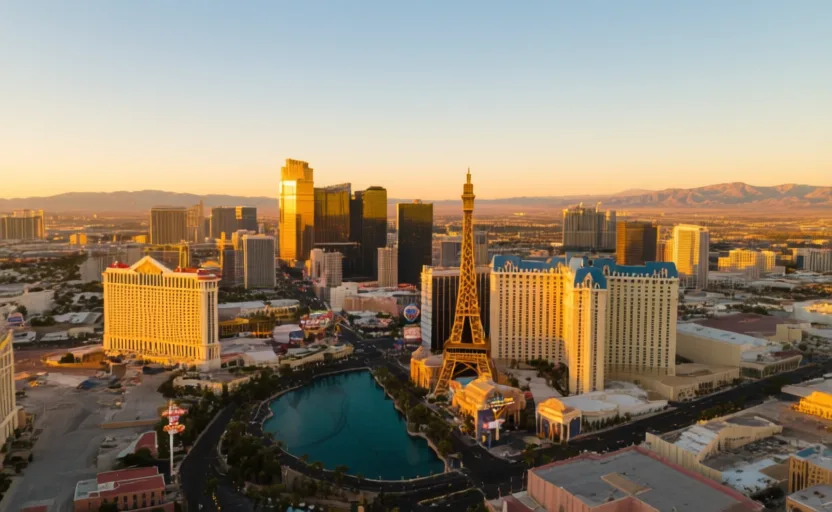 Las Vegas · AI city illustration · Artistic impression
City · North America
Las Vegas
Saved in this browser — no account needed. Sign in later and it comes with you.
Where it is
A rocky basin on the floor of the Mojave Desert, at about 620 metres and ringed by mountain ranges whose peaks pass 3,000 metres, holds the Las Vegas Valley. The ranges block moisture, so the city receives about 4 inches of rain a year and bright sun for most daylight hours. Summer highs average above 40 °C, and 137 days a year reach 32 °C or more. Rain, when it comes, can arrive as a flash flood that the drainage works now try to contain. The valley once held springs and streams feeding a meadow, and its Spanish name records that.
The land and water around it
The Las Vegas Springs and Washoasis
Artesian wells and springs once fed green meadows in the valley, and their outflow ran as the Las Vegas Wash to the Colorado River. The springs were the best resupply point on the route to California and why a settlement formed here at all.
The Mojave basindesert
A bowl of rock and desert scrub surrounded by ranges. The mountains hold back moisture, and the valley sits in one of the sunniest and driest places in North America.
The desert monsoonclimate
In July and August the North American Monsoon sometimes interrupts the dry pattern with clouds, lightning and short heavy rain, which is when flash floods strike.
Its history, in short
Southern Paiute people wintered by the springs and moved to higher ground in summer, and the 1829 trade caravan of Antonio Armijo, with Rafael Rivera as a scout, named the place for its meadows. A Mormon fort stood here from 1855 to 1857, and the springs later became a ranch. The city was founded in 1905 when land beside the Union Pacific line was auctioned, and incorporated in 1911. What kept it alive in the 1930s was a pair of decisions in 1931: Nevada legalised casino gambling and shortened divorce residency to six weeks, and work began on the tunnels for Hoover Dam. After the Second World War, hotels beyond the city limits on what became the Strip drew gangster money, then bank and pension-fund lending, and the 1951 start of nuclear testing 65 miles away was marketed as a spectacle. Growth was steep: the population rose by 85 percent between 1990 and 2000. Water supply is now the central limit on it.
Timeline
Dates are shown on a timeline rather than as changing shapes on the map. The globe draws modern boundaries only, and tinting a modern outline to stand for a historical one would state something we cannot source.
Post-classical world
from about AD 700
Paiute winters
Paiute people begin moving between the nearby mountains in summer and the valley near Big Springs in winter, after earlier visitors had left rock art.
Approximate dateWikipedia
Industrial & imperial
1829
Armijo’s caravan names the meadows
Rafael Rivera, a scout with Antonio Armijo’s 60-man party on the Old Spanish Trail, is credited as the first non-Native person to reach the valley. They call it Las Vegas, Spanish for the meadows.
1855 to 1857
The Mormon fort
Missionaries from Utah build an adobe fort on the road to southern California but give up because of internal tension, summer heat and poor crops.
1905
Railroad town
Land beside the Union Pacific tracks is auctioned and becomes downtown. The city is incorporated in 1911.
Well attestedWikipedia1931
Gambling, divorce and Hoover Dam
Nevada legalises casino gambling and cuts divorce residency to six weeks, and construction starts on the Hoover Dam tunnels. The influx of workers helps the town avoid ruin in the Depression.
Well attestedWikipedia
Contemporary
1946
The Flamingo
Bugsy Siegel, backed by mob money, builds the Flamingo, modelled on the high-class casino concept of Galveston, Texas. Siegel is killed in 1947, but financiers see the potential.
Well attestedWikipedia1951 to 1963
Atomic testing
Nuclear detonations at the Nevada Test Site, 65 miles northwest, begin. Residents and tourists can see the mushroom clouds, and the city adopts the nickname Atomic City until the 1963 treaty moves tests underground.
Places that carry meaning
Old Las Vegas Mormon Fort1855 to 1857
The remains of the adobe fort near Las Vegas Boulevard and Washington Avenue are preserved as a state historic park.
Fremont Street1905 onward
The original downtown, named for John C. Frémont, who passed through in 1844. Casinos clustered here before the Strip, and a five-block canopy of lights opened in 1995.
The Las Vegas Strip1941 onward
The resort corridor is not in the city proper but in the neighbouring unincorporated towns of Paradise and Winchester. The first resort on it, El Rancho Vegas, opened in 1941.
Languages here
Places are usually multilingual. This lists what is actually spoken, not one language per border.
EnglishGermanic family
The main language of daily life and business.
The language of the resort and hospitality industry that dominates the economy.
SpanishRomance family
The most widely spoken second language.
The city’s name is Spanish, and Hispanic or Latino residents are about 34 percent of the population, with Mexican ancestry the largest in the valley.
Southern PaiuteUto-Aztecan family
The language of the valley’s original winter residents.
Paiute people used the valley’s springs for centuries before the first Spanish-speaking travellers named it.
Learn the language here
- 1Understand which languages are spoken hereLas Vegas is multilingual. Start with which languages are used, by whom, and for what — the phrase list only covers one of them.Written by Globe Quest
- 2Learn 12 phrasesCurated everyday phrases for Las Vegas, with audio and a written form.Written by Globe Quest
- 3Say them out loudSpeaking practice with pronunciation feedback, one phrase at a time.Globe Quest material, your own additions
- 4Come back to themSpaced review, so what you learned this week is still there next month.Written by Globe Quest
Check yourself
What does “Las Vegas” mean?
The meadows
Spanish travellers on the Old Spanish Trail named the area for the green meadows fed by its artesian springs, and the name later passed to the town.
Which decision did Nevada make in 1931 that shaped the city?
Legalising casino gambling and shortening divorce residency
Together with the start of work on Hoover Dam, the 1931 laws brought workers and visitors that kept the railroad town afloat through the Depression.
Worth arguing about
- A city of over half a million sits in a desert with about four inches of rain a year. Which of its growth choices were really choices about water?
- Las Vegas treated nuclear tests nearby as a tourist draw while fallout drifted over its residents. What does that say about how a place weighs risk against income?
What we have not established
These are open questions, listed rather than filled in. We would rather show a gap than a plausible guess.
What was the city’s population at the 2020 census?
The accounts give 641,903 in one place and 644,883 in another, and the city’s boundaries exclude the Strip and much of the metropolitan area, so no single total is used.
Sources
- Wikipedia · Las VegasWikipedia · encyclopedia · checked 2026-11-24
- Wikipedia · History of Las VegasWikipedia · encyclopedia · checked 2026-11-24
- Wikipedia · Languages of the United StatesWikipedia · encyclopedia · checked 2026-11-24
Reviewed by Globe Quest editorial on 2026-11-24. Drafted with AI assistance and checked against the sources above before publication.