 Globe Quest
 Human Quest · LearningSign in
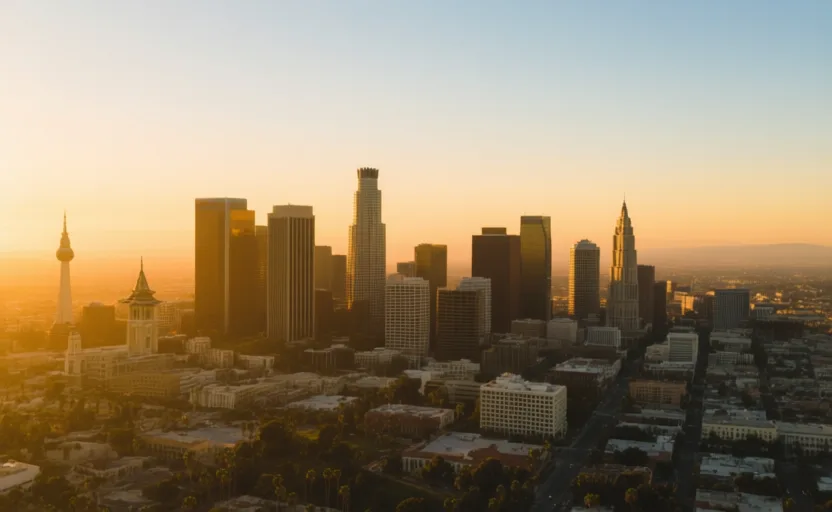 Los Angeles · AI city illustration · Artistic impression
City · North America
Los Angeles
Saved in this browser — no account needed. Sign in later and it comes with you.
Where it is
A coastal basin, ringed by mountains and cut by earthquake faults, holds most of Los Angeles. The city spreads over roughly 469 square miles of land, from the Pacific across the Los Angeles Basin, over the Santa Monica Mountains and into the San Fernando Valley, and up to 5,074 feet at Mount Lukens in the San Gabriel foothills. The climate is semi-arid, with dry summers and mild winters, and the rainfall has never matched the population. The same basin shape that holds the city also traps exhaust under temperature inversions. Water has to be brought a long way, and the San Andreas fault system passes through the metropolitan area.
The land and water around it
The Los Angeles Basinplain
A low coastal plain drained by the Los Angeles and San Gabriel rivers, which the Tongva used for villages and trade. The basin and the San Fernando Valley are both prone to atmospheric inversion, which holds smog in during the season from roughly May to October.
The Los Angeles Riverriver
A river that ran all year when the settlers arrived, among willows, oaks and wetlands. Its water and the aquifer beneath it decided where Yaanga stood and later the pueblo, and the first ditches were cut from it.
The San Andreas fault systemvalley
A strike-slip fault system on the boundary between the Pacific and North American plates, running through the metropolitan area. Southern California records about 10,000 earthquakes a year, most too small to feel.
Its history, in short
The Tongva lived across the basin, and their large village of Yaanga stood by a freshwater aquifer on the river where the Spanish later placed a town. Cabrillo claimed the coast in 1542 and the Portolá expedition passed through in 1769. In 1781 forty-four settlers, mostly of mixed Indigenous, African and Spanish descent, founded the pueblo on the governor’s orders, using Spanish planning law and a water system of ditches from the river. After Mexican independence it became a regional capital of Alta California, and after the war with the United States it was ceded in 1848. Railroads arrived in the 1870s and 1880s, oil was found in 1892, and by 1900 more than 100,000 people lived there. The 1913 aqueduct brought water from Eastern California and, because the city would supply it only to its own residents, drew neighbouring communities into annexation. Aircraft factories in the Second World War and freeway building afterwards pushed the city across the valleys.
Timeline
Dates are shown on a timeline rather than as changing shapes on the map. The globe draws modern boundaries only, and tinting a modern outline to stand for a historical one would state something we cannot source.
Early modern & oceanic
1542
Cabrillo claims the coast
Juan Rodríguez Cabrillo, on a Spanish expedition up the Pacific coast, claims the region for the Spanish Empire.
Well attestedWikipedia4 September 1781
The pueblo is founded
Los Pobladores, 44 settlers from Sonora and central New Spain, found the town on the Tongva village site. The full original name of the settlement is debated.
Industrial & imperial
1821
Mexican rule
New Spain’s independence places the pueblo inside the Mexican Republic, and Governor Pío Pico later makes Los Angeles the regional capital of Alta California.
Well attestedWikipedia1847–1848
Cession to the United States
The Treaty of Cahuenga ends fighting in January 1847, and the Treaty of Guadalupe Hidalgo formally cedes Los Angeles and the rest of Alta California in 1848. The city is incorporated in 1850.
Well attestedWikipedia24 October 1871
The Chinese massacre
A mob of about 500 attacks the Chinese quarter, killing nineteen people, most of them hanged. Old Chinatown stood where Union Station is now.
Well attestedWikipedia1876–1885
Railroads arrive
The Southern Pacific line from San Francisco reaches the city in 1876 and the Santa Fe in 1885, bringing Midwestern settlers in large numbers.
1892
Oil
Edward Doheny finds oil near the site of Dodger Stadium. By 1923 California is the country’s leading producer.
1913
The aqueduct opens
William Mulholland’s aqueduct delivers water from Eastern California, and charter rules that tie it to the city push surrounding communities to join Los Angeles.
Well attestedWikipedia
Places that carry meaning
El Pueblo de Los Ángeles and Olvera Street1781 onward
The historic district commemorating the founding pueblo, the oldest part of the city. The first plaza lay a block northwest of the present one and was set at a 45-degree angle to the compass.
YaangaPre-contact
The principal Tongva settlement of the basin, whose name has been translated as “place of the poison oak” and “the valley of smoke”. It supplied the colonists with food, baskets and labour, and the pueblo was founded on its site.
Mission San Gabriel Arcángel1771
The first mission in the area, built under Junípero Serra. The settlers of 1781 came by way of the mission before reaching the pueblo.
Languages here
Places are usually multilingual. This lists what is actually spoken, not one language per border.
EnglishGermanic family
The common language of public life.
Even so, in the 2021 survey about 57 per cent of residents aged five and over spoke another language at home, and well over 200 languages are spoken in the city.
SpanishRomance family
The second language of the city, rooted in its Spanish and Mexican past.
Hispanic and Latino residents were about 47 per cent of the city in 2023. Spanish names for the city and its streets date from the pueblo, though in 1849 street names in the surveyed city were switched from Spanish to English.
Immigrant community languages
Spoken in named neighbourhoods across the city.
Enclaves such as Chinatown, Koreatown, Historic Filipinotown, Little Armenia, Little Ethiopia, Thai Town and Little Bangladesh mark where successive groups settled and keep their languages in use.
Tongva (Kizh)Uto-Aztecan family
The Uto-Aztecan language of the basin’s first inhabitants.
The Tongva people, also known as Gabrieleño since Spanish colonisation, number about 2,000 in Southern California according to a 2006 report, and some are organising to protect burial and cultural sites.
Learn the language here
- 1Understand which languages are spoken hereLos Angeles is multilingual. Start with which languages are used, by whom, and for what — the phrase list only covers one of them.Written by Globe Quest
- 2Learn 12 phrasesCurated everyday phrases for Los Angeles, with audio and a written form.Written by Globe Quest
- 3Say them out loudSpeaking practice with pronunciation feedback, one phrase at a time.Globe Quest material, your own additions
- 4Come back to themSpaced review, so what you learned this week is still there next month.Written by Globe Quest
Check yourself
Why did neighbouring communities join Los Angeles after 1913?
The city’s charter barred supplying aqueduct water outside its borders
Because the aqueduct’s water could not be sold or provided outside the city, many adjacent communities felt compelled to be annexed to get it.
Where was the pueblo of 1781 placed?
At the Tongva village of Yaanga, beside a freshwater aquifer
The historic centre of Tongva power in the basin lay by the river’s aquifer, and the settlers depended on its people for food and labour.
Worth arguing about
- Los Angeles grew by importing water and by annexing the communities that wanted it. Is a city defined by its borders or by its supply lines?
- The city was founded by settlers of mixed African, Indigenous and Spanish descent on a Tongva village site, and later saw mob violence against Mexican and Chinese residents. Which of these beginnings does the city remember most readily, and why?
What we have not established
These are open questions, listed rather than filled in. We would rather show a gap than a plausible guess.
What was the settlement originally called?
Historians disagree on the name given in 1781. One account has “El Pueblo de la Reina de los Angeles” based on an 1785 map, while the diocesan archivist argued for “Nuestra Señora de los Angeles de Porciuncula” and that the map was in error. Longer forms in circulation vary.
Sources
- Wikipedia · Los AngelesWikipedia · encyclopedia · checked 2026-11-24
- Wikipedia · History of Los AngelesWikipedia · encyclopedia · checked 2026-11-24
- Wikipedia · Languages of the United StatesWikipedia · encyclopedia · checked 2026-11-24
Reviewed by Globe Quest editorial on 2026-11-24. Drafted with AI assistance and checked against the sources above before publication.