 Globe Quest
 Human Quest · LearningSign in
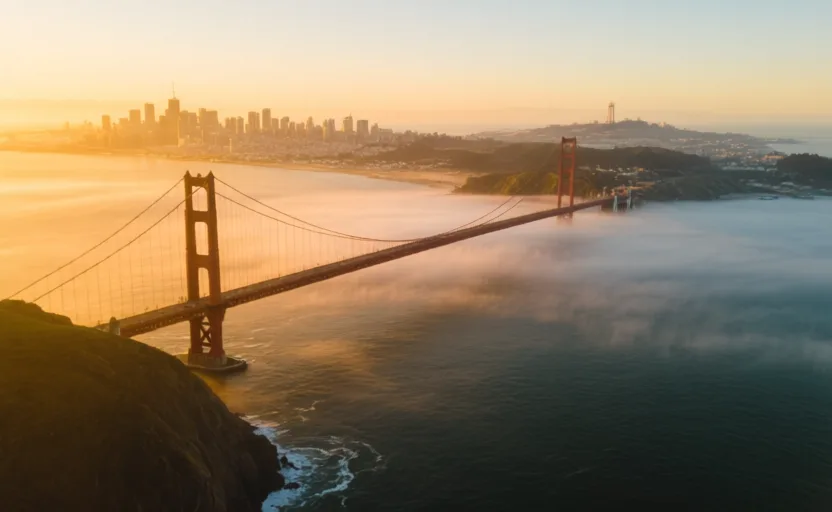 San Francisco · AI city illustration · Artistic impression
City · North America
San Francisco
Saved in this browser — no account needed. Sign in later and it comes with you.
Read its story
Where it is
San Francisco is a hilly city at the tip of a peninsula, with the Pacific on one side and a large bay on the other, and the narrow Golden Gate between them. The city limits, which are the same as the county’s, take in a block of land roughly seven miles by seven plus several islands, among them Alcatraz and Treasure Island, and the Farallon Islands 27 miles offshore. More than fifty hills lie inside the boundaries. Cold Pacific currents and the bay keep it cool and moist: summers here are the coolest of any major American city, and fog is pulled through the Golden Gate when the interior valleys heat up, so that October is often warmer than July.
The land and water around it
The Golden Gate and San Francisco Baystrait
A narrow entrance to a large natural harbour. It made the site strategic for the Spanish, who built a fort on its southern side, and its fog-prone approach kept earlier navigators from finding the bay at all.
The hillshill
More than fifty, including Nob Hill, Russian Hill, Telegraph Hill, Potrero Hill and Twin Peaks. Several neighbourhoods take their names from them, and cable cars climb the steepest.
Yerba Buena Covebay
The original anchorage on the northeast of the peninsula was covered with wharves, ships and then fill, and by 1870 it had become dry land. Lower Market Street stands where water once was.
Its history, in short
Before the Spanish, the peninsula held small villages of the Yelamu, part of the Ohlone linguistic group, who called the site Ahwaste, “place at the bay”. Spanish explorers saw the bay in 1769, after Manila galleons had sailed past it for two centuries without noticing it in the fog and the continuous-looking hills. In 1776 a presidio and a mission were founded, the latter a few miles away; its name, honouring Francis of Assisi, became the city’s. Mexico took over in 1821 and civilian settlement opened in the 1830s, when the missions were secularised. San Francisco was a village of 459 people in 1847. The 1849 gold rush lifted it to 25,000 within two years and left hundreds of abandoned ships rotting in the harbour. Yerba Buena Cove was filled in to make new ground, and buried hulls still turn up under building sites. An earthquake and fire on 18 April 1906 destroyed more than three-quarters of the city, which was rebuilt quickly rather than redesigned. The twentieth century added wartime shipping, the founding of the United Nations in 1945 and the counterculture of the 1960s, and then the technology boom that now defines its economy and housing costs.
Timeline
Dates are shown on a timeline rather than as changing shapes on the map. The globe draws modern boundaries only, and tinting a modern outline to stand for a historical one would state something we cannot source.
First cities & states
c. 3000 BCE
The earliest evidence of habitation
Archaeological finds place people on the peninsula by about 3000 BCE, long before the Yelamu villages that the Spanish met.
Early modern & oceanic
2 November 1769
The Portolá expedition
An overland Spanish party is the first to document San Francisco Bay.
1776
Presidio and Mission
The Presidio of San Francisco and Mission San Francisco de Asís, later known as Mission Dolores, are founded under Spanish rule. Accounts differ on the Presidio’s date.
Approximate dateWikipedia
Industrial & imperial
1847
From Yerba Buena to San Francisco
The alcalde renames the pueblo, whose population is reported to be 459.
Well attestedWikipedia1848–1849
The gold rush
Population rises from 1,000 in 1848 to 25,000 by the end of 1849, as crews desert their ships for the gold fields.
Well attestedWikipedia18 April 1906
Earthquake and fire
Fires from ruptured gas lines burn for days. More than three-quarters of the city is destroyed and more than half of its 400,000 people are made homeless. Contemporary reports of 498 deaths are now thought far too low.
Well attestedWikipedia
Contemporary
1945
The United Nations Charter
The charter is drafted and signed in the city. Fort Mason is at this time the main embarkation point for the Pacific war.
Well attestedWikipedialate 1960s
Counterculture and the Summer of Love
Returning servicemen, immigration, liberalising attitudes, the Beat and hippie scenes and opposition to the Vietnam War combine to make the city a centre of activism and the gay rights movement.
Approximate dateWikipedia
Places that carry meaning
Mission San Francisco de Asís (Mission Dolores)1776
Founded by Padre Francisco Palóu and named for a nearby creek called after Our Lady of Sorrows. It is the namesake of the city.
Portsmouth SquareSpanish and Mexican era
The original plaza of Yerba Buena and the earliest centre of San Francisco, at the northeast of the city between Market Street and the waterfront.
Chinatown19th century onward
Described as the oldest Chinatown in North America, set between Russian Hill and North Beach, the old Italian quarter and former centre of the Beat Generation.
Languages here
Places are usually multilingual. This lists what is actually spoken, not one language per border.
EnglishGermanic family
The dominant language, with the Spanish names of the city and its neighbourhoods built into it.
The city’s name, Spanish for Saint Francis, and Yerba Buena, “good herb”, are reminders of the Spanish and Mexican period.
Chinese languagesSino-Tibetan family
The language of the oldest and largest Asian community.
In 2017 about 40 per cent of the city’s Asian population was Chinese-born. Chinatown is the best-known Chinese district, and Filipino-born residents add another 13.1 per cent of the Asian population.
SpanishRomance family
The language of the Spanish colonisers and of today’s Mexican and Central American communities.
Hispanic and Latino residents are 15.6 per cent of the population, concentrated around the Mission District, where about a fifth of the Mexican-origin population was born in Mexico.
Ohlone languages
The languages of the Yelamu and Ramaytush peoples, once spoken across the peninsula.
The coming of the Spanish missions marked the beginning of the decline of the Ramaytush language and culture. Ohlone speakers were distinct from the Pomo speakers north of the bay.
Learn the language here
- 1Understand which languages are spoken hereSan Francisco is multilingual. Start with which languages are used, by whom, and for what — the phrase list only covers one of them.Written by Globe Quest
- 2Learn 12 phrasesCurated everyday phrases for San Francisco, with audio and a written form.Written by Globe Quest
- 3Say them out loudSpeaking practice with pronunciation feedback, one phrase at a time.Globe Quest material, your own additions
- 4Come back to themSpaced review, so what you learned this week is still there next month.Written by Globe Quest
- 5Read why the language is what it isThe quest for this place covers how its languages got here and who speaks them.Written by Globe Quest
Check yourself
Where does the city’s name come from?
A Spanish mission named for Francis of Assisi
The name comes from Mission San Francisco de Asís, itself named for Saint Francis. The earlier pueblo was called Yerba Buena until it was renamed in 1847.
Why does summer in San Francisco stay cool?
Rising heat inland draws cool, foggy air in through the Golden Gate
Hot air rising in California’s interior valleys pulls cold Pacific air through the Golden Gate, which produces the wind and fog and makes the city’s summers the coolest of any major US city.
Worth arguing about
- Much of the city’s waterfront is landfill over a harbour full of abandoned ships. What does it mean to build a modern financial district on top of a gold-rush anchorage?
- San Francisco rebuilt in 1906 on its old street grid rather than start again. Was speed the right choice over a redesigned city?
What we have not established
These are open questions, listed rather than filled in. We would rather show a gap than a plausible guess.
On what date was the Presidio founded?
The founding is given as 29 June 1776 in one place and 28 March 1776 in another, while the Mission is dated 9 October 1776, so only the year is firm.
How many people live in San Francisco?
The 2020 census counted 873,965, while a 2025 figure is 826,079 and a 2023 estimate 808,988, so the total depends on the year and method used.
Sources
- Wikipedia · San FranciscoWikipedia · encyclopedia · checked 2026-11-24
- Wikipedia · History of San FranciscoWikipedia · encyclopedia · checked 2026-11-24
Reviewed by Globe Quest editorial on 2026-11-24. Drafted with AI assistance and checked against the sources above before publication.