 Globe Quest
 Human Quest · LearningSign in
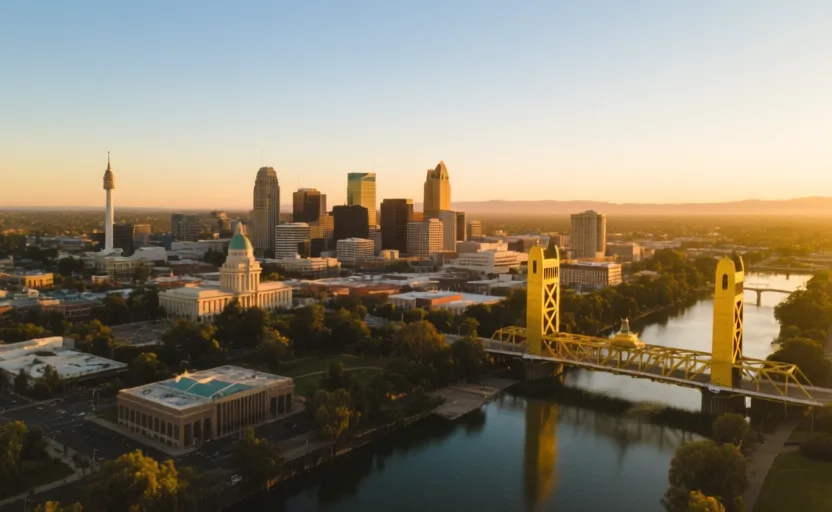 Sacramento · AI city illustration · Artistic impression
City · North America
Sacramento
Saved in this browser — no account needed. Sign in later and it comes with you.
Where it is
Two rivers meet here. The Sacramento comes down the broad floor of the Sacramento Valley and is joined by the American, and the city grew up on the low ground at that junction, with groundwater typically only about 30 feet down. The land is flat, fertile and very easy to flood. The climate is hot-summer Mediterranean, with long dry summers and short mild winters, and most of the year’s rain falls between November and April. Oaks and cottonwoods once lined the banks; the city is still known for its trees.
The land and water around it
The Sacramento and American Riversriver
Sutter’s embarcadero and then the city were built where the American River flows into the Sacramento. The river gave the city its name and its trade, and also its main danger: the early levees were breached in storms more than once.
The Sacramento Valleyvalley
The flat valley floor supported wheat, then fruit once the railroad and refrigeration reached it. Irrigation turned hundreds of thousands of acres of ranch land into orchards in the late 19th century.
A Mediterranean climateclimate
Rain arrives in a short winter season and the summers are dry and hot. In that setting the rivers are both the water supply and the flood threat, which is why the city’s history is so much about levees and grading.
Its history, in short
The Nisenan, Maidu and Plains Miwok lived on this ground for thousands of years, living on acorns, salmon, deer and elk, before a Spanish cavalry officer named the river in 1808. John Sutter, a Swiss-born Mexican citizen, arrived with a land grant in 1839 and built an adobe fort. Then in 1848 gold was found at his sawmill upriver, and his son and Samuel Brannan laid out a city on the riverbank against his wishes. Sacramento became the entry port for the gold fields, the first incorporated city in California in 1850, and the permanent state capital in 1854. Floods nearly destroyed it in 1850 and again in 1861–62, and the city solved the problem by raising its own streets, leaving old ground floors as basements. Four Sacramento businessmen formed the Central Pacific Railroad in 1861, and the railroad companies dominated the city’s politics for decades. Government has long dominated its economy, now joined by healthcare, manufacturing and technology. In 1942 the city also held a temporary camp for Japanese Americans removed from the West Coast.
Timeline
Dates are shown on a timeline rather than as changing shapes on the map. The globe draws modern boundaries only, and tinting a modern outline to stand for a historical one would state something we cannot source.
Industrial & imperial
1808
A Spanish name for the river
Gabriel Moraga surveys the valley and names the river after the Most Holy Sacrament.
1839
Sutter’s New Helvetia
John Sutter arrives with a Mexican land grant of 50,000 acres at the confluence of the two rivers. The next year he builds Sutter’s Fort, an adobe structure with walls 18 feet high.
Well attestedWikipedia1848
Gold, and a city on the waterfront
Gold is found at Sutter’s Mill in Coloma, about 50 miles to the north-east. In December Sutter’s son and Samuel Brannan begin laying out Sacramento City two miles south of the fort, against the older Sutter’s wishes.
Well attestedWikipedia1850
Incorporation and the first flood
The city is incorporated on 27 February, the oldest incorporated city in California. A flood on 10 January almost destroys it, and the levee built in 1852 is breached a month later.
Well attestedWikipedia1854
Permanent state capital
After the city offers its county courthouse to the legislature in 1852, Sacramento becomes the permanent capital in 1854. The new capitol building is finished in 1874.
Well attestedWikipedia1861
The Central Pacific is formed
Four Sacramento businessmen, later called the Big Four, join Theodore Judah to form the Central Pacific Railroad of California. Ground is broken in downtown Sacramento on 8 January 1863.
Well attestedWikipedia1863–1873
Raising the city
After the floods of 1861–62, voters back a high-level grading plan. Earth is dug from a bend near the rivers’ junction and used to lift city blocks; many first floors become basements, now known as the Sacramento Underground.
Well attestedWikipedia1942
An assembly centre for Japanese Americans
From 6 May to 26 June the Sacramento Assembly Center holds 4,739 Japanese Americans removed from the West Coast, before they are moved to Tule Lake.
Well attestedWikipedia
Places that carry meaning
Sutter’s Fort1840s
The adobe fort that began the settlement. The town laid out in 1848 soon eclipsed it, and Sutter’s own ventures eventually failed.
Old Sacramento and the Underground1850s–1870s
Cobbled streets and buildings from the 1850s and 1860s on the waterfront, together with the basements left when the streets were raised.
California State CapitolCompleted 1874
Sits at the end of Capitol Mall, the business district that links downtown with West Sacramento across the river.
Crocker Art MuseumModern
The oldest public art museum in the country west of that great river. It tripled its exhibit space in a 2010 expansion.
Languages here
Places are usually multilingual. This lists what is actually spoken, not one language per border.
EnglishGermanic family
The common language of government and daily life.
About 77% of Americans speak only English at home.
SpanishRomance family
Spoken by the largest minority.
Hispanic and Latino residents made up 28.8% of the city in 2020, most of Mexican heritage in 2010. Spanish is the second most common language in the United States.
ChineseSino-Tibetan family
The language of the city’s largest Asian community.
Among Asian Sacramentans the Chinese community is the biggest, with Filipino, Indian, Vietnamese, Hmong and Japanese communities after it. Chinese is the third most spoken language in the country after English and Spanish.
Learn the language here
- 1Understand which languages are spoken hereSacramento is multilingual. Start with which languages are used, by whom, and for what — the phrase list only covers one of them.Written by Globe Quest
- 2Learn 13 phrasesCurated everyday phrases for Sacramento, with audio and a written form.Written by Globe Quest
- 3Say them out loudSpeaking practice with pronunciation feedback, one phrase at a time.Globe Quest material, your own additions
- 4Come back to themSpaced review, so what you learned this week is still there next month.Written by Globe Quest
Check yourself
Why did Sacramento raise its streets in the 1860s and 1870s?
To protect the city from repeated flooding
After the floods of 1850 and 1861–62 the city lifted whole blocks with earth taken from a bend near the confluence. Ground floors became basements, which survive as the Sacramento Underground.
What is Sacramento’s claim among California cities?
The oldest incorporated city in California
The city was incorporated on 27 February 1850. It became the permanent capital four years later, after offering its courthouse to the legislature.
Worth arguing about
- Sacramento owes its existence to a gold find that ruined the man whose land it stood on. What does that say about who profits from a boom?
- A city that physically lifted itself out of the flood plain is still on that plain. How much should a state capital invest in staying where it is?
What we have not established
These are open questions, listed rather than filled in. We would rather show a gap than a plausible guess.
How many people lived in the valley before the Spanish arrived?
The Nisenan, Maidu, Modoc and Plains Miwok left little physical evidence, and no count of their numbers is recorded, so the pre-contact population cannot be stated.
Sources
- Wikipedia · Sacramento, CaliforniaWikipedia · encyclopedia · checked 2026-11-24
- Wikipedia · History of Sacramento, CaliforniaWikipedia · encyclopedia · checked 2026-11-24
- Wikipedia · Languages of the United StatesWikipedia · encyclopedia · checked 2026-11-24
Reviewed by Globe Quest editorial on 2026-11-24. Drafted with AI assistance and checked against the sources above before publication.