 Globe Quest
 Human Quest · LearningSign in
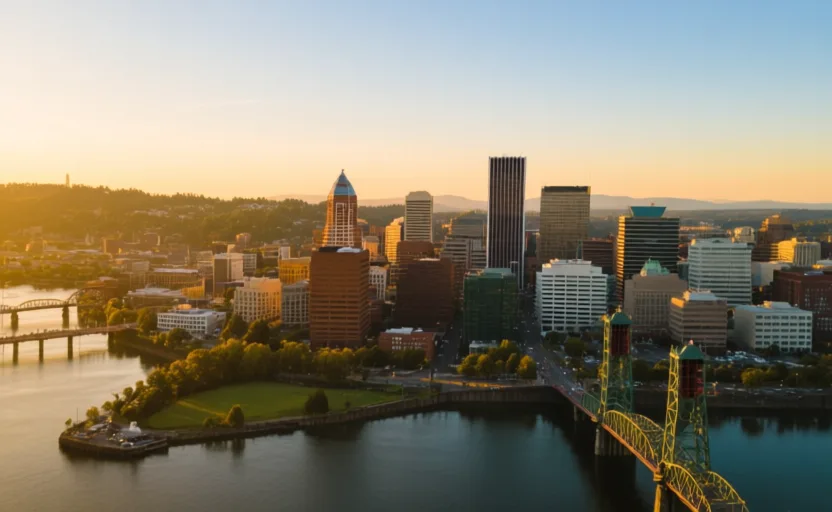 Portland · AI city illustration · Artistic impression
City · North America
Portland
Saved in this browser — no account needed. Sign in later and it comes with you.
Where it is
An ocean port that sits 100 miles from the ocean, Portland stands on the Willamette River less than ten miles above its meeting with the Columbia. The Columbia, the fourth-largest river in the country, divides Oregon from Washington here, and the Willamette flows north through the middle of the city and splits east from west. The city lies at the northern end of the Willamette Valley, about 60 miles east of the Pacific. Under it is a dormant volcanic field with at least 32 cinder cones, including Mount Tabor, and shallow active faults cross the metropolitan area. Winters are cool, cloudy and rainy; summers are warm and dry.
The land and water around it
The Willamette and Columbia confluenceriver
The Willamette separates the east and west sides, and the two rivers join less than ten miles downstream of downtown. Deep water at the clearing, noticed by a sea captain around 1840, gave the site its advantage over Oregon City upstream.
The Missoula floodsvalley
Glacial dams failed in what is now Montana during the last ice age, and the floods filled the Willamette Valley with hundreds of feet of water, shaping the basin where the city stands.
The Boring Lava Fieldvolcano
A dormant volcanic field with at least 32 cinder cones lies beneath the city, centred in the southeast. Mount Tabor is one of its cones, and the Portland Hills Fault runs along the west side.
Its history, in short
Ice-age floods from the collapse of glacial dams at Lake Missoula once covered the valley in hundreds of feet of water. Afterwards, Chinookan peoples, among them the Multnomah on and around Sauvie Island, fished, traded and gathered wapato in one of the most densely populated parts of the Pacific coast, until smallpox and malaria thinned them. American settlers arrived by the Oregon Trail in the 1840s, and a clearing on the west bank, halfway between Oregon City and Fort Vancouver, was claimed in 1843 and named by a coin toss. Portland’s edge over its older rival Oregon City was a river deep enough for ocean-going ships. It was the major port in the Northwest through most of the nineteenth century, until railroads gave Seattle a direct route east. In 1891 it absorbed the neighbouring cities of Albina and East Portland. In the Second World War shipyards drew thousands of workers, including Black migrants, and the city served as an assembly centre for people of Japanese descent sent to internment camps.
Timeline
Dates are shown on a timeline rather than as changing shapes on the map. The globe draws modern boundaries only, and tinting a modern outline to stand for a historical one would state something we cannot source.
Industrial & imperial
1805
Lewis and Clark record the Chinook
Meriwether Lewis and William Clark document the Chinook people of the lower Columbia, whose basin was among the most densely settled on the coast.
Well attestedWikipedia1843
A claim at The Clearing
William Overton and Asa Lovejoy file a 640-acre claim covering a stopping place on the west bank, known to travellers as The Clearing or Stumptown.
1844–1845
Named by coin toss
Francis Pettygrove and Lovejoy each want to name the town for their home town, Portland, Maine and Boston respectively. Pettygrove wins the toss. Accounts differ on whether this happened in 1844 or 1845.
8 February 1851
Incorporation
The new city counts 821 people at the 1850 census, and it already has a steam sawmill, a hotel, a weekly newspaper and the biggest population in the Pacific Northwest.
August 1873
Downtown fire
A fire destroys twenty blocks on the west side along Yamhill and Morrison Streets, causing $1.3 million in damage.
Well attestedWikipedia1891
Three cities become one
Portland, Albina and East Portland merge, which leaves inconsistent street names and addresses across the east and west banks.
1905
Lewis and Clark Centennial Exposition
The world’s fair raises the city’s profile, and the population grows from about 90,000 in 1900 to about 207,000 in 1910.
Well attestedWikipediaMay–September 1942
Assembly centre
Up to 3,676 people of Japanese descent from Portland, northern Oregon and central Washington are processed at the Pacific International Livestock Exposition before being sent to internment camps. It was the first American city to do so.
Well attestedWikipedia
Places that carry meaning
The Willamette bridges1910–1913 and later
The Hawthorne (1910), Steel (1912) and Broadway (1913) bridges are each over a century old and gave Portland the nickname Bridgetown. The first steel bridge on the West Coast opened here in 1888.
Mount TaborVolcanic
A cinder cone in the Boring Lava Field in southeast Portland, one of the dormant volcanic features that lie within the city.
The Pearl DistrictEarly to late 20th century
A neighbourhood of warehouses, light industry and railroad classification yards in northwest Portland through the middle of the twentieth century, now filled with galleries, restaurants and shops.
Languages here
Places are usually multilingual. This lists what is actually spoken, not one language per border.
EnglishGermanic family
The shared language of the city.
The population has long been overwhelmingly white and English-speaking: whites were over 98 per cent of the city in 1940, and non-Hispanic whites were still about 66 per cent in 2020.
SpanishRomance family
The main language after English.
Hispanic and Latino residents were about 9 per cent of the city in 2010. Spanish is the second most spoken language in the country, used at home by 14 per cent of residents.
Chinookan languages
The languages of the Multnomah, Clackamas and Cascades peoples.
The Upper Chinook bands who lived here before settlement were first documented in 1805. Smallpox and malaria destroyed much of the old settlement pattern after contact with Europeans.
Learn the language here
- 1Understand which languages are spoken herePortland is multilingual. Start with which languages are used, by whom, and for what — the phrase list only covers one of them.Written by Globe Quest
- 2Learn 11 phrasesCurated everyday phrases for Portland, with audio and a written form.Written by Globe Quest
- 3Say them out loudSpeaking practice with pronunciation feedback, one phrase at a time.Globe Quest material, your own additions
- 4Come back to themSpaced review, so what you learned this week is still there next month.Written by Globe Quest
Check yourself
How did Portland get its name?
A coin toss between two founders from Portland, Maine and Boston
Francis Pettygrove, from Portland, Maine, won two out of three tosses against Asa Lovejoy of Boston. The coin is kept at the Oregon Historical Society.
What gave Portland an advantage over older Oregon City?
Its position on a river deep enough for ocean-going ships
Oregon City lay at Willamette Falls, but Portland sat at the confluence with the Columbia and could take deep-draft vessels.
Worth arguing about
- Portland was the Northwest’s main port until railroads reached Seattle’s deepwater harbour. How much of a city’s fate comes down to a single route?
- The city is built on volcanic fields, fault lines and flood plains, and its urban growth boundary limits sprawl. Does a hard edge make a city more resilient or only more expensive?
What we have not established
These are open questions, listed rather than filled in. We would rather show a gap than a plausible guess.
When was Portland named?
Accounts date the coin toss to 1844, the year Pettygrove bought his share, and to 1845, so the exact year the town received its name remains uncertain.
Sources
- Wikipedia · Portland, OregonWikipedia · encyclopedia · checked 2026-11-24
- Wikipedia · History of Portland, OregonWikipedia · encyclopedia · checked 2026-11-24
- Wikipedia · Languages of the United StatesWikipedia · encyclopedia · checked 2026-11-24
Reviewed by Globe Quest editorial on 2026-11-24. Drafted with AI assistance and checked against the sources above before publication.