 Globe Quest
 Human Quest · LearningSign in
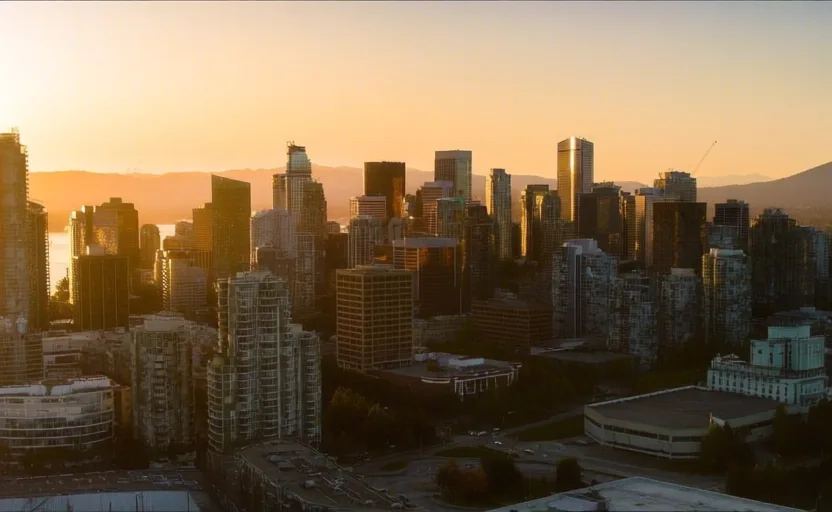 Vancouver · AI city illustration · Artistic impression
City · North America
Vancouver
Saved in this browser — no account needed. Sign in later and it comes with you.
Where it is
Vancouver fills the Burrard Peninsula, with Burrard Inlet on the north and the mouth of the Fraser River on the south. The Strait of Georgia lies to the west, shielded from the open Pacific by Vancouver Island, while the North Shore Mountains rise behind the inlet and, on clear days, the volcano of Mount Baker shows to the southeast. The land was once temperate rainforest of Douglas fir, western red cedar and hemlock, among the largest trees on the British Columbia coast. The climate is oceanic and the mildest in Canada: summers are cool and dry, winters wet, and rainfall climbs from about 1,190 mm at the airport to over 2,000 mm on the North Shore.
The land and water around it
Burrard Inlet and the harbourharbour
A natural deep-water harbour, chosen by the railway for its terminus, made Vancouver a link between Asia-Pacific trade and the rest of Canada. The Port of Vancouver is now the largest and most diversified port in the country.
The Fraser River mouthdelta
The Musqueam have lived at their winter village at the Fraser's mouth for about 4,000 years. The river also pulled the 1858 gold rush to New Westminster, upstream, and so bypassed the future city for a generation.
The coastal rainforestforest
Douglas fir, red cedar and hemlock once covered the peninsula, wet even on high ground because of poor drainage. Stanley Park's forest was logged between the 1860s and 1880s, and the cut trees became masts for sailing ships and the Royal Navy.
Its history, in short
The Musqueam, Squamish and Tsleil-Waututh have lived on this shore for thousands of years, with villages at Stanley Park, False Creek, Point Grey and the Fraser's mouth. Spanish and British ships surveyed the coast in 1791 and 1792, but Europeans did not settle until the 1860s, when sawmills on Burrard Inlet began cutting the giant trees. A tavern opened by John Deighton, known as Gassy Jack, in 1867 gave Gastown its name, and the townsite was surveyed as Granville in 1870. When the Canadian Pacific Railway chose it as its western terminus in 1884, the railway's president gave the city its present name. It was incorporated in 1886, razed by fire two months later, rebuilt with modern water, electricity and streetcars, and reached by the first transcontinental trains in 1887. Chinese settlers came after the railway, and later waves came from Europe, East Asia and elsewhere, including many from Hong Kong. Japanese Canadians were interned from the coast in 1942. Forestry gave way to the port, tourism and film as the main industries, and expensive housing has become the city's defining problem.
Timeline
Dates are shown on a timeline rather than as changing shapes on the map. The globe draws modern boundaries only, and tinting a modern outline to stand for a historical one would state something we cannot source.
First cities & states
8,000–10,000 years ago
First settlement
People settle the Lower Mainland as the ice-age glaciers retreat, and an encampment at the Glenrose Cannery site near the Fraser's mouth dates from this time.
Approximate dateWikipedia
Early modern & oceanic
1791–1792
Spanish and British surveys
The Spanish captain José María Narváez explores the Strait of Georgia in 1791, and George Vancouver surveys Burrard Inlet in 1792, where the two expeditions meet. The city is later named for him.
Industrial & imperial
1867
Hastings Mill and Gassy Jack
Edward Stamp relocates his sawmill to the south shore of the inlet, and John Deighton opens a saloon just beyond it. The settlement that grows around them is known as Gastown.
1884
The railway terminus
The Canadian Pacific Railway picks the site over rival bids from Port Moody, New Westminster and Victoria. A terminus was a condition of British Columbia joining Confederation.
1886
Incorporation and fire
The city is incorporated on 6 April and given the name Vancouver by the railway's president, William Van Horne. On 13 June the Great Vancouver Fire destroys most of it within 25 minutes, and it is rebuilt quickly.
1942
Internment of Japanese Canadians
Under the War Measures Act, residents of Japanese descent are held in Hastings Park and then sent to camps in the interior. The government acted amid public demands for their removal and fears of espionage.
Well attestedWikipedia
Contemporary
1986
Expo 86
The world's fair is one of a series of international events, from the 1954 Commonwealth Games to the 2010 Winter Olympics, that put the city on the global map.
Well attestedWikipedia2010
The Winter Olympics
Vancouver and Whistler host the Olympic and Paralympic Games. The same period sees the housing crisis worsen, with the average sale price peaking at $2,847,000 in 2024.
Places that carry meaning
Gastown1867 onward
The district around the site of Gassy Jack's saloon. The steam clock marks the original location, and the area's name outlived the official name Granville.
Stanley Park and X̱wáýx̱wayLong before 1860s logging
At 404.9 hectares it is among North America's largest urban parks. X̱wáýx̱way, a large Coast Salish village, stood in what is now the park near Lumberman's Arch, and the old-growth forest was logged from the 1860s to the 1880s.
The Port of VancouverSince the railway
Canada's busiest port, trading with more than 160 economies. It sits at the end of transcontinental rail and highway routes and ties the interior to Asia.
Languages here
Places are usually multilingual. This lists what is actually spoken, not one language per border.
EnglishGermanic family
The common language of the city.
About 94 percent of residents know English, but 49.3 percent were not raised speaking it, and 47.8 percent grew up with neither English nor French as a mother tongue.
Cantonese and MandarinSino-Tibetan family
The most widely known languages after English.
In the 2021 census about 14.9 percent of residents knew Cantonese and 11.5 percent knew Mandarin. Chinese settlers came after the railway, and later many wealthy migrants from Hong Kong arrived as the transfer of sovereignty approached.
Tagalog, Punjabi and other immigrant languages
Spoken across the city's neighbourhoods.
Tagalog is known to 4.7 percent of residents and Punjabi to 2.9 percent, followed by Hindi, Vietnamese, Persian languages, Japanese, German and Korean. French is known to 9.4 percent.
Halkomelem and SquamishSalishan family
The Coast Salish languages of the host nations.
The Musqueam and Tsleil-Waututh historically spoke the Downriver dialect of Halkomelem, and the Squamish speak a related but separate language. The Squamish name K'emk'emeláy̓, place of many maple trees, appears on road signs along the Sea to Sky Highway.
Learn the language here
- 1Understand which languages are spoken hereVancouver is multilingual. Start with which languages are used, by whom, and for what — the phrase list only covers one of them.Written by Globe Quest
- 2Learn 11 phrasesCurated everyday phrases for Vancouver, with audio and a written form.Written by Globe Quest
- 3Say them out loudSpeaking practice with pronunciation feedback, one phrase at a time.Globe Quest material, your own additions
- 4Come back to themSpaced review, so what you learned this week is still there next month.Written by Globe Quest
Check yourself
Why did the Canadian Pacific Railway choose this site for its terminus?
It had a natural harbour on the Pacific
The site offered a deep natural harbour, and a Pacific terminus was a condition of British Columbia joining Confederation in 1871. Port Moody, New Westminster and Victoria had all hoped to be chosen.
What does K'emk'emeláy̓, the Squamish name for part of the city, mean?
Place of many maple trees
It was the name of a village where the first sawmill on the south side of the inlet was built, and it now appears in Squamish on road signage along the Sea to Sky Highway.
Worth arguing about
- Vancouverism favours towers and density over sprawl, yet the city has some of the most expensive housing in the world. Can a planning philosophy that works on paper deliver affordability?
- The Squamish, Musqueam and Tsleil-Waututh each had their own names for this shore, and the settler name was borrowed from an island. Which names should a city use in public?
What we have not established
These are open questions, listed rather than filled in. We would rather show a gap than a plausible guess.
In what year did the settlement take the name Vancouver?
One account says the CPR gave the city its name in 1886, as it was incorporated, while another says the name was given in 1885. The surviving summaries do not settle which applies.
How many people live in Vancouver?
The 2021 census counted 662,248 in the city, about 2.6 million in Greater Vancouver and over 3 million in the Lower Mainland. The figure depends on the boundary used.
Sources
- Wikipedia · VancouverWikipedia · encyclopedia · checked 2026-11-24
- Wikipedia · History of VancouverWikipedia · encyclopedia · checked 2026-11-24
Reviewed by Globe Quest editorial on 2026-11-24. Drafted with AI assistance and checked against the sources above before publication.