 Globe Quest
 Human Quest · LearningSign in
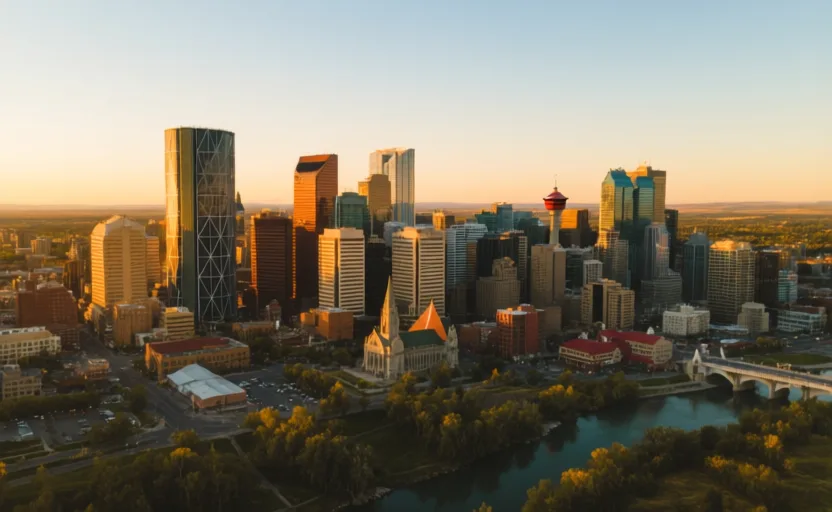 Calgary · AI city illustration · Artistic impression
City · North America
Calgary
Saved in this browser — no account needed. Sign in later and it comes with you.
Where it is
Calgary stands at the point where the Bow River, running down from the west, meets the Elbow River coming up from the south, about 1,040 metres above sea level. It is the hinge between the foothills of the Rockies, which begin some 80 km to the west, and the open prairie that runs east. The setting is dry and swings widely: winters are long and cold but broken by warm chinook winds, July averages about 17 °C, and the record low is -45 °C. The surrounding grassland edges into the semi-arid Palliser's Triangle, and the border with the United States lies about 240 km south.
The land and water around it
The Bow and Elbow riversriver
The Bow flows from west to south through the city and the Elbow comes up from the south to join it near the site of Fort Calgary. The sharp bend of the two rivers is what the Blackfoot, Nakoda, Cree and Tsuutʼina names all mean: elbow.
The foothills and prairie transitionplain
The city sits where Parkland and Grassland natural regions meet, in the transition between the Rocky Mountain foothills and the Canadian Prairies. The Rocky Mountain Douglas-fir reaches near its eastern limit here, which shows how quickly the mountain landscape gives way to grass.
Chinook winds and the dry beltclimate
Calgary lies at the edge of Palliser's Triangle, a cold semi-arid steppe, and gets warm, wet summers and cold, dry winters. Chinook winds bring sudden thaws in winter, so temperatures swing wildly from week to week.
Its history, in short
People have lived around the rivers for at least 11,000 years, and the area belongs to the Niitsitapi (Blackfoot Confederacy), the Nakoda and the Tsuutʼina, as well as Métis districts. The surveyor David Thompson wintered with a Peigan band on the Bow in 1787, the first European known to have come. A North-West Mounted Police post was set up in the mid-1870s and named Fort Calgary, after Calgary Castle on the Isle of Mull. Treaty 7, signed in 1877, ceded the land around the fort to the Crown, and the Canadian Pacific Railway arrived in 1883, turning the post into a railway and ranching town. It became a town in 1884 and a city in 1894. The Stampede, begun in 1912, grew out of a federally funded exhibition in 1908. Calgary's second identity came from oil: a discovery well at Turner Valley in 1914 began the age of oil and gas, and the boom of the 1970s took the population from 330,575 in 1966 to 636,107 in 1986. The city hosted the Winter Olympics in 1988, and when the Canadian Pacific Railway moved its head office there in 1996 it showed how far the centre of corporate Canada had shifted west.
Timeline
Dates are shown on a timeline rather than as changing shapes on the map. The globe draws modern boundaries only, and tinting a modern outline to stand for a historical one would state something we cannot source.
Early modern & oceanic
1787
David Thompson winters on the Bow
The cartographer spends the winter with a band of Peigan camped along the river. He is the first recorded European visitor to the area.
Well attestedWikipedia
Industrial & imperial
1877
Treaty 7
Treaty 7 is signed with the First Nations of southern Alberta, and title to the Fort Calgary area passes to the Crown.
Well attestedWikipedia1883
The railway arrives
The Canadian Pacific Railway reaches the area and builds a station. Calgary is incorporated as a town the following year and elects George Murdoch as first mayor.
Well attestedWikipedia1894
City status
The City of Calgary is incorporated, while the surrounding land is still part of the North-West Territories. Alberta becomes a province in 1905, with Edmonton as its capital.
14 May 1914
The Turner Valley discovery well
A well southwest of the city comes in and starts speculation. Later, flared gas from the field lights Calgary's streets at night.
Contemporary
1966–1986
The oil boom
After the 1970s energy crisis, investment pours in and the population nearly doubles, from 330,575 to 636,107. By 1981 a larger share of the labour force than the national average worked in management, administrative or clerical jobs.
Well attestedWikipedia1988
Winter Olympics
Calgary is the first Canadian city to host the Winter Games. Organisers sold memberships to 80,000 residents to build support, wary of the debt Montreal ran up after 1976.
2013
The southern Alberta flood
Flooding across the region forces the evacuation of 75,000 Calgarians, a reminder that a city built at the meeting of two mountain-fed rivers is exposed to both.
Well attestedWikipedia
Places that carry meaning
Fort Calgary1870s
The police post at the meeting of the Bow and the Elbow, where the city began. It is now a historic site beside downtown.
Stephen AvenueDesignated 1992
The retail street at the heart of the downtown commercial core, designated a National Historic Site of Canada in 1992.
The Stampede grounds1908–1912
For the federally funded Dominion Exhibition of 1908 the city built six pavilions and a racetrack, with a rodeo and a parade, and the first Stampede followed in 1912. It has been held every year since 1923.
Languages here
Places are usually multilingual. This lists what is actually spoken, not one language per border.
EnglishGermanic family
The everyday language of the city and the official language of Alberta.
English dominates daily life, and Alberta's government works almost entirely in it. French is also an official language of debate in the legislature, but the bureaucracy functions almost solely in English.
Blackfoot, Nakoda, Cree and Tsuutʼina
The languages of the nations of Treaty 7.
Each calls the place by its own word: Mohkínstsis in Blackfoot (Siksiká), Wîchîspa Oyade in Nakoda, otôskwanihk in Cree, Guts’ists’i in Tsuutʼina, all meaning elbow. Local colleges and universities use the Blackfoot name in their territorial acknowledgements.
Immigrant languages
Spoken by the third of residents born abroad.
About 33 percent of Calgarians are immigrants, led by people from the Philippines, India, China, the United Kingdom, Pakistan and Vietnam. South Asians are the largest visible-minority group, followed by Chinese and Filipino Canadians.
Learn the language here
- 1Understand which languages are spoken hereCalgary is multilingual. Start with which languages are used, by whom, and for what — the phrase list only covers one of them.Written by Globe Quest
- 2Learn 11 phrasesCurated everyday phrases for Calgary, with audio and a written form.Written by Globe Quest
- 3Say them out loudSpeaking practice with pronunciation feedback, one phrase at a time.Globe Quest material, your own additions
- 4Come back to themSpaced review, so what you learned this week is still there next month.Written by Globe Quest
Check yourself
What do the Blackfoot, Nakoda, Cree and Tsuutʼina names for Calgary have in common?
They all mean elbow, after the bend where the two rivers meet
The Bow and Elbow rivers meet at a sharp bend, and each nation's name for the place picks out that feature, which is older than the Scottish name the police gave the fort.
What marked the beginning of Calgary's oil and gas age?
The Turner Valley discovery well in 1914
The well southwest of the city started oil speculation long before the 1970s boom, and flared gas from the field lit the sky over Calgary at night.
Worth arguing about
- In 2017 the Stoney Nakoda applied to rename Calgary Wichispa Oyade, and the Piikani Blackfoot objected. Who has the standing to name a place that several nations call home?
- Calgary has been tied to oil and gas since 1914, and the energy sector is still its largest contributor to GDP even as the city diversifies. How does a city reinvent itself when its founding wealth is also its risk?
What we have not established
These are open questions, listed rather than filled in. We would rather show a gap than a plausible guess.
When did Fort Brisebois become Fort Calgary?
One account has Colonel James Macleod renaming the post in 1875, another says he proposed the name in 1876 after returning to Canada. The surviving summaries do not settle which year the name took effect.
What should the city be called in Indigenous languages?
The Stoney Nakoda proposal of 2017 for Wichispa Oyade was challenged by the Piikani Blackfoot, and Mohkínstsis is the form used in many official acknowledgements. There is no agreed single name, and the matter is not decided by the sources consulted.
Sources
- Wikipedia · CalgaryWikipedia · encyclopedia · checked 2026-11-24
- Wikipedia · Timeline of Calgary historyWikipedia · encyclopedia · checked 2026-11-24
- Wikipedia · Languages of CanadaWikipedia · encyclopedia · checked 2026-11-24
Reviewed by Globe Quest editorial on 2026-11-24. Drafted with AI assistance and checked against the sources above before publication.