 Globe Quest
 Human Quest · LearningSign in
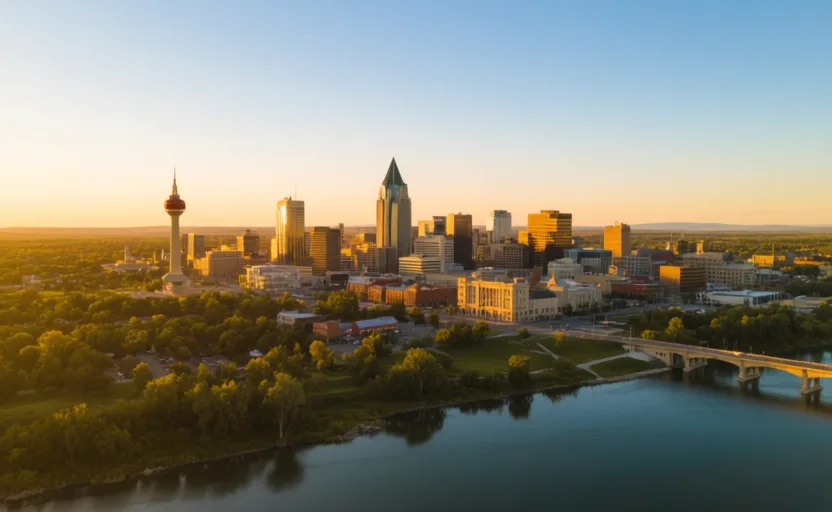 Saskatoon · AI city illustration · Artistic impression
City · North America
Saskatoon
Saved in this browser — no account needed. Sign in later and it comes with you.
Where it is
Saskatoon sits on both banks of the South Saskatchewan River, where it bends through the middle of the province, on a belt of rich chernozem soil where the aspen parkland begins to thin toward open prairie. With no mountains nearby, the city spreads over a nearly flat grid that the river divides into east and west sides, joined by nine bridges. The climate is borderline between cold semi-arid and humid continental: warm summers, long cold winters, only about 350 millimetres of precipitation a year and well over 2,000 hours of bright sun. The record low is −50 °C, set in 1893, and the record high is 41.5 °C in 1988.
The land and water around it
The South Saskatchewan Riverriver
The river splits the city, and its banks are protected as parkland by the Meewasin Valley Authority. Crossing it has driven the city’s history, from the rail bridge that collapsed in 1904 to the Traffic Bridge of 1907 that joined Nutana to the west side.
Chernozem and parklandplain
A long belt of dark, potassium-rich soil under aspen parkland. It is the reason wheat farming surrounds the city, and the region holds close to 65 per cent of the world’s recoverable potash.
Hudson Bay Sloughmarsh
A relic of a glacier-formed water body that once dominated the north of the city. Industrial development drained most of it, but remnants survive at RCAF Memorial Park and in the Hudson Bay Industrial area.
Its history, in short
People have used this stretch of river for some 6,000 years; the winter camps at Tipperary Creek and the excavations at Wanuskewin show it. In 1876 First Nations signed Treaty 6, handing the surrounding lands to the Crown. The city itself began as an idea of Toronto Methodists, the Temperance Colonization Society, who wanted a “dry” prairie colony and got a land grant in 1882. Settlers led by John Neilson Lake arrived the next year, though the temperance plan soon failed when the group could not get a large block of land. The railway reached the river in 1890, and a boom followed when the Grand Trunk Pacific and Canadian Pacific both chose Saskatoon as a divisional centre and built bridges by 1907. The University of Saskatchewan was sited here in the same year. Three separate communities, Saskatoon, Nutana and Riversdale, united as a city in 1906 with about 4,500 people. In the 1940s it was an air training centre and a regional distribution hub, and today its economy rests on potash, oil, agriculture and uranium.
Timeline
Dates are shown on a timeline rather than as changing shapes on the map. The globe draws modern boundaries only, and tinting a modern outline to stand for a historical one would state something we cannot source.
First cities & states
about 6,000 years ago
The oldest traces of occupation
Stratified remains at Tipperary Creek, near the city, show that Indigenous peoples wintered here, and Wanuskewin Heritage Park preserves a long record of use.
Industrial & imperial
1876
Treaty 6
The lands that include the future city pass to the Crown under the treaty.
Well attestedWikipedia1882–1883
The temperance colony
The Temperance Colonization Society is granted land in 1882 and settlers led by John Neilson Lake arrive in 1883, travelling by rail to Moose Jaw and then by cart. Its founding year is counted as 1882.
1885
The North-West Rebellion
Chief Whitecap and Charles Trottier cross the future university campus to join Louis Riel’s forces at Batoche. Wounded Canadian soldiers are afterwards nursed in the Marr Residence.
Well attestedWikipedia1890
The railway arrives
The Qu’Appelle, Long Lake and Saskatchewan Railway reaches Saskatoon and crosses the river, setting off a boom on the west side.
Well attestedWikipedia1906
City status
Saskatoon, Nutana and Riversdale combine as a city of 4,500 people.
7 April 1907
The university
The University of Saskatchewan’s board chooses Saskatoon over Regina, Prince Albert, Moose Jaw and other candidates. Three bridges open the same year.
Well attestedWikipedia
Places that carry meaning
Wanuskewin Heritage Parkabout 6,000 years of First Nations history
A National Historic Site in the rural municipality around the city, a candidate for World Heritage listing, where ongoing archaeology records millennia of Indigenous presence.
Nutana1903 onward
The original townsite, renamed Nutana in 1903 when the west side took the Saskatoon name. It later united with Riversdale and Saskatoon to form the city.
Delta Bessborough Hotel1932–1935
Known as the Bez, a railway hotel built by Canadian National and one of the last begun before the Depression ended the era of railway hotels. It was finished in 1932 and did not open until 1935.
Languages here
Places are usually multilingual. This lists what is actually spoken, not one language per border.
EnglishGermanic family
The main language of daily life and work.
English is the language of the large majority, and Canada’s official-language policies also give federal services in French.
CreeAlgonquian family
The Indigenous language that gave the city its name.
Saskatoon comes from the Cree word for the saskatoon berry, misâskwatômina, and Cree remains a language of the city’s First Nations residents, who are mostly of Cree or Dakota background. About 11.5 per cent of the population is Indigenous.
Dakota and other Indigenous languages
Spoken by Dakota, Saulteaux, Assiniboine and Dene communities.
Dakota is the second major First Nations cultural presence, with smaller Saulteaux, Assiniboine and Dene communities and a substantial Métis population.
Immigrant languages
Brought by newer communities, led by arrivals from the Philippines.
About 20 per cent of residents are immigrants. The leading origins are the Philippines (22.3 per cent of immigrants), India, China, Pakistan, Nigeria, the United Kingdom and Bangladesh, so the languages of those countries are part of the city’s daily mix alongside English.
Learn the language here
- 1Understand which languages are spoken hereSaskatoon is multilingual. Start with which languages are used, by whom, and for what — the phrase list only covers one of them.Written by Globe Quest
- 2Learn 13 phrasesCurated everyday phrases for Saskatoon, with audio and a written form.Written by Globe Quest
- 3Say them out loudSpeaking practice with pronunciation feedback, one phrase at a time.Globe Quest material, your own additions
- 4Come back to themSpaced review, so what you learned this week is still there next month.Written by Globe Quest
Check yourself
Where does the name Saskatoon come from?
A Cree word for the saskatoon berry
The name comes from the Cree misâskwatômina, the sweet violet berry that grows in the area. Its exact route to the settlement is unclear, and one theory is that it came from an older Cree name meaning “where willows are cut”.
Why did Saskatoon become a railway divisional centre by 1907?
Its board of trade pressed Ottawa on a river crossing
After a rail bridge collapsed in 1904, the Board of Trade sent delegates to Ottawa to argue for the crossing. Both the Canadian Pacific and the Grand Trunk Pacific then picked Saskatoon and built bridges by 1907.
Worth arguing about
- A city founded as a temperance colony became a prairie rail hub and then a potash and uranium centre. What stays of the founders’ ideals?
- Saskatoon’s First Nations population grew by 382 per cent between 1981 and 2001, though part of that was more people identifying themselves in the census. What does that growth demand of a city?
What we have not established
These are open questions, listed rather than filled in. We would rather show a gap than a plausible guess.
Is Saskatoon’s founding year 1882 or 1883?
The temperance society received its land in 1882, which the city counts as its founding year (its centennial was in 1982), but the first settlers did not arrive until 1883. How the name itself came about is also uncertain, with the founder’s “Arise Saskatoon” story contradicted by an earlier Cree place name.
Sources
- Wikipedia · SaskatoonWikipedia · encyclopedia · checked 2026-11-24
- Wikipedia · History of SaskatoonWikipedia · encyclopedia · checked 2026-11-24
- Wikipedia · CanadaWikipedia · encyclopedia · checked 2026-11-24
Reviewed by Globe Quest editorial on 2026-11-24. Drafted with AI assistance and checked against the sources above before publication.