 Globe Quest
 Human Quest · LearningSign in
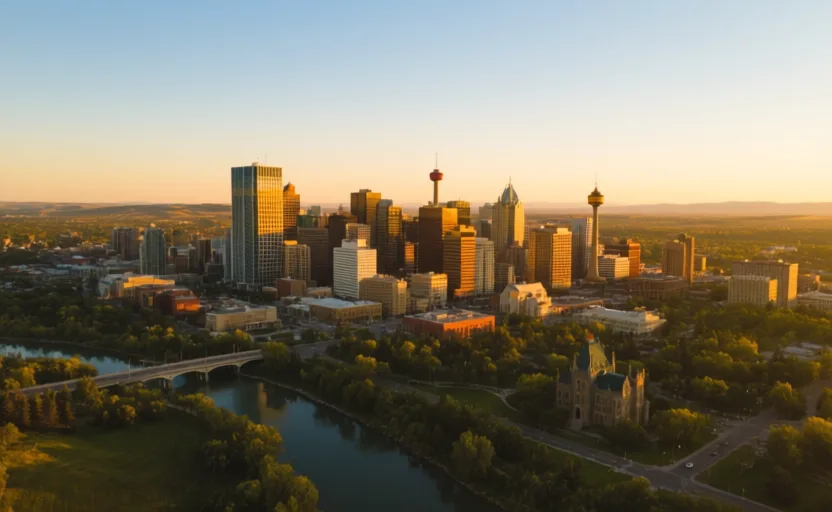 Edmonton · AI city illustration · Artistic impression
City · North America
Edmonton
Saved in this browser — no account needed. Sign in later and it comes with you.
Where it is
The North Saskatchewan River divides Edmonton in two, flowing through a deep valley across country that is otherwise flat or gently rolling. The river starts at the Columbia Icefield in the Rockies, which lie about 220 km to the southwest, and eventually reaches Hudson Bay through Lake Winnipeg and the Nelson River. At about 671 metres above sea level, the city has the cold, dry winters and warm, sunny summers of the northern prairies, with 17 hours of daylight at midsummer and one of the longest growing seasons on the plains. No other city in North America this far north has a million people.
The land and water around it
The North Saskatchewan River valleyvalley
A deep river valley, with ravines running into it, cuts through the middle of the city. The river brought fish, stone for tools and an early trade route, but it also floods: it forced the fort to move in 1830, and a major flood struck the valley again in 1915.
The prairie parklandplain
Flat to gently rolling country surrounds the city, and its growing season is one of the longest on the Canadian Prairies. Chert and quartzite for making tools are abundant around it.
The Old North Trailvalley
An ancient north-south route passed through what are now the Old Strathcona and Rossdale districts, stretching from the northern tundra country down to Mexico.
Its history, in short
Cree, Nakota, Blackfoot, Tsuut'ina, Ojibwe and Denesuline peoples all used this stretch of river, and the Cree name for the place means Beaver Hills House. Rival fur-trading forts, one for the North West Company and one for the Hudson's Bay Company, were built here in 1795 and moved several times before settling at Rossdale in 1813. The two firms merged in 1821, leaving the single Fort Edmonton, which was moved to higher ground after a flood in 1830. The land was ceded in Treaty 6 in 1876, and a railway reached the south bank in 1891, so the rival town of Strathcona grew up there while Edmonton stayed on the north side. Edmonton became a city in 1904 and the capital of the new province a year later, with only about 5,000 people, and it absorbed Strathcona in 1912. The city fell back sharply after the land boom ended before the First World War. Its role as a northern gateway grew with the first licensed airfield in Canada in 1926 and with the building of the Alaska Highway. After the Leduc oil discovery of 1947, oil made Edmonton the base of Alberta's petroleum industry, and the booms and busts that followed set the pace of its growth.
Timeline
Dates are shown on a timeline rather than as changing shapes on the map. The globe draws modern boundaries only, and tinting a modern outline to stand for a historical one would state something we cannot source.
Early modern & oceanic
1795
Two rival forts
The North West Company builds Fort Augustus and the Hudson's Bay Company builds Edmonton House within musket range of it. Falling beaver catches and firewood force both to move upstream.
Industrial & imperial
1813
Fort Edmonton at Rossdale
After several moves, the fort is re-established at Rossdale, on land disputed between the Blackfoot and Cree. The 1821 merger of the two companies later closes Fort Augustus.
1876
Treaty 6
The Crown and the Plains and Woods Cree, Assiniboine and other First Nations sign a treaty covering most of central Saskatchewan and Alberta, including Edmonton.
1891
The railway stops on the south bank
The Calgary and Edmonton Railway is finished but does not cross the river. A railway townsite, Strathcona, grows on the south side as a rival to Edmonton.
1905
Provincial capital
A year after becoming a city, Edmonton is made the capital of the new province of Alberta, with a population of only around 5,000.
1912
Amalgamation with Strathcona
The two cities merge, and Edmonton extends south of the river. The land boom that fed the merger collapses before the war, and the population falls from over 72,500 in 1914 to under 54,000 in 1916.
1926
Blatchford Field
Canada's first licensed airfield opens. Pioneering aviators use it to carry mail, food and medicine to the north, which reinforces the city's reputation as the gateway to the North.
Well attestedWikipedia
Contemporary
13 February 1947
The Leduc discovery
The first major oil strike in Alberta is made near Leduc, south of the city. Most oil reserves lie in central and northern Alberta, and Edmonton becomes the centre of the province's oil industry.
Well attestedWikipedia
Places that carry meaning
Rossdale and the Fort Edmonton sites1813–1830s
The flats beside the river where the fur-trade fort stood for most of the early nineteenth century. Fort Edmonton Park, a living-history museum, now interprets this history.
Old Strathcona1891 onward
The former railway town on the south bank, annexed in 1912, has the most heritage buildings in the city and is its main nightlife strip, along 82 Avenue.
West Edmonton Mall1981
Opened in 1981 as the largest mall in the world, with an amusement park, waterpark and ice rink inside. It remains one of Alberta's most-visited attractions.
Languages here
Places are usually multilingual. This lists what is actually spoken, not one language per border.
EnglishGermanic family
The everyday language of the city and the official language of Alberta.
English dominates daily life. some lower courts accept French and schooling is available in it, and Alberta is among the provinces with a substantial French-speaking population.
CreeAlgonquian family
The language of the first name for the place.
Cree speakers called the area amiskwacîwâskahikan, or Beaver Hills House, after the hills east of the city. The Blackfoot name is Omahkoyis, big lodge, the Nakota name is Titâga and the Tsuutʼina name Nââsʔágháàchú, both meaning big house, and in Denesuline it is Kuę́ Nedhé. Every one refers to the fur-trade posts.
Immigrant languages
Spoken by residents with origins across Asia, Africa and Europe.
Beyond people of European origin, who include people of Ukrainian descent, many residents report Filipino, Chinese, Vietnamese, Indian, Lebanese and other roots. South Asian, Chinese, Black, Filipino and Arab residents are the most numerous visible minorities.
Learn the language here
- 1Understand which languages are spoken hereEdmonton is multilingual. Start with which languages are used, by whom, and for what — the phrase list only covers one of them.Written by Globe Quest
- 2Learn 11 phrasesCurated everyday phrases for Edmonton, with audio and a written form.Written by Globe Quest
- 3Say them out loudSpeaking practice with pronunciation feedback, one phrase at a time.Globe Quest material, your own additions
- 4Come back to themSpaced review, so what you learned this week is still there next month.Written by Globe Quest
Check yourself
What does the Cree name amiskwacîwâskahikan mean?
Beaver Hills House
The name points to the Beaver Hills east of the city and to the trading house on the river, and several other Indigenous names for Edmonton also refer to the posts.
What helped Edmonton earn the nickname Gateway to the North?
Aviators using its airfield to supply the north, and later the Alaska Highway and oil sands work
Pilots flew mail, food and medicine north from Blatchford Field from 1926, the city was a base in the Second World War, and it still outfits the oil sands and northern mines.
Worth arguing about
- Edmonton's rival Strathcona got the railway because the line stopped on the south bank. How much of a city's fate comes down to where a track happens to end?
- The city's growth has followed oil prices up and down since 1947. Could a capital that depends on a single resource ever steady itself?
What we have not established
These are open questions, listed rather than filled in. We would rather show a gap than a plausible guess.
When did people first reach the Edmonton area?
Accounts give around 3,000 BC for the earliest known inhabitants, and perhaps as early as 12,000 BC or 10,000 BC when an ice-free corridor opened. The gap between the two dates reflects how little evidence survives from the earliest period.
When was Edmonton first incorporated as a town?
One account has Matthew McCauley elected as first mayor of the town in 1892, another dates the establishment of the Town of Edmonton to 1894. The record is not clear on which date applies.
Sources
- Wikipedia · EdmontonWikipedia · encyclopedia · checked 2026-11-24
- Wikipedia · History of EdmontonWikipedia · encyclopedia · checked 2026-11-24
- Wikipedia · Languages of CanadaWikipedia · encyclopedia · checked 2026-11-24
Reviewed by Globe Quest editorial on 2026-11-24. Drafted with AI assistance and checked against the sources above before publication.