 Globe Quest
 Human Quest · LearningSign in
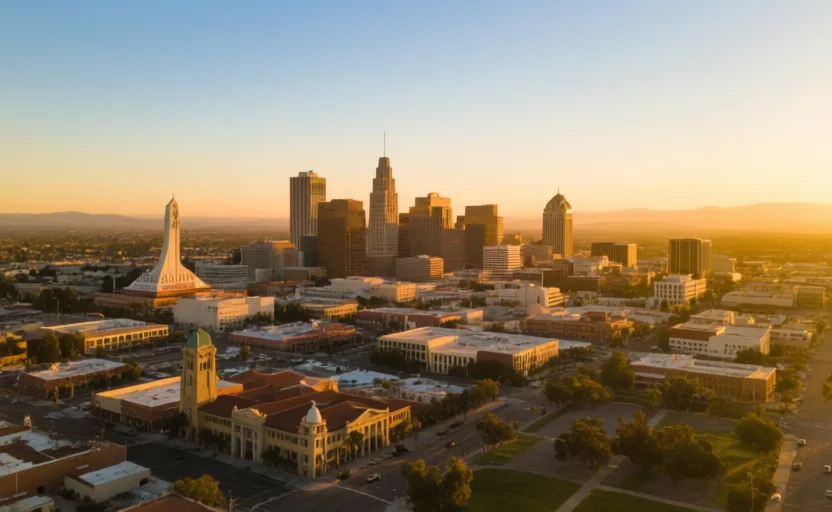 Fresno · AI city illustration · Artistic impression
City · North America
Fresno
Saved in this browser — no account needed. Sign in later and it comes with you.
Where it is
Flat farmland stretches out in every direction here, in the San Joaquin Valley, the southern half of California's Central Valley. The city lies close to the geographic centre of the state, roughly 220 miles north of Los Angeles and 170 miles south of Sacramento, with the Sierra Nevada rising to the east and Yosemite, Kings Canyon and Sequoia national parks within about 60 to 75 miles. The San Joaquin River runs along its northern edge, and the climate is semi-arid, with cool, mild winters and long, hot, dry summers that bring about 38 days a year at 100 °F or above. Water, not land, limits what grows. The city had 542,107 people in 2020 and is the largest in the Central Valley.
The land and water around it
The San Joaquin Valleyvalley
A flat, irrigated plain that is the agricultural heart of California. The towns around Fresno are largely tied to large-scale farming, and the city is the regional hub that serves them.
The San Joaquin River and Millerton Lakeriver
The river flooded on Christmas Eve 1867 and wrecked the town of Millerton, and the Friant Dam, completed in 1944, later drowned its remains under Millerton Lake. Fresno draws on that lake and on Pine Flat Reservoir for its water.
The Sierra Nevada foothillsmountains
The mountains rise to the east of the city, with the Sierra National Forest 40 miles away and lakes such as Bass, Shaver and Huntington within reach. Their snowmelt feeds the rivers and canals that make farming here possible in a semi-arid climate.
Its history, in short
The valley's first inhabitants were the Yokuts and Miwok, who traded with other Californian peoples. The first European to enter was Pedro Fages in 1772, and Fresno County was formed in 1856, taking its name from the ash trees, fresno in Spanish, along the San Joaquin. The modern city has a more specific origin: in 1872 the Central Pacific Railroad put a station beside a wheat farm that Anthony Easterby had made productive with an irrigation system, and a store beside the station grew into the town. Flooding at the old county seat, Millerton, pushed residents to the railway, and the county seat moved here two years later. Fresno was incorporated in 1885, and canals turned dry land into vineyards, orchards and row crops. Armenians, Hmong, Japanese, Germans, Italians and others settled in separate neighbourhoods. The city's isolation from the Bay Area and Los Angeles made it an early place for experiments, from a high school college course in 1910 that became Fresno City College to the world's first modern landfill in 1937 and the launch of the BankAmericard, later Visa, in 1958. After the Second World War housing replaced farmland across the north of the city.
Timeline
Dates are shown on a timeline rather than as changing shapes on the map. The globe draws modern boundaries only, and tinting a modern outline to stand for a historical one would state something we cannot source.
Early modern & oceanic
1772
Pedro Fages enters the valley
The first European to enter the San Joaquin Valley finds it inhabited by the Yokuts and Miwok, who traded plant and animal products with coastal peoples such as the Chumash.
Well attestedWikipedia
Industrial & imperial
1856
Fresno County formed
The county is created after the Gold Rush and named for the ash trees lining the river. Millerton is its first seat.
Well attestedWikipedia24 December 1867
Millerton flooded
The river inundates the county seat, and floods destroy Scottsburg on the Kings River too. Some residents rebuild, others leave. That same year Anthony Easterby buys the land that later becomes the Sunnyside district.
Well attestedWikipedia1872
A railway station beside a wheat farm
The Central Pacific Railroad founds a station on its new Southern Pacific line near Easterby's farm. Easterby's irrigation canals, begun by the sheep man Moses Church, had made the farm productive, and many Millerton residents moved to the new community.
Well attestedWikipedia1885
Incorporation
Fresno becomes a city. Major fires in 1882 and 1883 had destroyed blocks of its wooden buildings.
Well attestedWikipedia1937
The first modern landfill
The Fresno Municipal Sanitary Landfill opens, with trenching, compacting and daily covering of waste with soil. It operates until 1987 and is now both a National Historic Landmark and a Superfund site.
Well attestedWikipedia1942
Pinedale Assembly Center
In what is now North Fresno an interim camp holds Japanese Americans from the Fresno area before they are sent to internment camps. The fairgrounds are used for the same purpose. Fresno's Chinatown had been mainly a Japanese neighbourhood.
Well attestedWikipedia
Contemporary
September 1958
BankAmericard launches in Fresno
Bank of America picks Fresno partly for its remoteness, so that a failure would not damage its name. The card becomes the first successful general credit card and later the company Visa.
Well attestedWikipedia
Places that carry meaning
Millerton1850s–1944
The old county seat now lies under Millerton Lake. In severe droughts, when the reservoir shrinks, its ruins can be seen again.
The Southern Pacific depot1872 and 1889
The railway built a small wooden depot in 1872 and replaced it in 1889 with a brick Queen Anne building, one of the oldest still standing. It closed to rail in 1971 as business declined.
Fresno Municipal Sanitary Landfill1937–1987
A site that changed how cities dispose of waste, and which is now a landmark and a pollution cleanup site at once.
Old Armenian TownEarly 20th century
The old Armenian neighbourhood in the middle of the city, where in 1920 about 4,000 Armenians made up 9 per cent of the population. The Armenian Museum of Fresno and the annual Armenian Grape Blessing keep the community's identity visible.
Languages here
Places are usually multilingual. This lists what is actually spoken, not one language per border.
EnglishGermanic family
The shared language of public life.
Nationally, 77 per cent of residents speak only English at home. In Fresno it sits alongside a Spanish-speaking community that is about half the city.
SpanishRomance family
The language of the largest community.
Hispanic or Latino residents were 50.5 per cent of the city in 2020, making it one of the largest majority-Hispanic cities in the country. Most were of Mexican origin, with smaller Salvadoran and Puerto Rican communities.
ArmenianIndo-European family
The language of a long-established immigrant community.
Armenians have lived in Fresno since the early twentieth century, and Fresno's Old Armenian Town and its museum keep the community's identity visible.
HmongHmong–Mien family
The language of one of the largest Hmong communities in the country.
Just over 24,000 people, about 5 per cent of the city, are of Hmong descent, a community that along with the one in Minneapolis–Saint Paul is the largest of its kind in a US city.
Learn the language here
- 1Understand which languages are spoken hereFresno is multilingual. Start with which languages are used, by whom, and for what — the phrase list only covers one of them.Written by Globe Quest
- 2Learn 13 phrasesCurated everyday phrases for Fresno, with audio and a written form.Written by Globe Quest
- 3Say them out loudSpeaking practice with pronunciation feedback, one phrase at a time.Globe Quest material, your own additions
- 4Come back to themSpaced review, so what you learned this week is still there next month.Written by Globe Quest
Check yourself
How did Fresno begin?
As a railway station beside an irrigated wheat farm
The Central Pacific Railroad built a station in 1872 beside Anthony Easterby's farm, and the town of Fresno Station grew out of a store there.
Why was Fresno chosen to launch the BankAmericard in 1958?
Its remoteness limited the damage to the bank's name if the card failed
The bank wanted a test far from its main markets, and the experiment eventually became Visa.
Worth arguing about
- Fresno was a trial site for ideas that other cities adopted, from a landfill to a credit card. What does it mean to be a city that others use for experiments?
- The city's core holds the most concentrated poverty in California while the surrounding countryside is one of the world's richest farming regions. How can both things be true of the same valley?
Sources
- Wikipedia · Fresno, CaliforniaWikipedia · encyclopedia · checked 2026-11-24
- Wikipedia · United StatesWikipedia · encyclopedia · checked 2026-11-24
Reviewed by Globe Quest editorial on 2026-11-24. Drafted with AI assistance and checked against the sources above before publication.