 Globe Quest
 Human Quest · LearningSign in
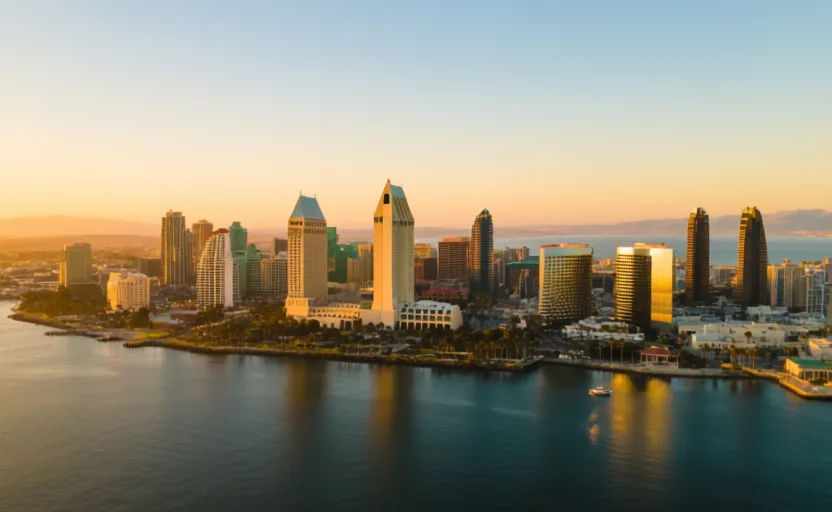 San Diego · AI city illustration · Artistic impression
City · North America
San Diego
Saved in this browser — no account needed. Sign in later and it comes with you.
Where it is
Between the sea and the border, San Diego is the last large American city on the Pacific coast before Mexico. Its bay is the visible part of a down-dropped block of crust, a graben, with faults of the San Andreas system running along it. Inland, the Laguna Mountains of the Peninsular Ranges stand about 40 miles east. The city is cut by roughly 200 deep canyons that separate flat-topped mesas, and the habit has been to build on the mesas and leave the canyons wild. Rainfall is low, falling mostly between December and March, and summers are warm, dry and often foggy near the coast.
The land and water around it
San Diego Baybay
A natural harbour and, in the 1830s, the only adequate one on the coast, which made San Diego the major port of the hide and tallow trade. The deepwater port today supports the navy’s submarine and shipbuilding yards, the only major ones of their kind on that coast.
Mesas and canyonsplateau
About 200 canyons divide the mesas on which neighbourhoods are built, leaving scattered pockets of open ground and giving the city its hilly layout. Chaparral and coastal sage scrub cover much of the land and burn easily at the edges of built-up areas.
The Rose Canyon and Point Loma fault zonesvalley
Two named branches of the San Andreas Fault system run near the bay. They make the coast earthquake country, and the bay itself sits in the sunken block they help bound.
Its history, in short
The Kumeyaay lived here for thousands of years, with a village called Kosa’aay beside a freshwater spring in what is now Old Town. Cabrillo claimed the bay for Spain in 1542, and Vizcaíno gave it its present name in 1602, but settlement waited until 1769, when a presidio and the first mission in California were founded above the Kumeyaay village of Cosoy. A Kumeyaay revolt in 1775 burned the mission and forced it to move up the river. Under Mexican rule the town shrank to 100 to 150 people by 1838 and lost its pueblo status, with Kumeyaay raids on the surrounding ranchos. The United States took control in 1846 to 1848, and the city was incorporated in 1850, only to go bankrupt two years later. The original town stood too far from the water, so in the late 1860s Alonzo Horton promoted a new downtown on the bay. A railroad link in 1878, naval and military facilities and the Second World War then made the city.
Timeline
Dates are shown on a timeline rather than as changing shapes on the map. The globe draws modern boundaries only, and tinting a modern outline to stand for a historical one would state something we cannot source.
Early modern & oceanic
1542
Cabrillo claims the bay
Juan Rodríguez Cabrillo sails in from New Spain and claims the bay for the Spanish Empire, calling it San Miguel. Nothing follows for more than two centuries.
November 1602
Vizcaíno names it
Sebastián Vizcaíno surveys the harbour, holds the first Catholic mass on California soil and names it for San Diego de Alcalá.
1769
Presidio and mission
Portolá founds the Presidio of San Diego in May and Junípero Serra the Mission San Diego de Alcalá in July. Europeans had not settled anywhere earlier in what is now California.
1775
Kumeyaay revolt
The Kumeyaay rebel, burn the mission and kill a priest and two others, and the mission relocates about six miles upriver. By 1797 it has more than 1,400 Native residents.
Industrial & imperial
1838
Loss of pueblo status
The town loses its status as its population falls to roughly 100 to 150 and Kumeyaay raids threaten it and the ranchos.
1850
City and county seat
California becomes a state, and San Diego is incorporated and named seat of the new county. It is bankrupt within two years and run by trustees until 1889.
Well attestedWikipediaLate 1860s
Horton’s New Town
Alonzo Horton promotes a move to the bay shore, away from Old Town, which stood several miles from navigable water. New Town becomes downtown.
Approximate dateWikipedia1878
The railroad
A rail connection ends San Diego’s long period as a backwater town.
Well attestedWikipedia
Places that carry meaning
Old Town1769 onward
The site of the Mexican-era Pueblo de San Diego at the foot of Presidio Hill, above the Kumeyaay village of Kosa’aay. The Presidio and the Mission are both National Historic Landmarks.
San Ysidro Port of EntryPresent
The main crossing to Tijuana, the busiest land border crossing in the world outside Asia. San Diego and Tijuana together form a transborder region of about five million people.
Balboa ParkPresent
A park spread across several mesas and canyons northeast of downtown, home to many of the city’s museums and to the zoo.
Languages here
Places are usually multilingual. This lists what is actually spoken, not one language per border.
EnglishGermanic family
The everyday language of public life.
The United States has no statutory official language, and English is by far the most widely used.
SpanishRomance family
The second language of the city, tied to the border and to Mexican heritage.
Hispanic or Latino residents were about 29 per cent of the city in 2010, and the largest group were of Mexican heritage, at about 25 per cent. The city’s culture is described as heavily shaped by the mix of American and Mexican traditions.
Filipino languages and other Asian languages
Spoken by some of the city’s largest immigrant communities.
Filipinos made up about 6 per cent of the city in 2010, ahead of Chinese and Vietnamese residents. The foreign-born population comes mostly from Mexico, the Philippines, China and Vietnam.
KumeyaayYuman family
The Yuman language of the region’s first inhabitants.
Two dialects were spoken in the area: Ipai north of the San Diego River and Tiipai to the south. The Kumeyaay name for Old Town, Kosa’aay, means “drying out place”, and Luiseño speakers called the area Pushuyi.
Learn the language here
- 1Understand which languages are spoken hereSan Diego is multilingual. Start with which languages are used, by whom, and for what — the phrase list only covers one of them.Written by Globe Quest
- 2Learn 12 phrasesCurated everyday phrases for San Diego, with audio and a written form.Written by Globe Quest
- 3Say them out loudSpeaking practice with pronunciation feedback, one phrase at a time.Globe Quest material, your own additions
- 4Come back to themSpaced review, so what you learned this week is still there next month.Written by Globe Quest
Check yourself
Why is San Diego called the birthplace of California?
It was the first place on the West Coast visited and settled by Europeans
Cabrillo reached the bay in 1542 and the presidio and mission of 1769 were the first European settlement in what is now California.
Why did downtown move away from Old Town in the 1860s?
Old Town was several miles from navigable water, and the bay shore suited shipping
Goods had to be hauled overland to Point Loma anchorages, so Alonzo Horton’s New Town on the bay drew people and businesses away.
Worth arguing about
- San Diego and Tijuana share a bay, a climate and millions of daily crossings, but sit under two governments. Is it one city or two?
- The Kumeyaay were here for thousands of years and rose against both Spanish and Mexican rule. Which of the city’s founding stories gets told, and by whom?
What we have not established
These are open questions, listed rather than filled in. We would rather show a gap than a plausible guess.
How long have people lived in the San Diego area?
Accounts date the first inhabitants, the San Dieguito complex, to at least 9,000 years ago in one text and to about 12,000 BCE in another, and scholars still dispute whether the Kumeyaay descend from them or arrived around 1000 CE.
Sources
- Wikipedia · San DiegoWikipedia · encyclopedia · checked 2026-11-24
- Wikipedia · History of San DiegoWikipedia · encyclopedia · checked 2026-11-24
- Wikipedia · Languages of the United StatesWikipedia · encyclopedia · checked 2026-11-24
Reviewed by Globe Quest editorial on 2026-11-24. Drafted with AI assistance and checked against the sources above before publication.