 Globe Quest
 Human Quest · LearningSign in
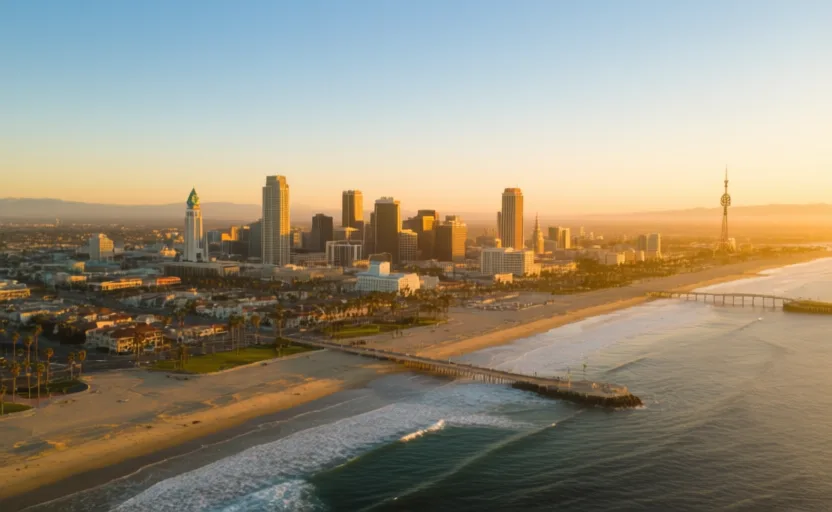 Long Beach · AI city illustration · Artistic impression
City · North America
Long Beach
Saved in this browser — no account needed. Sign in later and it comes with you.
Where it is
About 20 miles south of downtown Los Angeles, Long Beach faces the Pacific across a harbour, and more than a third of its total area, about 35%, is water. It is a flat coastal plain with a low hill, Signal Hill, rising in the middle and surrounded entirely by the city. The climate is Mediterranean to semi-arid, with mild winters, hot but breezy summers and morning fog that burns off by the afternoon. Below the ground lies an oilfield, and just to the west lies the twin harbour of Los Angeles, so the wind that blows from the west carries the ports’ diesel and ship exhaust straight across the city.
The land and water around it
The harbour and the open coastharbour
The deep-water port handles trade worth more than $140 billion a year and ranks second among American container ports.
Signal Hillplateau
A hill in the middle of the area that the city wraps around entirely. The boundary between two old land-grant ranches ran diagonally through it.
The Los Angeles River floodplainriver
Floods on the river shifted the boundary between ranches and caused long disputes. A Tongva settlement stood inland near the river.
Its history, in short
Long before the city, the Tongva lived on this coast for a very long time, with villages near the river and the shore, including a place the Tongva regard as the site of their emergence as a people. Spain granted the land as a ranch in 1784, and by 1805 the villagers at the main Tongva settlement had mostly been taken to Mission San Gabriel, where many died. The ranches passed through Mexican and then American hands. Sheep-raisers bought Rancho Los Cerritos in 1866, and in 1880 a land syndicate renamed a subdivision Long Beach. It was incorporated in 1897 and developed as a seaside resort, with a famous amusement zone called the Pike running from 1902 to 1969. Oil, the navy and the port then became the mainstays, and aircraft factories boomed in the Second World War. Postwar newcomers, many from the Midwest, earned it the nickname “Iowa by the sea”, but in the decades since it has become a port of entry for immigrants from Latin America and Asia, and it now has the largest Cambodian community outside Asia.
Timeline
Dates are shown on a timeline rather than as changing shapes on the map. The globe draws modern boundaries only, and tinting a modern outline to stand for a historical one would state something we cannot source.
First cities & states
over 10,000 years ago
Coastal peoples
Indigenous people have lived on the coast of Southern California for over 10,000 years. By the time Spanish explorers arrive in the sixteenth century the main group is the Tongva, with at least three major settlements in the area of the present city.
Approximate dateWikipedia
Early modern & oceanic
1784
Rancho Los Nietos
King Carlos III of Spain grants a large ranch to the soldier Manuel Nieto. It later splits into Rancho Los Cerritos and Rancho Los Alamitos.
Well attestedWikipedia
Industrial & imperial
1805
Puvunga emptied
Most villagers from the main Tongva village are taken to Mission San Gabriel as converts and labourers. The mission had a high death rate, particularly among children.
Well attestedWikipedia1843
Juan Temple buys Los Cerritos
Temple, who arrived from New England in 1827, builds an adobe ranch house that still stands and is a National Historic Landmark.
Well attestedWikipedia1880
A town named Long Beach
After William Willmore’s farm community fails, a Los Angeles syndicate buys the land and renames it Long Beach.
Well attestedWikipedia1897
Incorporation
The city incorporates as a seaside resort with light agriculture. The Pike amusement zone runs from 1902 to 1969.
Well attestedWikipedia23 December 1941
Douglas Aircraft
The first plane rolls out of the company’s largest plant. The factory produced transports and bombers simultaneously, and aircraft building continued for decades until Boeing closed the plant in 2015.
Well attestedWikipedia
Places that carry meaning
PuvungaBefore Spanish contact
A major Tongva village, understood by the Tongva as the place where their people emerged. It was also a regional trading centre and a hub for fishermen.
Tongva account of their emergence
Rancho Los Cerritos1840s
The adobe ranch house built by Juan Temple, who became the wealthiest man in Los Angeles County through cattle ranching.
The Port of Long Beach20th century onward
Along with the Navy base that closed and the oilfield that still funds part of the city budget, the port is the engine of the economy and supports more than 30,000 jobs in the city.
Languages here
Places are usually multilingual. This lists what is actually spoken, not one language per border.
SpanishRomance family
The largest language after English.
Hispanic and Latino residents were 44.0% of the population in recent estimates, and Mexico is the top country of origin of immigrants.
KhmerAustroasiatic family
The language of the large Cambodian community.
The Cambodian population of about 20,000 is the largest outside Asia, and Khmer is one of the three most common languages in the city after English.
TagalogAustronesian family
The language of a large Filipino community.
Filipinos were 4.5% of the 2010 population, the largest single Asian group in the city.
Learn the language here
- 1Understand which languages are spoken hereLong Beach is multilingual. Start with which languages are used, by whom, and for what — the phrase list only covers one of them.Written by Globe Quest
- 2Learn 12 phrasesCurated everyday phrases for Long Beach, with audio and a written form.Written by Globe Quest
- 3Say them out loudSpeaking practice with pronunciation feedback, one phrase at a time.Globe Quest material, your own additions
- 4Come back to themSpaced review, so what you learned this week is still there next month.Written by Globe Quest
Check yourself
Why was Long Beach once nicknamed “Iowa by the sea”?
It grew after the war with many migrants from the Midwest
Wartime workers and veterans moved in from Iowa and other Midwestern states, and in 1950 white residents were 97.4% of the population. Picnics for each state’s migrants were an annual event into the 1960s.
What is distinctive about Long Beach’s Cambodian population?
It is the largest outside Asia, at about 20,000
From the later twentieth century the city has been a gateway for immigrants from Asia and Latin America, and the Cambodian community is its best-known example.
Worth arguing about
- The prevailing wind carries pollution from the busiest ports straight into a residential city. Who should bear the cost of trade that benefits the whole country?
- The Tongva consider Puvunga their place of origin, yet it sits within a modern city. How should a city recognise a sacred place that is also part of a university and neighbourhoods?
What we have not established
These are open questions, listed rather than filled in. We would rather show a gap than a plausible guess.
Where exactly did the Tongva settlements lie, and what do they call them?
Names for the villages appear in several spellings, and the location of Puvunga and its relation to present buildings is only roughly given. The entry names the three settlements without placing them on a map.
Sources
- Wikipedia · Long Beach, CaliforniaWikipedia · encyclopedia · checked 2026-11-24
Reviewed by Globe Quest editorial on 2026-11-24. Drafted with AI assistance and checked against the sources above before publication.