 Globe Quest
 Human Quest · LearningSign in
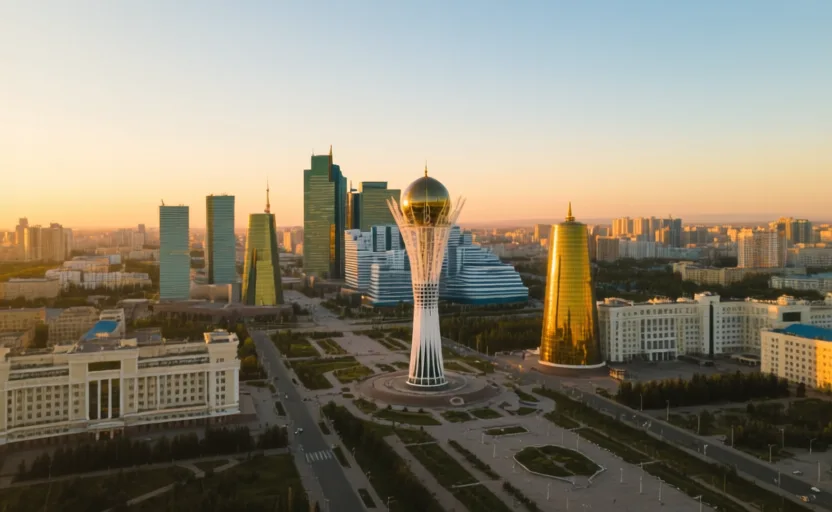 Astana · AI city illustration · Artistic impression
City · Central Asia
Astana
Saved in this browser — no account needed. Sign in later and it comes with you.
Where it is
Astana stands in the middle of an open plain. The city is at about 347 metres on the Ishim River in the north of central Kazakhstan, in dry, treeless steppe with no hills to break the wind, which is strongest on the exposed Left Bank. The climate is extremely continental: summer days can reach 35 °C, while −30 to −35 °C is common between mid-December and early March, and the river stays frozen from November until April. Only Ulaanbaatar is a colder capital. The nearest big city is Karaganda, 200 km away, and Almaty is almost 1,000 km to the south-east.
The land and water around it
The Ishim Riverriver
The river divides the older city on the north bank from the new government quarter on the south, and is frozen for around five months of the year.
The northern steppesteppe
A very flat, semi-arid grassland that covers most of the country. With nothing to slow the air, winds are famously strong, and temperatures swing from about −51.6 °C, the record from 1893, to 35 °C in summer.
Its history, in short
A medieval fortress of the steppe branch of the Silk Road, Bozok, once stood on the site. The modern town began in 1830 as the Russian settlement of Akmoly, named for a local landmark, and became the town of Akmolinsk in 1832. Its fortress was burned in 1838 during Kenesary Khan’s rising and rebuilt. The city grew with wartime evacuation and the deportation of Russian-Germans, and then became the centre of Khrushchev’s Virgin Lands Campaign: in 1961 it was renamed Tselinograd, the city of virgin lands, and rebuilt in the 1960s with new districts and civic palaces. After independence it became Akmola, and in December 1997 the capital moved here from Almaty. It was renamed Astana, meaning capital, in 1998, and a competition won by the Japanese architect Kisho Kurokawa set the plan for a new city south of the river. The name changed to Nur-Sultan in 2019 and reverted in 2022.
Timeline
Dates are shown on a timeline rather than as changing shapes on the map. The globe draws modern boundaries only, and tinting a modern outline to stand for a historical one would state something we cannot source.
Post-classical world
12th–14th centuries
The Bozok fortress
A large military settlement on a branch of the Silk Road stands on ground that the modern city is now expanding into.
Approximate dateWikipedia
Industrial & imperial
18 June 1830
Akmoly founded
Fyodor Shubin establishes the settlement on the Ishim as the seat of a district. It becomes the town of Akmolinsk in 1832.
Well attestedWikipedia
Contemporary
2 August 1959
The Yesil Bridge collapse
A bridge collapse kills 143 people. A single police officer, Nurmukhambet Kozhakhmetov, saves 40.
Well attestedWikipedia1961
Tselinograd
Khrushchev suggests a name to match the city’s role in the Virgin Lands Campaign, and the republic’s Supreme Soviet renames it Tselinograd. In the 1960s the city is rebuilt with high-rise districts, a Virgin Lands Palace and a new airport.
Well attestedWikipedia10 December 1997
The capital moves
Kazakhstan’s seat of government is relocated here from Almaty. The factors cited include location, land for expansion, proximity to economic centres and transport links.
Well attestedWikipedia1998
Astana and the Kurokawa plan
The city is renamed Astana in May, and in October the Japanese architect Kisho Kurokawa wins the competition for a plan that keeps the old city and builds a new one south and east of the river.
Well attestedWikipedia2019–2022
Nur-Sultan and back
In March 2019, shortly after Nursultan Nazarbayev resigned as president, the city is renamed in his honour. In September 2022 President Tokayev signs an amendment restoring the name Astana, which gives the city a record for name changes among capitals.
Well attestedWikipedia
Places that carry meaning
The Left Bank government quarterSince 1998
The new area south of the Ishim River, planned for government buildings and a diplomatic quarter, in a very open and windy part of the city.
Palace of Peace and Reconciliation2006
Put up for a gathering of world religious leaders, it has space for several faiths, among them Jewish, Muslim, Christian, Buddhist, Hindu and Taoist worship.
Astana Grand MosqueContemporary
The largest mosque in Kazakhstan and Central Asia, in a city that also holds Central Asia’s largest synagogue and an Orthodox headquarters.
Languages here
Places are usually multilingual. This lists what is actually spoken, not one language per border.
KazakhTurkic family
The state language and the language of a large majority.
Ethnic Kazakhs were about 17.7 per cent of the city in 1989 and are around 83 per cent in 2026, a measure of how thoroughly the capital’s move changed the population.
RussianSlavic family
An official language used in business and government.
Ethnic Russians were 54.1 per cent of Tselinograd in 1989 and are about 8 per cent now. Russian is still used routinely, and most migrants are described as ethnic Russians.
Ukrainian, Tatar and Uzbek
Minority languages of long-settled and newer communities.
Ukrainians are about 1.4 per cent, Tatars about 1 per cent and Uzbeks 0.6 per cent. Migrant workers have come from across Kazakhstan and from Uzbekistan and Kyrgyzstan.
Learn the language here
- 1Understand which languages are spoken hereAstana is multilingual. Start with which languages are used, by whom, and for what — the phrase list only covers one of them.Written by Globe Quest
- 2Learn 11 phrasesCurated everyday phrases for Astana, with audio and a written form.Written by Globe Quest
- 3Say them out loudSpeaking practice with pronunciation feedback, one phrase at a time.Globe Quest material, your own additions
- 4Come back to themSpaced review, so what you learned this week is still there next month.Written by Globe Quest
Check yourself
What was Astana called between 1961 and 1991?
Tselinograd
Tselinograd, “city of virgin lands”, was a name chosen for the Virgin Lands Campaign. It was Akmolinsk before 1961, Akmola after independence, then Astana from 1998.
Why is Astana described as one of the coldest capitals?
Its extreme continental steppe climate gives −30 to −35 °C winters
Only Ulaanbaatar is colder. The open steppe offers no shelter, and the Ishim River freezes from around the second week of November to early April.
Worth arguing about
- A capital was built on a cold, windy plain because of its location and space to expand. What is gained and lost when a country moves its centre of government?
- The city has been renamed several times in a few decades, including once for a living president and then back. What does a name change say about who a city belongs to?
What we have not established
These are open questions, listed rather than filled in. We would rather show a gap than a plausible guess.
Where does the original name Akmola come from?
It is usually read as the Kazakh for “white grave” or “white tomb”, named for a local landmark, but that explanation is not universally accepted and the landmark itself is not identified.
Sources
- Wikipedia · AstanaWikipedia · encyclopedia · checked 2026-11-24
- Wikipedia · KazakhstanWikipedia · encyclopedia · checked 2026-11-24
Reviewed by Globe Quest editorial on 2026-11-24. Drafted with AI assistance and checked against the sources above before publication.