 Globe Quest
 Human Quest · LearningSign in
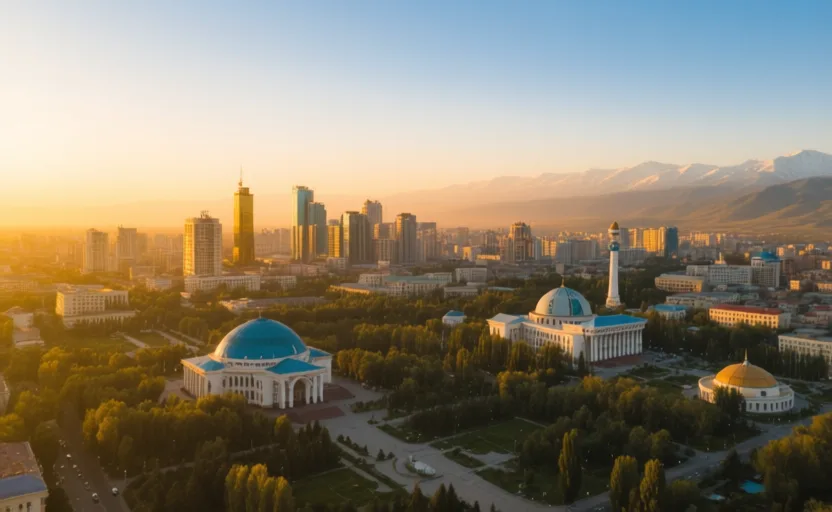 Bishkek · AI city illustration · Artistic impression
City · Central Asia
Bishkek
Saved in this browser — no account needed. Sign in later and it comes with you.
Where it is
Bishkek is a grid of straight, tree-lined streets laid out on a gentle slope at about 800 metres, just north of the Kyrgyz Ala-Too, whose peaks climb to 4,895 metres and shelter the city from the worst weather. To the north the steppe rolls away toward Kazakhstan, a short distance across the border, and the Chüy River drains the plain. Narrow irrigation channels run along most streets to water the shade trees, because the climate is dry and continental: about 440 mm of rain a year, daytime highs near 31 °C in July and winter averages below freezing, with fog and temperature inversions.
The land and water around it
The Kyrgyz Ala-Toomountains
An extension of the Tian Shan about 40 km south, rising to 4,895 metres and forming the backdrop to the city. Ala Archa National Park lies within an hour’s drive.
The Chüy valley and the northern steppesteppe
North of the city a fertile, gently rolling steppe reaches far into Kazakhstan. The Chüy River drains most of it and gives its name to the region and to the main avenue.
Its history, in short
A caravan stop on a branch of the Silk Road, possibly of Sogdian origin, was fortified by the Khanate of Kokand with a mud fort in 1825, and for a short time in 1844 it was held by Ormon Khan’s Kyrgyz forces. In 1860 Russian troops under Colonel Zimmermann destroyed the fortress, and a Russian settlement called Pishpek was set up on the site in 1868. From 1877 the imperial government encouraged Russian peasants to settle and farm. In 1925 the town became capital of the Kara-Kirghiz Autonomous Oblast, and in 1926 it was renamed Frunze, after the Bolshevik commander Mikhail Frunze, who had been born there. It remained capital through the creation of the Kirghiz Soviet Socialist Republic in 1936, and the city was Russian-majority for most of the twentieth century: in 1970 Russians were more than 80 per cent of residents and Kyrgyz only 12.3 per cent. It became Bishkek on 5 February 1991, and by the 2022 census about 85 per cent of residents were Kyrgyz.
Timeline
Dates are shown on a timeline rather than as changing shapes on the map. The globe draws modern boundaries only, and tinting a modern outline to stand for a historical one would state something we cannot source.
Industrial & imperial
1825
The Kokand fortress of Pishpek
The Khanate of Kokand builds a mud fort at a caravan stop to control the routes and collect tribute from Kyrgyz tribes.
Well attestedWikipedia4 September 1860
Russians raze the fort
Colonel Apollon Zimmermann’s troops destroy the fortress, with the approval of the Kyrgyz according to the account given. A Russian settlement is established on the site in 1868.
Well attestedWikipedia1926
Pishpek becomes Frunze
The city, capital of the Kara-Kirghiz Autonomous Oblast since 1925, is renamed for Mikhail Frunze, born there in 1885. It becomes capital of the Kirghiz SSR in 1936.
Well attestedWikipedia
Contemporary
1946
The railway station
The station is built by German prisoners of war, many of whom died and were buried in unmarked pits nearby. It has survived without major repair since.
Well attestedWikipedia5 February 1991
Renamed Bishkek
The Kyrgyz parliament changes the name from Frunze to a modified form of the old name, Pishpek. Independence follows in August.
2004 and 2011
Russian share falls
Russians, about a fifth of the city in 2004, fall to around 7 to 8 per cent in 2011 as the Soviet-era industry that drew them shrinks.
Approximate dateWikipedia
Places that carry meaning
Ala-Too SquareSoviet era onward
The main city square, with the independence monument, the guard-changing ceremony and the historical museum. The seven-storey marble White House, once the Communist Party headquarters, stands nearby as the main government building.
Osh Bazaar and Dordoy BazaarSoviet era onward
Osh Bazaar is the produce market west of the centre. Dordoy, on the north-eastern edge, is one of the city’s largest employers, selling Chinese goods imported to the CIS countries.
The old fortress site1825–1860
What remains of the Kokand fortress lies north of Jibek Jolu Street, close to the new main mosque, and is the spot the city grew from.
Languages here
Places are usually multilingual. This lists what is actually spoken, not one language per border.
KyrgyzTurkic family
The state language and now the language of most residents.
Around 85 per cent of the population is ethnically Kyrgyz according to the 2022 census, a sharp change from the Soviet decades when the city was mostly Russian.
RussianSlavic family
The city’s everyday second language and an official language.
Russians and other European peoples were the majority from the city’s founding until the mid-1990s. A Russian-language newspaper, Vecherniy Bishkek, is published here.
Dungan
A minority language with its own newspaper.
Bishkek is home to Huimin bao, described as the world’s only Dungan-language newspaper, serving a community of about 1 per cent of the country’s population.
Learn the language here
- 1Understand which languages are spoken hereBishkek is multilingual. Start with which languages are used, by whom, and for what — the phrase list only covers one of them.Written by Globe Quest
- 2Learn 12 phrasesCurated everyday phrases for Bishkek, with audio and a written form.Written by Globe Quest
- 3Say them out loudSpeaking practice with pronunciation feedback, one phrase at a time.Globe Quest material, your own additions
- 4Come back to themSpaced review, so what you learned this week is still there next month.Written by Globe Quest
Check yourself
Which sequence of names has the city had?
Pishpek, Frunze, Bishkek
It was Pishpek until 1926, Frunze from 1926 to 1991 after the Bolshevik Mikhail Frunze, and Bishkek since 1991, a modified form of the original name.
What was the ethnic makeup of the city in 1970?
Russians were more than 80 per cent and Kyrgyz only 12.3 per cent
The city grew as a Russian settlement and a Soviet capital, so Russians were the large majority until the 1990s, while today around 85 per cent are Kyrgyz.
Worth arguing about
- A city renamed twice in the twentieth century has changed its population as well as its name. What does Bishkek keep of its Russian and Soviet past, and what has it dropped?
- A bazaar of imported goods is one of the largest employers in a capital whose factories have closed. What does a city live on when its industry goes?
What we have not established
These are open questions, listed rather than filled in. We would rather show a gap than a plausible guess.
How many people live in Bishkek?
Estimates range from about 1.07 million in 2021 to around 1.2 million in 2024, and official counts do not capture the many people living in settlements on the edge of the city.
Sources
- Wikipedia · BishkekWikipedia · encyclopedia · checked 2026-11-24
- Wikipedia · KyrgyzstanWikipedia · encyclopedia · checked 2026-11-24
Reviewed by Globe Quest editorial on 2026-11-24. Drafted with AI assistance and checked against the sources above before publication.