 Globe Quest
 Human Quest · LearningSign in
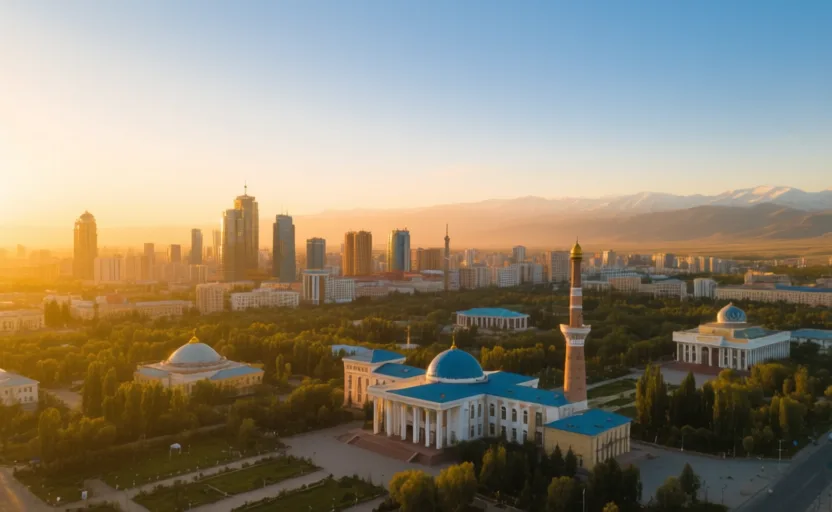 Osh · AI city illustration · Artistic impression
City · Central Asia
Osh
Saved in this browser — no account needed. Sign in later and it comes with you.
Where it is
Osh lies in the Kyrgyz part of the Fergana Valley, the low and hot basin in the south of the country, and a single steep mountain, Sulaiman-Too, rises straight out of the plain behind the city. Rainfall is about 400 mm a year, mostly outside the summer, and summers are hot and dry, while winters are cold enough to stay below freezing for much of the season. The Alay Mountains stand to the south, and the old trade route crossed them toward Kashgar. The Uzbek border is close, and the built-up area spills across it.
The land and water around it
Sulaiman-Toomountains
A mountain with five peaks that dominates the Fergana Valley and forms the backdrop to Osh. For at least 1,500 years it has been revered as sacred, its slopes dotted with cult places, caves with petroglyphs and, later, mosques.
The Fergana Valleyvalley
The irrigated basin around Osh, which made it one of the largest medieval cities of the region and kept the town at a crossroads of routes through the mountains.
The Alay Mountainsmountains
The range south of the city crossed by the Silk Road route to Kashgar in the east.
Its history, in short
Osh is the oldest city in Kyrgyzstan, estimated to be more than 3,000 years old, and by the 8th century it was already known for silk production on the Silk Road. Its name is linked to the river Vakhsh, personified as a water goddess worshipped at a fire temple on the sacred mountain. In 1496–1497 the young Babur, later founder of the Mughal Empire, built a pavilion on one of its spurs and wrote of the city’s excellence. Russia annexed the town in 1876. From the 1960s Soviet industrialisation drew Kyrgyz from the countryside to a city whose population had long included many Uzbeks, and competition for land produced bloody clashes in 1990 with more than 300 dead. In June 2010 riots killed at least 81 people, destroyed over 2,000 buildings and sent a reported 100,000 ethnic Uzbek refugees over the border.
Timeline
Dates are shown on a timeline rather than as changing shapes on the map. The globe draws modern boundaries only, and tinting a modern outline to stand for a historical one would state something we cannot source.
Post-classical world
8th century
A silk centre on the Silk Road
Osh is known as a centre of silk production along the trade route, which crossed the Alay Mountains to reach Kashgar.
Approximate dateWikipedia
Early modern & oceanic
1496–1497
Babur’s pavilion
Babur, born at Andijan and a descendant of Tamerlane, has a porticoed pavilion built on a spur of Bara-Koh, the mountain southeast of the Osh fortress, and later writes about the city.
Well attestedWikipedia
Industrial & imperial
1876
Russian annexation
The city is annexed by the Russian Empire, in the contest between Britain and Russia for Central Asia known as the Great Game.
Well attestedWikipedia1939
Seat of Osh Region
Osh becomes the administrative centre of the region, a role it keeps, earning the nickname “capital of the south”.
Well attestedWikipedia
Contemporary
1990
Ethnic clashes
Kyrgyz and Uzbek communities fight over land in and around the city, with about 1,200 casualties, including over 300 dead.
Well attestedWikipediaJune 2010
The June violence
Riots from 10 June kill at least 81 people in the city, destroy more than 2,000 buildings across the south and deepen the divide between Kyrgyz and Uzbeks. Explanations of who started it, including claims about the ousted president, remain contested.
DisputedWikipediaThe Kyrgyz intelligence agency blames the deposed president, Kurmanbek Bakiyev, while others have noted that no serious proof has been published.
Places that carry meaning
Sulaiman-Too Sacred MountainAt least 1,500 years
A World Heritage property described as the most complete picture of a sacred mountain in Central Asia, where mountain worship, the cult of the horse and later Islam have been absorbed into one landscape.
The Eagle Cave fire templePre-Islamic
A Zoroastrian shrine on the mountain, where the river goddess Vakhsh was worshipped alongside sacred fire, and from which the city’s name is said to derive.
Babur’s mosque and pavilion1496–1497
Babur wrote of building a pavilion on Bara-Koh and also built a mosque on top of the mountain, linking the founder of the Mughal Empire to this city.
Languages here
Places are usually multilingual. This lists what is actually spoken, not one language per border.
KyrgyzTurkic family
The state language, and the language of about half the city.
Kyrgyz were 47.9 per cent of the population at the 2009 census, with the share of Kyrgyz speakers swelled in Soviet times by migration from the countryside to industrial jobs.
UzbekTurkic family
The language of the other large community.
Uzbeks made up 44.2 per cent in 2009, and the built-up area extends into neighbouring Uzbekistan, with about 400,000 people in the wider conurbation.
RussianSlavic family
An official language and a bridge between communities.
Russians are a small minority of 2.5 per cent, but Russian remains co-official in Kyrgyzstan, alongside Kyrgyz. Turks, Tatars, Koreans and Ukrainians also live in the city.
Learn the language here
- 1Understand which languages are spoken hereOsh is multilingual. Start with which languages are used, by whom, and for what — the phrase list only covers one of them.Written by Globe Quest
- 2Learn 12 phrasesCurated everyday phrases for Osh, with audio and a written form.Written by Globe Quest
- 3Say them out loudSpeaking practice with pronunciation feedback, one phrase at a time.Globe Quest material, your own additions
- 4Come back to themSpaced review, so what you learned this week is still there next month.Written by Globe Quest
Check yourself
What is Sulaiman-Too?
A sacred mountain behind the city, revered for at least 1,500 years
The mountain’s five peaks hold cult places, petroglyphs and later mosques. It was inscribed as a World Heritage site for the way worship of mountains has been absorbed into Islam.
Who built a pavilion on the mountain above Osh in 1496–1497?
Babur
Babur, born at nearby Andijan, was a descendant of Tamerlane and later founded the Mughal Empire. He wrote that the Fergana Valley was too small for his ambitions.
Worth arguing about
- Osh was a mixed Kyrgyz and Uzbek city long before the 20th century. What makes a shared city stable in some periods and violent in others?
- A sacred mountain is threatened by building on and around it. Whose job is it to protect a landscape that is both a holy site and a city’s neighbourhood?
What we have not established
These are open questions, listed rather than filled in. We would rather show a gap than a plausible guess.
Who was responsible for the June 2010 violence?
Kyrgyz officials have named the deposed president, but the claim has not been supported by published evidence, and independent accounts of the causes remain unsettled.
Sources
- Wikipedia · OshWikipedia · encyclopedia · checked 2026-11-24
- Wikipedia · KyrgyzstanWikipedia · encyclopedia · checked 2026-11-24
- UNESCO · Sulaiman-Too Sacred MountainUNESCO World Heritage Centre · intergovernmental · checked 2026-11-24
Reviewed by Globe Quest editorial on 2026-11-24. Drafted with AI assistance and checked against the sources above before publication.