 Globe Quest
 Human Quest · LearningSign in
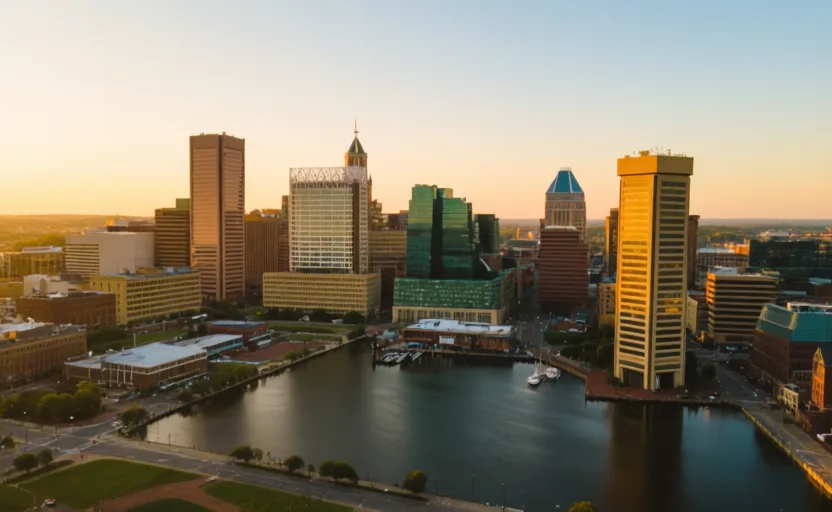 Baltimore · AI city illustration · Artistic impression
City · North America
Baltimore
Saved in this browser — no account needed. Sign in later and it comes with you.
Where it is
Baltimore lies on the Patapsco River close to where it opens into Chesapeake Bay, and it sits right on the fall line, the step where the hard rock of the Piedmont Plateau drops to the soft Atlantic coastal plain. That line splits the city into a lower city by the harbour and an upper city rising to about 146 metres in the northwest. The Jones Falls, a stream that runs south into the Inner Harbor, marks the east edge of the old town. The climate is humid subtropical, with hot, humid summers, chilly to mild winters.
The land and water around it
The Patapsco River and Inner Harborharbour
A deep tidal basin at the head of the river’s estuary. The harbour made the port, and the Inner Harbor later became the second-leading port of entry for immigrants after Ellis Island.
The fall lineplateau
The boundary between the Piedmont and the coastal plain runs through the city, and it is what divides Baltimore into a lower and an upper city.
Chesapeake Baybay
The large estuary into which the Patapsco empties. A southeasterly bay breeze often blows on summer afternoons.
Its history, in short
The place was a hunting ground for the Susquehannock and a land named in Algonquian for its backwaters before English colonists arrived. Maryland’s assembly set up a tobacco port at Whetstone Point in 1706 and a town in 1729, named for the Calvert family’s Irish title, and wheat exports and wartime trade made it the fourth-largest city in the country by 1790. German settlers were among the first residents. Its defence against a British bombardment in 1814 inspired the poem that became the national anthem. The Baltimore and Ohio Railroad, the nation’s oldest, tied the port to the Midwest, and the harbour became a leading entry point for immigrants. Before the Civil War the city held the largest free Black community in the country. It also pioneered a residential segregation ordinance around 1910 that other cities copied, and struck down in 1917, and its legacy persisted through redlining. A fire in 1904 burned over 1,500 buildings. After a peak of nearly 950,000 in 1950, heavy industry declined and population fell in every census. Johns Hopkins is now the leading employer.
Timeline
Dates are shown on a timeline rather than as changing shapes on the map. The globe draws modern boundaries only, and tinting a modern outline to stand for a historical one would state something we cannot source.
Early modern & oceanic
1706
Port of Baltimore
Maryland’s assembly creates a port at Whetstone Point, now Locust Point, to serve the tobacco trade. The Town of Baltimore is founded on 8 August 1729.
Well attestedWikipedia1790
Fourth-largest city
From a village of about 250 people in 1752, Baltimore becomes the fourth-largest city in the United States, driven by wheat exports and wartime shipping.
Well attestedWikipedia
Industrial & imperial
1814
Bombardment of Fort McHenry
A British bombardment of the city inspires “The Star-Spangled Banner”, designated the national anthem in 1931, and the Battle Monument that becomes the city’s emblem.
Well attestedWikipedia1829 to 1830
Baltimore and Ohio Railroad
The nation’s oldest railroad is established, giving producers in the Midwest and Appalachia a route to the port.
1851
Independent city
After being the seat of Baltimore County since 1768, the city becomes independent under Maryland’s constitution and remains outside any county.
Well attestedWikipedia7 February 1904
The Great Baltimore Fire
The fire destroys more than 1,500 buildings across about 70 downtown blocks, with damage estimated at $150 million, and leads to rebuilding and better firefighting standards.
1910 to 1917
Residential segregation law
Baltimore passes the first ordinance in the country restricting where Black and white residents may live, copied by other cities, until the Supreme Court rules such laws unconstitutional in 1917. The city’s housing inspectors were then told to report anyone selling or renting across the line, helping to lay the basis for redlining.
Places that carry meaning
Fort McHenry1814
The fort at Whetstone Point whose bombardment inspired Francis Scott Key’s poem.
Fells Point18th century onward
A former shipbuilding port annexed into the town, once an entertainment area for sailors, and one of the earliest National Register historic districts.
Lexington Market1782 onward
A market begun in 1782, part of the oldest continuously operating public market system in the country.
Phoenix Shot Tower1828
A 234-foot tower for making lead shot, built without exterior scaffolding and the tallest building in the country until the Civil War.
Languages here
Places are usually multilingual. This lists what is actually spoken, not one language per border.
EnglishGermanic family
The language nearly everyone speaks at home.
In 2010 about 91 percent of residents spoke only English at home. The local accent, sometimes called Bawlmerese, is a Mid-Atlantic variety similar to Philadelphia’s, and bends the long “o” vowel.
SpanishRomance family
The leading minority language.
Close to 4 percent of residents spoke Spanish at home in 2010, and Hispanic residents of Salvadoran and Mexican origin form the biggest groups.
GermanGermanic family
The language of early settlers.
German immigrants were arriving by the 1720s, and the German Society of Maryland was founded in 1783 to keep the language and culture alive. A German Lutheran church opened in 1755.
Learn the language here
- 1Understand which languages are spoken hereBaltimore is multilingual. Start with which languages are used, by whom, and for what — the phrase list only covers one of them.Written by Globe Quest
- 2Learn 14 phrasesCurated everyday phrases for Baltimore, with audio and a written form.Written by Globe Quest
- 3Say them out loudSpeaking practice with pronunciation feedback, one phrase at a time.Globe Quest material, your own additions
- 4Come back to themSpaced review, so what you learned this week is still there next month.Written by Globe Quest
Check yourself
What event in Baltimore inspired the national anthem?
The British bombardment of Fort McHenry in 1814
The bombardment led Francis Scott Key to write the poem that became “The Star-Spangled Banner”, and the city’s Battle Monument was built to mark the defence.
What does the fall line do in Baltimore?
Divides hard Piedmont rock from soft coastal plain, creating an upper and lower city
The geological step runs through the city. It gave streams the drop to power mills and created the lower and upper city that residents still talk about.
Worth arguing about
- Baltimore wrote the first residential segregation law of its kind in 1910 and exported the idea. How do historic housing policies still shape where people live and how long they live?
- A city that is not part of any county has fixed borders since 1918. What does that do to a city when its richer residents move just across the line?
What we have not established
These are open questions, listed rather than filled in. We would rather show a gap than a plausible guess.
When exactly did Baltimore pass its residential segregation ordinance, and when was the B&O Railroad founded?
Accounts give 1910 and 1911 for the ordinance, and 1829 and 1830 for the railroad, so the entry gives a range for each rather than a single year.
Sources
- Wikipedia · BaltimoreWikipedia · encyclopedia · checked 2026-11-24
- Wikipedia · History of BaltimoreWikipedia · encyclopedia · checked 2026-11-24
Reviewed by Globe Quest editorial on 2026-11-24. Drafted with AI assistance and checked against the sources above before publication.