 Globe Quest
 Human Quest · LearningSign in
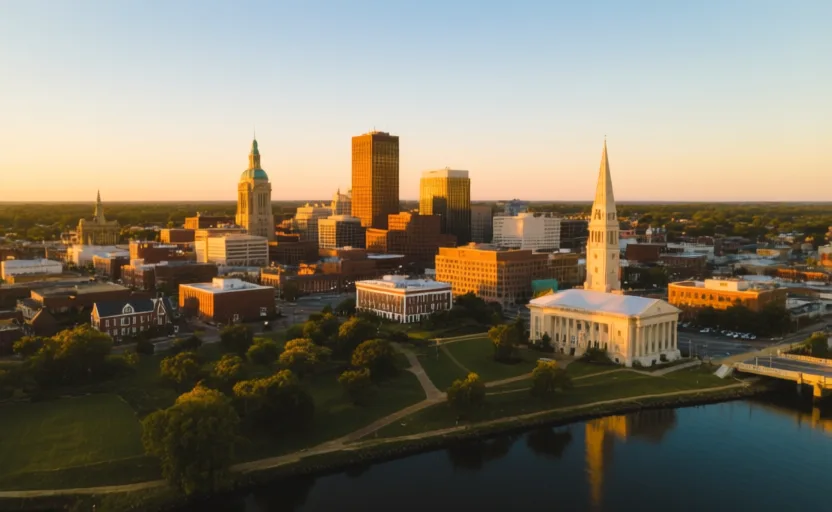 Norfolk · AI city illustration · Artistic impression
City · North America
Norfolk
Saved in this browser — no account needed. Sign in later and it comes with you.
Where it is
Norfolk is a low, water-bound city at the south-eastern corner of Virginia, where the Elizabeth River meets the Chesapeake Bay. Its natural deepwater channels made it a port, and its position at the heart of the Hampton Roads region, home to more than 1.8 million people, made it the region's centre of trade, finance and culture. The land is low and slowly sinking. Some areas already flood at high tide, and tidal flooding days rose from about five a year in 2000 to ten to fifteen by 2020. Summers are warm and humid, with hurricane season from mid-August to the end of September.
The land and water around it
The Elizabeth Riverriver
The river's branches meet downtown, and the first town was laid out just northeast of the point where the Eastern and Southern Branches join. Over time the city annexed Berkley across the river, so Norfolk now lies on both banks.
Hampton Roads and the Chesapeake Bayharbour
A natural harbour with deepwater channels that supports the Port of Virginia, the shipping line Maersk Line, Limited, and the naval base. The city also has beaches on the Chesapeake Bay.
Sinking land and rising watercoast
Norfolk's ground is subsiding while the sea rises. A 2012 study put the cost of coping with one foot of sea-level rise at about one billion dollars, and scientists estimated in 2013 that the sea could rise five and a half feet or more by 2100. In 2003 Hurricane Isabel's surge flooded the Midtown Tunnel.
Its history, in short
The English crown ordered storehouses built in each Virginia county in 1670, and Norfolk's deepwater harbour made it the natural port for Lower Norfolk County. A town was chartered in 1680 to 1682, incorporated in 1705 and made a borough in 1736. By 1775 it was one of Virginia's richest places, shipping tobacco, corn, cotton and timber and importing rum, sugar and manufactured goods; much of that trade rested on enslaved labour. It was also Loyalist, and when the last royal governor, Lord Dunmore, failed to hold it, his ships bombarded it on New Year's Day 1776 and fires destroyed nearly all of it. The city rebuilt, then suffered another fire in 1804, a yellow fever epidemic in 1855, and the seizure of its navy yard in 1861. The Virginian Railway and the Jamestown Exposition of 1907 showed off the peninsula's value to the navy, and in 1917 the Naval Station was established, now the world's largest naval base. Population peaked at 307,951 in 1970 and has fallen since, while the sea has become the city's chief long-term problem.
Timeline
Dates are shown on a timeline rather than as changing shapes on the map. The globe draws modern boundaries only, and tinting a modern outline to stand for a historical one would state something we cannot source.
Early modern & oceanic
1680–1682
A town and a fort
A “Half Moone” fort is built on land bought from local people of the Powhatan Confederacy in exchange for tobacco, 10,000 pounds of it. In 1680 the colonial legislature, the House of Burgesses, sets up the town, and a charter follows by 1682.
1736
Royal borough
After incorporation in 1705, George II grants a royal charter that makes Norfolk a borough. It is an important port for exports to the British Isles.
Well attestedWikipedia1 January 1776
The burning of Norfolk
After Dunmore's defeat at Great Bridge, his ships bombard the city and fires spread. The Virginia Assembly later found that the British had set only 19 of 882 burned houses alight. A further 416 buildings were destroyed in February to deny the British cover.
British and Patriot accounts of who burned the city; the Virginia Assembly's inquiry
Industrial & imperial
1861–1862
Navy yard and ironclad
In 1861 Union forces burn the Gosport navy yard at Norfolk, and the Confederates seize its supplies and the hull of the frigate Merrimac. Rebuilt there as the ironclad CSS Virginia, it fights the Battle of Hampton Roads from 8 March 1862.
Well attestedWikipedia1907
The Jamestown Exposition
The Virginian Railway arrives, and the exposition's naval review demonstrates the peninsula's favourable location, laying the groundwork for the naval base. By 1917 an air station and a naval operating base have been built on the exposition grounds.
Well attestedWikipedia
Contemporary
1970
Population peak
The census records 307,951 people, making Norfolk then the most populous city in Virginia. Every later count except 2010 has been lower; the 2020 figure is 238,005.
Well attestedWikipedia2003
NATO headquarters
Allied Command Transformation, a NATO command, is founded in the city, one of the alliance's two strategic headquarters.
Well attestedWikipedia
Places that carry meaning
Saint Paul's Episcopal Churchbefore 1776
The only building to survive the burning of 1776. A cannonball from the bombardment is still embedded in its wall.
Naval Station Norfolk1917 onward
The world's largest naval base, established in 1917 as the United States prepared to enter the First World War; an air station went up on the former exposition grounds the same year. Around 89,000 active-duty sailors and marines were assigned to the Hampton Roads area in 2020, about two-thirds of them to this base.
Nauticus and the USS Wisconsin2000
The maritime museum on the downtown waterfront, which gained a battleship, the USS Wisconsin, as a museum ship in December 2000.
Languages here
Places are usually multilingual. This lists what is actually spoken, not one language per border.
EnglishGermanic family
The language of nearly nine in ten residents at home.
Only about 10.9 percent of residents use another language at home, well below the 18.2 percent for Virginia as a whole. The city's name was suggested by Adam Thoroughgood, an early settler, for his birthplace in the English county of Norfolk.
SpanishRomance family
The most common language other than English.
About 5.6 percent of residents speak Spanish. Honduras, Mexico, El Salvador and Guatemala are all among the countries of origin of Norfolk's foreign-born population.
TagalogAustronesian family
The language of the Philippines, the largest source of the city's immigrants.
The Philippines is the most common country of origin of Norfolk's foreign-born residents, at 3,440 people in 2024. Tagalog is among the languages spoken at home by more than a million people in the United States, though no local count is available.
Learn the language here
- 1Understand which languages are spoken hereNorfolk is multilingual. Start with which languages are used, by whom, and for what — the phrase list only covers one of them.Written by Globe Quest
- 2Learn 12 phrasesCurated everyday phrases for Norfolk, with audio and a written form.Written by Globe Quest
- 3Say them out loudSpeaking practice with pronunciation feedback, one phrase at a time.Globe Quest material, your own additions
- 4Come back to themSpaced review, so what you learned this week is still there next month.Written by Globe Quest
Check yourself
Which building survived the burning of Norfolk in 1776?
Saint Paul's Episcopal Church
Only the walls of Saint Paul's survived the bombardment and the fires. A British cannonball is still lodged in the wall.
What is happening to Norfolk's land relative to the sea?
The land is subsiding while the sea rises, so high-tide flooding is more frequent
Tidal flooding days rose from about five in 2000 to ten to fifteen in 2020. A low, sinking coast meets a rising sea.
Worth arguing about
- Norfolk's economy is tied to the navy and the port, and its land is among the most exposed on the American coast. How much should a city invest in defending places that are likely to flood more often?
- Accounts of 1776 disagree about who burned the city, and the Assembly's inquiry found that the British set few of the fires. How do communities remember a destruction that no side wants to own?
What we have not established
These are open questions, listed rather than filled in. We would rather show a gap than a plausible guess.
When was Norfolk founded?
The House of Burgesses established the town in 1680, and a charter for it was issued in 1682. Accounts give either year, and they describe different acts, so no single founding year is settled.
Sources
- Wikipedia · Norfolk, VirginiaWikipedia · encyclopedia · checked 2026-11-24
- Wikipedia · History of Norfolk, VirginiaWikipedia · encyclopedia · checked 2026-11-24
- Wikipedia · Languages of the United StatesWikipedia · encyclopedia · checked 2026-11-24
Reviewed by Globe Quest editorial on 2026-11-24. Drafted with AI assistance and checked against the sources above before publication.