 Globe Quest
 Human Quest · LearningSign in
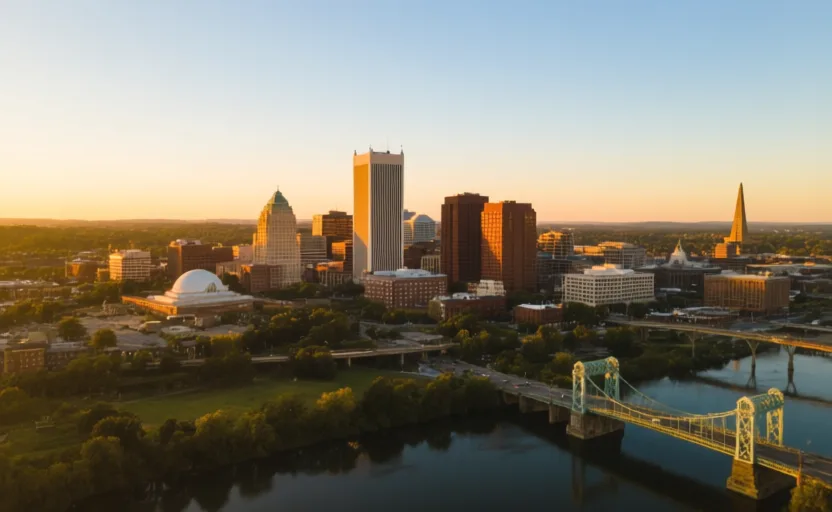 Richmond · AI city illustration · Artistic impression
City · North America
Richmond
Saved in this browser — no account needed. Sign in later and it comes with you.
Where it is
Rapids on the James River decide where this city is. Ships coming upstream from the Chesapeake Bay and the Atlantic cannot pass them, which makes Richmond the highest navigable point on the river, and the rocky ledge marks the boundary between Virginia's low, flat Tidewater and the rolling Piedmont. The old town climbed the slopes of Shockoe Hill and Church Hill, with a low-lying district, Shockoe Bottom, in between. The mountains to the west hold off the worst continental cold, so winters are moderate and summers hot and humid. The city itself is small, about 62 square miles with 226,610 people in 2020, and since 1871 it has been independent of the surrounding Henrico County. The metropolitan area holds over 1.37 million.
The land and water around it
The James River fall lineriver
Rapids and a drop of rocky ledges mark where the river leaves the Piedmont and meets the tidewater. Cargo coming down in flat-bottomed bateaux had to be moved to ocean-going ships, and a canal designed with the help of George Washington was cut around the falls.
The Piedmont hillsplateau
Richmond sits in a region of low, rolling hills between the flat coastal Tidewater and the Blue Ridge Mountains. Its original grid, laid out in 1737, ran between Broad Street, the river and 17th and 25th Streets, and downtown later moved west onto the slopes of Shockoe Hill.
River floodsclimate
A humid subtropical climate means heavy rain can arrive with tropical storms. In 1972 Hurricane Agnes dropped 16 inches on central Virginia and raised the James to 6.5 feet above a record that had stood for two centuries, and a flood wall was finished in 1995 to protect Shockoe Bottom.
Its history, in short
The falls were already a significant place for the Powhatan, whose name for them, Pawat-hanne, means “falls in a stream”, and a village on the hill above them served as the capital of the weroance Parahunt. English colonists from Jamestown reached the falls in 1607 and several times tried to settle them, but were driven out. In 1737 William Mayo laid out the town on land from the Byrd family, and in 1742 it was chartered. The decisive change came in 1780, when Virginia's capital moved here from Williamsburg to be closer to the growing western population and, in theory, further from British ships. Benedict Arnold's raid burned the town in 1781, and it recovered within a year. The James River and Kanawha Canal carried cargo around the rapids, but railways soon took over as the main way to ship goods, and tobacco processing stayed central to the economy. In 1861 Richmond became the capital of the Confederacy, and its Tredegar Iron Works was the largest Confederate arms factory. Afterwards, with tobacco, rail and finance, it recovered, and Jackson Ward became a centre of Black business. The statues of Confederate leaders on Monument Avenue came down in 2020 and 2022, a mark of how much the city is still working out its own history.
Timeline
Dates are shown on a timeline rather than as changing shapes on the map. The globe draws modern boundaries only, and tinting a modern outline to stand for a historical one would state something we cannot source.
Early modern & oceanic
May 1607
Newport reaches the falls
Captain Christopher Newport leads an English party upriver from Jamestown and meets Parahunt, the weroance of the village at the falls. The falls mark the western frontier of the Powhatan confederacy against the Monacan.
1737
The town is laid out
William Mayo draws a street plan of thirty-two squares on land provided by William Byrd II. The name comes from Richmond in England, and the town is chartered in 1742.
1775
“Give me liberty or give me death”
Patrick Henry delivers his speech at what is now St. John's Church, during the Second Virginia Convention, helping to push Virginia into the Revolutionary War.
1780
Capital of Virginia
The state capital is moved from Williamsburg to Richmond, which is closer to the western settlers and farther from the coast. Benedict Arnold burns the town the next year, and the Assembly incorporates Richmond as a city in 1782.
Industrial & imperial
1861
Capital of the Confederacy
The Confederate Congress votes to move its capital from Montgomery to Richmond, which holds a railway hub, hospitals, one of the largest slave markets, and the Tredegar Iron Works. Tredegar supplies artillery and the armour plating for the ironclad CSS Virginia.
Well attestedWikipedia1903
Maggie Walker founds a bank
Maggie L. Walker charters the St. Luke Penny Savings Bank and becomes its president, the first Black woman to head a bank in the United States. Her bank is part of the thriving Black business district of Jackson Ward, known as the “Wall Street of Black America”.
1910
Manchester merges with Richmond
For 250 years the river had separated Richmond from the independent city of Manchester on the south bank. The merger keeps a free bridge and a separate courthouse, and the river becomes the centre of the larger city.
Contemporary
2020–2022
Confederate statues removed
Most statues of Confederate leaders on Monument Avenue are taken down during or after the protests of June 2020, including the monument to Robert E. Lee, and the last one is removed in December 2022. The statue of tennis player Arthur Ashe is the only one that remains.
Well attestedWikipedia
Places that carry meaning
Virginia State CapitolCompleted 1788
Designed by Thomas Jefferson with Charles-Louis Clérisseau in the Greek Revival style. During the Civil War the Confederate Congress shared the building with the Virginia General Assembly.
St. John's ChurchMid-18th century
A church on Church Hill, the oldest neighbourhood in the city, where Patrick Henry spoke in 1775. The Virginia Statute for Religious Freedom, written by Jefferson and passed in 1786, is commemorated nearby.
Jackson WardLate 19th and early 20th century
A neighbourhood where freed people and their descendants built a Black business community, known as the “Harlem of the South” as well as the “Wall Street of Black America”.
Monument AvenueLate 19th century onward
A boulevard in the Fan district lined with Victorian architecture and, until 2020, with statues of Confederate leaders. It is now more commonly associated with the one statue still standing, of Arthur Ashe.
Languages here
Places are usually multilingual. This lists what is actually spoken, not one language per border.
EnglishGermanic family
The language of government, business and daily life.
Introduced by colonists from Jamestown in the early seventeenth century. Nationally, 77 per cent of residents speak only English at home, and Spanish is by far the next most common language.
PowhatanAlgonquian family
The language of the first people recorded at the falls.
English observers wrote down the names of the village and river as spoken by the Powhatan, including Paqwachowng and Shocquohocan, and the meaning of Powhatan as “falls in a stream” comes from that language. A French Huguenot settlement above the falls around 1700 survives in the name Manakin-Sabot.
Learn the language here
- 1Understand which languages are spoken hereRichmond is multilingual. Start with which languages are used, by whom, and for what — the phrase list only covers one of them.Written by Globe Quest
- 2Learn 13 phrasesCurated everyday phrases for Richmond, with audio and a written form.Written by Globe Quest
- 3Say them out loudSpeaking practice with pronunciation feedback, one phrase at a time.Globe Quest material, your own additions
- 4Come back to themSpaced review, so what you learned this week is still there next month.Written by Globe Quest
Check yourself
Why is Richmond located where it is?
It is the point where the James River's rapids stop ships coming upstream
The fall line made Richmond the highest navigable point on the James, so goods had to change from river boats to ships here.
When did Richmond become the capital of Virginia?
1780
The capital moved from Williamsburg in 1780 because Richmond was more central for western settlers and was thought safer from a British attack from the coast. It later became the capital of the Confederacy too.
Worth arguing about
- A city that was a capital of the Confederacy removed the statues celebrating its leaders after 2020. What should a city do with monuments that no longer match its values?
- Richmond is small, independent of the county around it, and part of a much larger metropolis. How does that boundary shape who pays for and who benefits from the city?
What we have not established
These are open questions, listed rather than filled in. We would rather show a gap than a plausible guess.
When did the English first settle at the falls of the James?
One account says English colonists from Jamestown held the site from 1609 to 1611. Another describes forts built there in 1609 and 1610, each abandoned within months, and a first lasting settlement at Henricus downriver in 1611. The city's own founding date is variously given as 1737, 1742 and 1782.
Sources
- Wikipedia · Richmond, VirginiaWikipedia · encyclopedia · checked 2026-11-24
- Wikipedia · History of Richmond, VirginiaWikipedia · encyclopedia · checked 2026-11-24
- Wikipedia · United StatesWikipedia · encyclopedia · checked 2026-11-24
Reviewed by Globe Quest editorial on 2026-11-24. Drafted with AI assistance and checked against the sources above before publication.