 Globe Quest
 Human Quest · LearningSign in
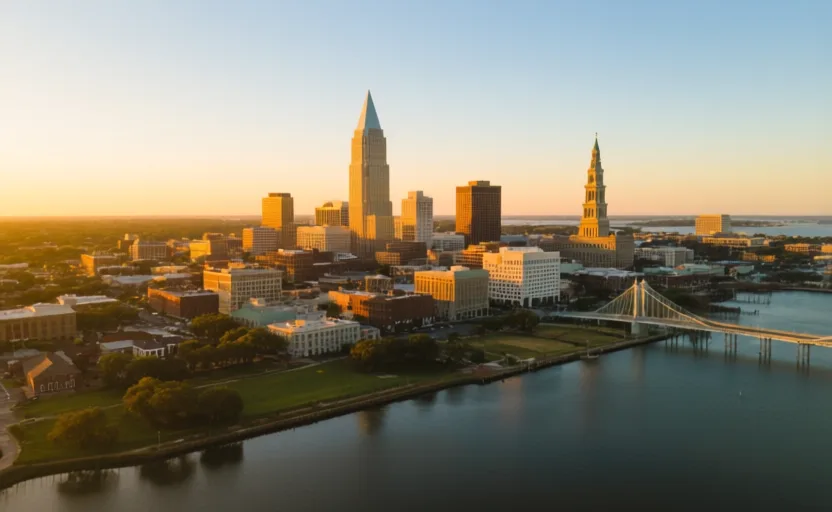 Charleston · AI city illustration · Artistic impression
City · North America
Charleston
Saved in this browser — no account needed. Sign in later and it comes with you.
Where it is
The old city occupies a peninsula squeezed between two tidal rivers, the Ashley on the west and the Cooper on the east, just south of the midpoint of South Carolina's coast. Together with the Wando they meet in Charleston Harbor, an inlet of the Atlantic about 7 miles long and 2 miles wide, closed on all sides except an entrance about a mile across, which Sullivan's Island and Morris Island flank. The rivers are drowned valleys, evidence of a sunken coastline. The ground is almost at sea level, around 6 metres. Summers are hot and humid, with almost half the year's rain falling between June and September, while snow arrives about once a decade.
The land and water around it
Charleston Harborharbour
An inlet formed where the Ashley, Cooper and Wando rivers meet, running about 7 miles to the Atlantic. The entrance was originally only 18 feet deep and was enlarged from the 1870s, and the port is today among the busiest in the country.
The peninsula and its drowned riverspeninsula
The old city is bordered by the Ashley and Cooper. North Charleston blocks growth up the neck, and the tidal Wando, Cooper, Stono and Ashley are drowned river valleys. The city later spread across the rivers to take in James Island, Johns Island and Daniel Island.
A coast of storms and shocksclimate
Rain falls year round, in thundershowers through the summer. The city also sits on ground that shook violently on 31 August 1886, when a quake of magnitude about 7.0 damaged 2,000 buildings and was felt as far away as Boston and Chicago.
Its history, in short
The Cusabo and Ittiwan peoples lived on this coast before the English came. In 1670 settlers from Bermuda and Barbados, under Governor William Sayle, founded Charles Town at Albemarle Point beside the Ashley, and about a decade later moved it to the peninsula. By the 1690s only four cities on the continent were larger. Its wealth rested on rice and later sea island cotton, and on the Atlantic slave trade: its customs processed roughly 40 per cent of enslaved Africans landed in North America from 1700 to 1775, and Native Americans were also captured and exported. Alongside enslaved people lived French Huguenots, Scots, Irish, Germans and a Sephardic Jewish community that was North America's largest for a time. The city was incorporated as Charleston in 1783, though the state capital moved to Columbia in 1788. South Carolina voted to secede in December 1860, and shore batteries opened the Civil War at Fort Sumter on 12 April 1861. The war ruined the economy; an earthquake in 1886 and tourism-led preservation from the 1920s followed, and in 2018 the city council apologised for its part in the slave trade.
Timeline
Dates are shown on a timeline rather than as changing shapes on the map. The globe draws modern boundaries only, and tinting a modern outline to stand for a historical one would state something we cannot source.
Early modern & oceanic
1670
Charles Town
English colonists from Bermuda and Barbados settle at Albemarle Point, on the Ashley's west bank. It is named for Charles II and is a planned town, the first of its kind among the Thirteen Colonies.
About 1680
Move to the peninsula
The settlement relocates to its present site, and grows quickly, ranking fifth among North American cities by the 1690s.
1700 to 1775
Hub of the slave trade
About 40 per cent of enslaved Africans arriving in North America pass through the city's customs, and about half until the trade ends in 1808. Earlier, Native Americans had been captured in large numbers and sold from the colony.
13 August 1783
Incorporation
The state legislature incorporates the city, and Charles Town becomes Charleston, although the state capital moves to Columbia in 1788.
Well attestedWikipedia
Industrial & imperial
12 April 1861
Fort Sumter
Confederate shore batteries under General Beauregard open fire on the US Army garrison in Fort Sumter in Charleston Harbor, starting the Civil War. Major Robert Anderson evacuates the fort after 34 hours.
31 August 1886
The earthquake
A strong earthquake damages 2,000 buildings and causes $6 million in damage, in a city whose buildings were valued at about $24 million.
Well attestedWikipedia
Contemporary
1969
Hospital strike
Mostly Black hospital workers strike over discrimination and low pay, in what is counted among the final big campaigns of the civil rights movement. Ralph Abernathy, Coretta Scott King and Andrew Young march with local leader Mary Moultrie.
Well attestedWikipedia17 June 2018
An apology
The City Council apologises for the city's role in the slave trade, condemns its “inhumane” history and acknowledges wrongs done under slavery and Jim Crow laws.
Well attestedWikipedia
Places that carry meaning
Fort Sumter1861
The fort in the harbour where the first full battle of the Civil War was fought. Fort Sumter National Monument is among the city's best-known attractions.
Emanuel African Methodist Episcopal ChurchCongregation of 1791
The congregation began as a religious group organised solely by African Americans, free and enslaved. It is the oldest AME church in the South, and no older Black congregation exists between it and Baltimore.
Coming Street CemeteryEstablished 1762
A Jewish cemetery that records the long presence of a Sephardic community, which by about 1800 was the continent's biggest and richest Jewish community.
Languages here
Places are usually multilingual. This lists what is actually spoken, not one language per border.
EnglishGermanic family
The everyday language, with a distinctive traditional Charleston accent.
The older educated accent is nonrhotic and heard mostly among wealthy white families who trace their roots back generations in the city. Local speech was also shaped by the African American community.
Gullah
A creole of the Sea Islands and the Low Country.
Charleston once had a large population of Gullah speakers, and some African American residents still speak it. Rapid development since 1980, especially on the Sea Islands, has drawn in newcomers and reduced its prominence. Gullah heritage also marks the city's cuisine and its music, including early jazz.
Learn the language here
- 1Understand which languages are spoken hereCharleston is multilingual. Start with which languages are used, by whom, and for what — the phrase list only covers one of them.Written by Globe Quest
- 2Learn 12 phrasesCurated everyday phrases for Charleston, with audio and a written form.Written by Globe Quest
- 3Say them out loudSpeaking practice with pronunciation feedback, one phrase at a time.Globe Quest material, your own additions
- 4Come back to themSpaced review, so what you learned this week is still there next month.Written by Globe Quest
Check yourself
Where was Charles Town first settled in 1670?
At Albemarle Point on the west bank of the Ashley, before moving to the peninsula
The first settlement was a few miles northwest of today's centre. It moved to the peninsula within about a decade.
Roughly what share of Africans brought to North America from 1700 to 1775 came through Charleston's customs?
About 40 per cent
Around 40 per cent, and about half until the trade ended in 1808, which made the city a primary entry point and explains why its council apologised in 2018.
Worth arguing about
- The nickname “Holy City” is often tied to church spires, but the phrase may have begun as mockery in the twentieth century. How much do a city's nicknames tell about it?
- Charleston apologised in 2018 for its role in the slave trade. What should an apology from a city involve beyond words?
What we have not established
These are open questions, listed rather than filled in. We would rather show a gap than a plausible guess.
On what date did South Carolina vote to secede?
One account says 20 December 1860, another 24 December. The act is clearly the first state secession, but the day is recorded two ways.
When did Charles Town move to the peninsula?
Accounts give 1680 in one place and 1681 in another, so the move is dated only to about 1680.
Sources
- Wikipedia · Charleston, South CarolinaWikipedia · encyclopedia · checked 2026-11-24
- Wikipedia · History of Charleston, South CarolinaWikipedia · encyclopedia · checked 2026-11-24
Reviewed by Globe Quest editorial on 2026-11-24. Drafted with AI assistance and checked against the sources above before publication.