 Globe Quest
 Human Quest · LearningSign in
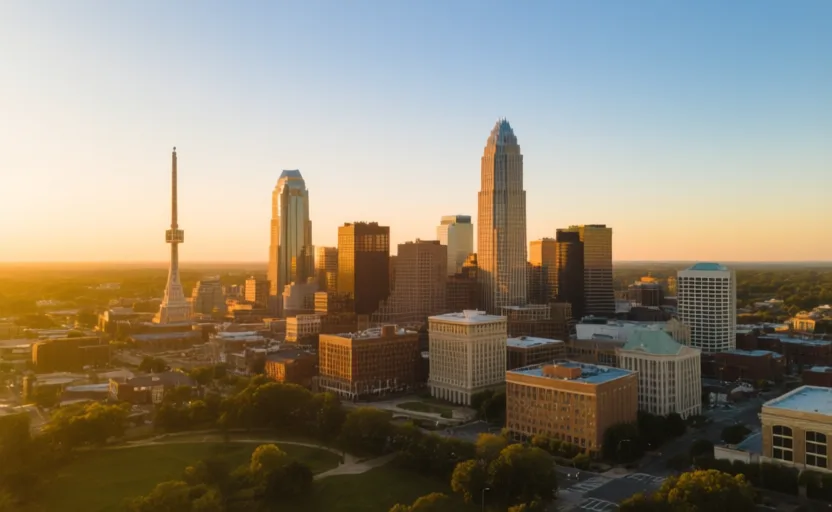 Charlotte · AI city illustration · Artistic impression
City · North America
Charlotte
Saved in this browser — no account needed. Sign in later and it comes with you.
Where it is
For a city this large, Charlotte has almost no water at its centre. It stands on the rolling Carolina Piedmont, at around 750 feet, on a long rise between two small streams, Sugar Creek and Irwin Creek. The Catawba River and its reservoirs are several miles to the west, so the city grew from the land routes crossing the ridge rather than from a river or a harbour. The climate is humid subtropical, with four distinct seasons, summers that average 44 days a year at or above 90 °F, and short mild winters. Charlotte covers about 312 square miles and makes up most of Mecklenburg County.
The land and water around it
The Uptown ridgeplain
Uptown sits on a long rise between Sugar Creek and Irwin Creek, built over the workings of two gold mines. Neighbourhoods radiate outward from this ridge in every direction.
The Catawba River and its lakesriver
The river lies several miles west of the city. Lake Norman, the largest human-made lake in the state, and the smaller Lake Wylie and Mountain Island Lake were created on or near it,, so the city has water nearby even though none touches its centre.
The Piedmontplain
Charlotte is part of the Carolina Piedmont, the rolling country between the coastal plain and the mountains. About 200 miles inland, it is far enough from the sea for coastal residents to shelter there during hurricanes.
Its history, in short
Catawba trading paths came first. One ran north to south as part of the Great Wagon Road, another east to west along what is now Trade Street, and the paths crossed on the ridge where the first European settlers built. Spanish explorers met the Catawba in 1567; by 1759 smallpox had killed half of them. Settlers came from Ulster, mostly Scots-Irish Presbyterians, with some Germans, and gave the region a Presbyterian cast that earned it the name City of Churches. The town was named for a British queen and incorporated in 1768, and local leaders signed a declaration of independence in 1775. Gold was mined nearby, and a mint opened in the city. The real boom came after the Civil War, when Charlotte became a cotton market and a junction on the railway between Atlanta and Washington, then a textile town. It overtook Wilmington as the state’s largest city by 1910. In the 1970s and 1980s local banks grew into national ones, and Charlotte is now the second-largest banking centre in the country.
Timeline
Dates are shown on a timeline rather than as changing shapes on the map. The globe draws modern boundaries only, and tinting a modern outline to stand for a historical one would state something we cannot source.
Early modern & oceanic
1567
The Spanish meet the Catawba
The conquistador Juan Pardo encounters the Catawba people, the earliest known inhabitants of the area.
Well attestedWikipediac. 1755
European settlement
Thomas Spratt and his family settle near the present Elizabeth neighbourhood. Thomas Polk, who later marries Spratt’s daughter, builds near the crossing of two Native trading paths.
Approximate dateWikipedia1759
Smallpox among the Catawba
By this year half the Catawba have died of smallpox. At its peak the nation numbered about 10,000, and by 1826 only 110 remained.
Well attestedWikipedia1768
Incorporation as Charlotte
The town takes the name of the German-born consort of the king, Charlotte of Mecklenburg-Strelitz, queen since 1761. Charlotte and its county both carry the nickname Queen City.
Well attestedWikipedia1775
The Mecklenburg Declaration
Local leaders sign a declaration of independence, described as one of the first such declarations in the build-up to the American Revolution.
Well attestedWikipedia
Industrial & imperial
1881
The Charlotte Cotton Mill
Promoters begin building textile factories, starting with this mill, which still stands at Graham and 5th Streets. Farmers had long brought cotton to the railway platform in Uptown.
Well attestedWikipedia1910
The state’s largest city
With 34,014 residents Charlotte passes Wilmington. It falls behind Winston-Salem in 1920, passes it again by 1930, and has stayed the largest since.
Well attestedWikipedia
Contemporary
1970s–1980s
A banking capital
Under Hugh McColl, North Carolina National Bank grows through acquisitions until it merges with BankAmerica. First Union, later Wachovia, follows a similar path, and Charlotte becomes the second-largest banking centre in the nation.
Well attestedWikipedia
Places that carry meaning
Uptown18th century onward
The central business district on the ridge, with the headquarters of Bank of America and other banks. The old trading-path crossing is here.
The Charlotte Cotton Mill1881
The first of the city’s textile factories, which started the move from cotton market to cotton manufacturing.
Biddleville19th century onward
The main historic centre of Charlotte’s African American community, west of Uptown around the Johnson C. Smith University campus.
The Mint MuseumUntil 1861
The city’s mint was active until Confederate forces seized it in 1861 at the outbreak of the Civil War, and it was not reopened. The building, now at a different location, houses an art museum.
Languages here
Places are usually multilingual. This lists what is actually spoken, not one language per border.
EnglishGermanic family
The main language of daily life and government.
About 77% of Americans speak only English at home, though Congress has never named an official language.
SpanishRomance family
The second language of the city, spoken by a large Hispanic community.
Hispanic or Latino residents were about 16.3% of the city in 2020, with a large community along Far South Boulevard. Plaza Midwood adds Greek, Eastern European and Middle Eastern residents, and the North Tryon and Sugar Creek areas include several Asian American communities.
Learn the language here
- 1Understand which languages are spoken hereCharlotte is multilingual. Start with which languages are used, by whom, and for what — the phrase list only covers one of them.Written by Globe Quest
- 2Learn 14 phrasesCurated everyday phrases for Charlotte, with audio and a written form.Written by Globe Quest
- 3Say them out loudSpeaking practice with pronunciation feedback, one phrase at a time.Globe Quest material, your own additions
- 4Come back to themSpaced review, so what you learned this week is still there next month.Written by Globe Quest
Check yourself
Who is Charlotte named after?
Charlotte of Mecklenburg-Strelitz, queen consort of Great Britain
The town was named seven years after she became queen consort in 1761. The nickname Queen City, shared with the county, comes from the same source.
What was Charlotte’s first main reason for growing as a city?
The crossing of Native trading paths
There is no major body of water at its centre. The north–south Great Wagon Road and an east–west trading path crossed there, and later railways followed the same ground.
Worth arguing about
- A city with no great river or harbour became a national banking capital. How much of that was geography, and how much was a few leaders and a few mergers?
- The Catawba trading paths became the city’s first streets, yet the nation that made them dropped from about 10,000 to 110 people. Whose history does a street map record?
Sources
- Wikipedia · Charlotte, North CarolinaWikipedia · encyclopedia · checked 2026-11-24
- Wikipedia · Languages of the United StatesWikipedia · encyclopedia · checked 2026-11-24
Reviewed by Globe Quest editorial on 2026-11-24. Drafted with AI assistance and checked against the sources above before publication.