 Globe Quest
 Human Quest · LearningSign in
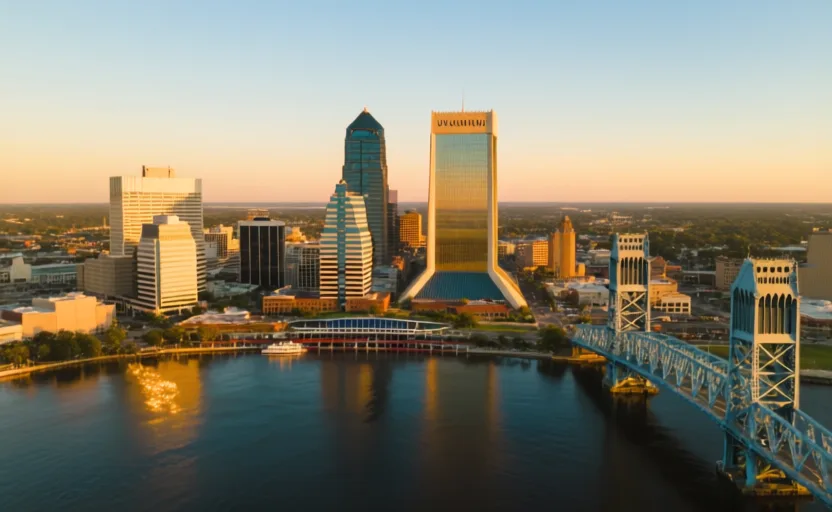 Jacksonville · AI city illustration · Artistic impression
City · North America
Jacksonville
Saved in this browser — no account needed. Sign in later and it comes with you.
Where it is
The St. Johns River runs north through Florida before bending east to the Atlantic, and Jacksonville is built on both banks of that last stretch, around 12 miles south of the Georgia line in the north-east corner of the state. The river is wide and slow, and the city began where it narrows enough for cattle to cross. Offshore, barrier islands and tidal marsh fill the coast, and the climate is humid subtropical: hot, humid summers with brief heavy storms from May to September, and drier winters. Since 1968 the city limits have matched Duval County, which is why a city of under a million people covers some 875 square miles.
The land and water around it
The St. Johns Riverriver
The river runs through the middle of the city and gave it a deepwater port, now the largest seaport in Florida by volume. A narrow crossing point on the river shaped where the town started.
The Timucuan wetlandsmarsh
More than 46,000 acres of wetlands and waterways at the river mouth form the Timucuan Preserve. Black Hammock Island, in the preserve, produced some of the oldest pottery found in the United States.
A wet, hot climateclimate
Annual rainfall averages about 52 inches, concentrated in the warm months. Jacksonville has been largely spared by hurricanes, and only Dora in 1964 has brought hurricane-force winds in recorded history.
Its history, in short
The Timucua lived on this coast for thousands of years, and the Mocama, a coastal branch, controlled the river mouth when Europeans arrived. French Huguenots charted the river in 1562 and built Fort Caroline two years later, and Spain ran the region from St. Augustine for most of the next 250 years apart from a short British period. British settlers called the crossing Cow Ford. A town was platted in 1822 and named for Andrew Jackson. Jacksonville shipped hogs and cattle for the Confederacy and changed hands several times during the Civil War, then became a winter resort for wealthy northerners until yellow fever in 1886 and 1888 and the extension of the Florida railway south shifted tourists to Palm Beach and Miami. A fire in 1901 destroyed most of downtown in eight hours and brought a wave of rebuilding. Film studios used the city before Hollywood did, and from 1940 the Navy made it a major base. In 1968 the city merged with Duval County to stop the loss of tax revenue to the suburbs, and the merger made it the largest city in Florida.
Timeline
Dates are shown on a timeline rather than as changing shapes on the map. The globe draws modern boundaries only, and tinting a modern outline to stand for a historical one would state something we cannot source.
First cities & states
c. 2500 BCE
Early pottery
A University of North Florida team finds some of the oldest remains of pottery in the United States on Black Hammock Island.
Approximate dateWikipedia
Early modern & oceanic
1562–1564
The French on the river
Jean Ribault charts the river and names it the River of May, and in 1564 René de Laudonnière founds the short-lived Fort Caroline near its mouth.
Well attestedWikipedia1763–1783
British Cow Ford
During a short spell of British rule, a settlement forms at the river’s narrowest crossing, a place where herds were driven over. The British call it Cow Ford, and the Seminole Wacca Pilatka.
Well attestedWikipedia
Industrial & imperial
1822
Jacksonville is platted
A year after Spain cedes Florida to the United States, American settlers lay out streets on the ford’s north bank and name the town for Andrew Jackson, who was then military governor of the new Florida Territory.
Well attestedWikipedia3 May 1901
The Great Fire
A spark from a cook stove sets Spanish moss at a mattress factory alight. The fire sweeps through 146 blocks in eight hours, destroying over 2,000 buildings and leaving about 10,000 people homeless.
Well attestedWikipedia1908
The Winter Film Capital
Kalem Studios opens the first permanent film studio in Jacksonville. During the following ten years over thirty silent-film firms set up in town, attracted by warm weather, locations, railways and lower wages.
Well attestedWikipedia
Contemporary
27 August 1960
Ax Handle Saturday
After Black students begin sit-ins at segregated lunch counters in downtown, a group of about 200 white men gather in Hemming Park armed with bats and ax handles and attack the protesters.
Well attestedWikipedia1968
City-county consolidation
On 1 October voters merge the city government with Duval County to counter the loss of population and tax revenue to the suburbs. Jacksonville becomes the largest city in Florida by population and the largest city by area in the contiguous United States.
Well attestedWikipedia
Places that carry meaning
Timucuan Preserve, Fort Caroline and Kingsley Plantation16th–19th century
Inside the preserve stand the national memorial for the French fort and the Kingsley Plantation, which is the oldest plantation building still standing in Florida.
LaVilla and the Ritz Theatre1920s–1930s
LaVilla’s music scene in the 1930s earned it a nickname borrowed from New York. Touring Black artists, among them Duke Ellington, Ella Fitzgerald and Louis Armstrong, filled the Ritz Theatre, which opened in 1929.
The St. James Building1912
Architect Henry John Klutho led the rebuilding of downtown after the fire, and the St. James Building was his crowning work. It is now the city hall. Few buildings in the centre are older than the fire, and the city holds a large collection of Prairie School architecture.
Hemming ParkMid-20th century
The downtown square was the site of civil rights demonstrations in the 1960s and the violence of Ax Handle Saturday.
Languages here
Places are usually multilingual. This lists what is actually spoken, not one language per border.
EnglishGermanic family
The first language of about nine in ten residents in 2000.
Speakers of English as a first language were 90.6% of the population in the 2000 census.
SpanishRomance family
The largest second language.
Spanish speakers were 4.13% in 2000, and in 2010 Hispanic and Latino residents were 7.7% of the city, led by Puerto Ricans, Mexicans and Cubans.
TagalogAustronesian family
The language of a Navy-linked Filipino community.
Tagalog was spoken at home by 1.00% in 2000. Jacksonville has Florida’s largest Filipino American community, much of it tied to the U.S. Navy.
ArabicSemitic family
The language of one of the country’s larger Arab American communities.
In 2000 Arabic was spoken at home by 0.44% of residents, and the city had the tenth-largest Arab American population in the United States.
Learn the language here
- 1Understand which languages are spoken hereJacksonville is multilingual. Start with which languages are used, by whom, and for what — the phrase list only covers one of them.Written by Globe Quest
- 2Learn 12 phrasesCurated everyday phrases for Jacksonville, with audio and a written form.Written by Globe Quest
- 3Say them out loudSpeaking practice with pronunciation feedback, one phrase at a time.Globe Quest material, your own additions
- 4Come back to themSpaced review, so what you learned this week is still there next month.Written by Globe Quest
- 5Practise with people: Arabic practice · DohaAn in-person practice circle. It is a prepared plan and needs a host before it runs.Run by members
Check yourself
Why is Jacksonville the largest city by area in the contiguous United States?
It merged with Duval County in 1968
Consolidation put most of the county inside the new city limits, so the municipal boundary now covers farmland, wetlands and suburbs as well as the urban core.
What spread the Great Fire of 1901 so quickly?
Spanish moss drying at a nearby mattress factory
Sparks from a cook stove ignited the moss, and in eight hours the fire destroyed over 2,000 buildings. Few structures downtown now predate it.
Worth arguing about
- Jacksonville solved a shrinking tax base by merging with its county. What does a city gain, and what does it lose, when its limits swallow its suburbs and its farmland?
- A winter resort, a film capital and a naval base: the city has reinvented its economy several times. Which of those layers still shapes the place?
What we have not established
These are open questions, listed rather than filled in. We would rather show a gap than a plausible guess.
How large is Jacksonville?
Accounts give about 900 square miles in one place and 874.3 in another, and call it largest by total area or by land area depending on the measure. The wide gap between land and water counts means any single figure depends on the boundary used.
Sources
- Wikipedia · Jacksonville, FloridaWikipedia · encyclopedia · checked 2026-11-24
- Wikipedia · History of Jacksonville, FloridaWikipedia · encyclopedia · checked 2026-11-24
Reviewed by Globe Quest editorial on 2026-11-24. Drafted with AI assistance and checked against the sources above before publication.