 Globe Quest
 Human Quest · LearningSign in
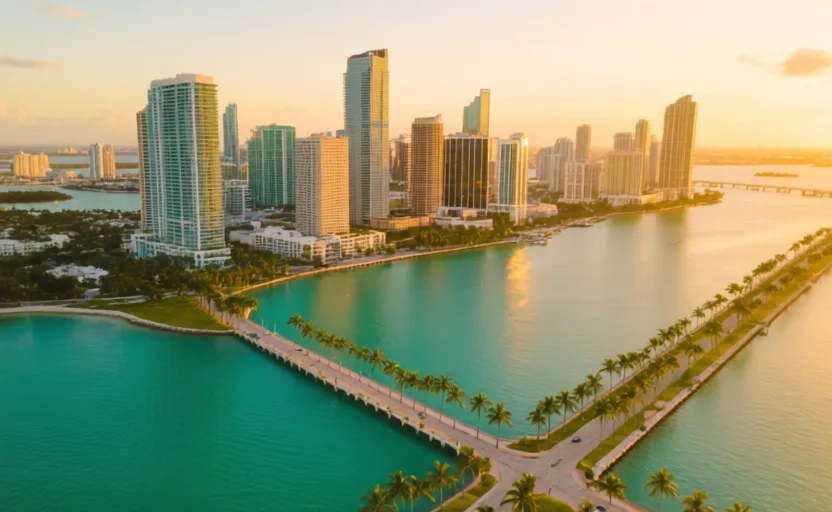 Miami · AI city illustration · Artistic impression
City · North America
Miami
Saved in this browser — no account needed. Sign in later and it comes with you.
Where it is
Miami is a city of low ground. It spreads across a broad plain, averaging only about six feet above sea level, hemmed in by the Everglades on one side and the water of Biscayne Bay on the other. Its highest points run along the Miami Rock Ridge, a limestone spine under the eastern part of the metropolitan area, and the bay is edged with several hundred barrier islands, of which the largest carries Miami Beach. The Gulf Stream passes only about 15 miles offshore, and together with the city’s position just above the Tropic of Cancer it keeps the climate hot and wet from May to October and warm and dry from November to April, with a tropical monsoon pattern.
The land and water around it
Between the Everglades and Biscayne Bayplain
A broad plain at the southern end of the chain of waters that runs from Lake Okeechobee to Florida Bay. Most neighbourhoods sit near sea level, with the highest ground on the rock ridge.
Miami limestonereef
The bedrock is a thin layer of limestone, no more than 50 feet thick, formed from oolites and bryozoan shells when seas stood about 25 feet higher than today and a line of reefs enclosed a lagoon here. Falling sea levels later exposed it as land.
The Gulf Streamsea
A warm ocean current that flows north only about 15 miles off the coast and keeps the winter mild. Cold fronts drop night temperatures below 50 °F only three or four times a winter.
Its history, in short
The Tequesta lived on this shore for around 2,000 years before contact; a village of hundreds stood at the mouth of the Miami River as early as 500 to 600 BCE. Spain claimed the area in 1566 and held Florida, with one British interlude, until ceding it to the United States in 1821. The army built Fort Dallas on the river in 1836 during the Second Seminole War, which almost wiped out the area’s native population. The modern city was a late and deliberate creation. Julia Tuttle, a widow from Cleveland who owned land on the north bank, persuaded the railway magnate Henry Flagler to extend his line south after a freeze in 1894–95 killed crops across the rest of Florida but spared the Miami area. The city was incorporated in 1896 with about 300 people. It grew through winter tourism and construction, relying heavily on Bahamian and African American labour under Jim Crow rules, and then through war-time defence work. After 1959 many Cubans came, and later Haitians and other Latin Americans, which made it the second-largest American city with a Spanish-speaking majority. Hispanic and Latino residents were 70.2 per cent of the population in 2020.
Timeline
Dates are shown on a timeline rather than as changing shapes on the map. The globe draws modern boundaries only, and tinting a modern outline to stand for a historical one would state something we cannot source.
Classical world
500–600 BCE
A Tequesta village at the river mouth
A village of hundreds of people stands where the Miami River reaches the bay. The Tequesta later occupied much of the southeast coast.
Early modern & oceanic
1566–1567
Spain claims the coast
Pedro Menéndez de Avilés, Florida’s first governor, claims the area and lands among the Tequesta. A short-lived Spanish mission follows a year later.
Industrial & imperial
1836
Fort Dallas
The US Army builds a fort on the Miami River in the Second Seminole War, as part of its effort to remove the Seminoles. That war is described as causing almost a total loss of the native population around Miami.
1894–1895
The Great Freeze and the railway
Freezes destroy the citrus crop across northern Florida, leaving Miami’s untouched. Julia Tuttle uses this to win Henry Flagler’s agreement to extend his railway and build a hotel.
28 July 1896
Incorporation
Miami is made a city, home to only about 300 people at the time. It is noted as the only major US city founded by a woman.
Well attestedWikipedia1920s
Boom, hurricane and Jim Crow
The 1920s land boom brings northerners, and the 1926 hurricane and the Depression slow development. Segregation is enforced by a police force in which some officers belonged to the Ku Klux Klan.
Well attestedWikipedia
Contemporary
1959 onward
Cuban arrivals
After Fidel Castro’s rise to power, many Cubans seek refuge in Miami. By 1970 the Census Bureau counts 45.3 per cent of the city as Hispanic.
Well attestedWikipedia1985
First Cuban-born mayor
Xavier Suarez is elected, as the city’s Hispanic majority consolidates. Miami becomes the largest US city with a Cuban-American plurality.
Well attestedWikipedia
Places that carry meaning
The mouth of the Miami River500–600 BCE onward
The site of the Tequesta village, the short-lived Spanish mission of 1567 and Fort Dallas, and the later downtown. The Tequesta are also credited with the Miami Circle.
Brickell and Downtown20th century onward
The largest business district in Florida, with Brickell Avenue holding more international banks than anywhere else in the country.
Calle Ocho1978 onward
The Calle Ocho Festival, held since 1978, is the largest Latin music festival in the country.
Languages here
Places are usually multilingual. This lists what is actually spoken, not one language per border.
SpanishRomance family
The majority language of the city, second only to El Paso among American cities.
Hispanic and Latino residents make up 70.2 per cent of the population, and Cuban Americans are the largest single group. Business with Latin America has earned the city the nickname “Gateway to Latin America”.
EnglishGermanic family
The common language of government and business, with its own local accent.
The “Miami accent” is a local variety of American English, formed among Cuban Americans and other Hispanics of the second and third generations who grew up speaking English first.
Haitian Creole
The language of a large immigrant community from Haiti.
Immigration from Haiti and other Caribbean countries has shaped neighbourhoods such as Little Haiti. Nationally, Haitian Creole is among the languages with more than a million speakers.
Learn the language here
- 1Understand which languages are spoken hereMiami is multilingual. Start with which languages are used, by whom, and for what — the phrase list only covers one of them.Written by Globe Quest
- 2Learn 12 phrasesCurated everyday phrases for Miami, with audio and a written form.Written by Globe Quest
- 3Say them out loudSpeaking practice with pronunciation feedback, one phrase at a time.Globe Quest material, your own additions
- 4Come back to themSpaced review, so what you learned this week is still there next month.Written by Globe Quest
Check yourself
What distinguishes Miami among major American cities?
It was founded by a woman, Julia Tuttle
Julia Tuttle owned the land on the Miami River’s north bank and persuaded Henry Flagler to bring his railway. The Spanish missions of the 1500s and 1700s did not last.
What event in 1894–95 sped up Miami’s growth?
A freeze that destroyed Florida crops except those around Miami
The Great Freeze killed citrus farther north but spared the Biscayne Bay area, which gave Tuttle her argument for the railway.
Worth arguing about
- Miami is a city of low limestone ground with a majority-Hispanic population and a global financial role. Which of those will shape its next fifty years most?
- The city’s Black population has fallen since 1990 as rents rose. What can a fast-growing city do about displacement?
What we have not established
These are open questions, listed rather than filled in. We would rather show a gap than a plausible guess.
How many people live in Miami?
The 2020 census counted 442,241 residents inside the city limits, but the metropolitan area has well over six million, so the figure depends heavily on which boundary is used.
Sources
- Wikipedia · MiamiWikipedia · encyclopedia · checked 2026-11-24
- Wikipedia · History of MiamiWikipedia · encyclopedia · checked 2026-11-24
- Wikipedia · Languages of the United StatesWikipedia · encyclopedia · checked 2026-11-24
Reviewed by Globe Quest editorial on 2026-11-24. Drafted with AI assistance and checked against the sources above before publication.