 Globe Quest
 Human Quest · LearningSign in
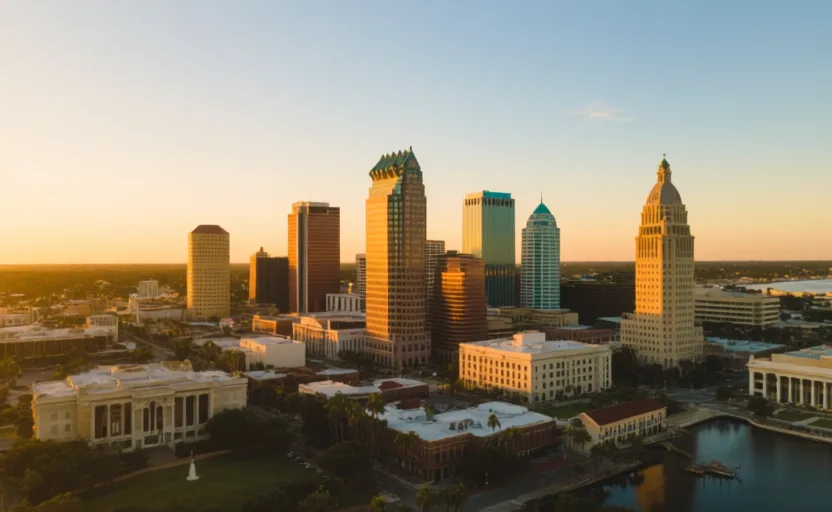 Tampa · AI city illustration · Artistic impression
City · North America
Tampa
Saved in this browser — no account needed. Sign in later and it comes with you.
Where it is
Tampa is built on low, sandy ground around the head of a large bay on Florida’s Gulf coast. Hillsborough Bay and Old Tampa Bay meet and flow out to the Gulf, and more than a third of the city’s area is water. The highest ground in the city is only 48 feet above sea level. That flatness makes the harbour deep in importance and the city exposed to storm surge: tropical systems threaten almost every hurricane season, though direct hits by major hurricanes have been rare. The climate is humid subtropical, with wet summers and a dry, mild winter.
The land and water around it
Tampa Baybay
Old Tampa Bay and Hillsborough Bay join to form Tampa Bay, which opens to the Gulf of Mexico. Early Spanish maps called it the Bay of the Holy Spirit, and its barrier islands confused mapmakers about which bay was which for two centuries.
The Hillsborough River mouthriver
Fort Brooke was built at the river’s mouth in 1824, on the downtown shore, and the settlement and port grew around that landing.
Bone Valley phosphateplain
Phosphate discovered in Bone Valley, south-east of the city, in 1883 was shipped out through Tampa’s port in large volumes. Tampa is still a major exporter, and the port is the largest in Florida by tonnage.
Its history, in short
Shell mounds and middens along the bay’s shore record centuries of coastal chiefdoms, among them the Tocobaga, who met the first Spanish expeditions in the sixteenth century. Disease emptied the shoreline, and for over 200 years the area was barely inhabited. The modern town began with Fort Brooke in 1824, soon after the United States acquired Florida. Growth was slow, with fevers, conflict with the Seminoles and the Civil War all delaying it, and the town had fewer than 800 residents in 1880. Then three things arrived in a few years: phosphate was found inland in 1883, Henry Plant’s railway reached the port the same year, and in 1885 Vicente Martinez Ybor moved his cigar factories from Key West. Cuban, Spanish and Italian cigar workers poured into Ybor City and West Tampa, and the population passed 15,000 by 1900. Cigars were the backbone of the economy into the 1920s, and shipping, tourism and the military base at MacDill later took over. The same period brought organised crime and political machines, and a white-only municipal party that shut Black residents out of city politics.
Timeline
Dates are shown on a timeline rather than as changing shapes on the map. The globe draws modern boundaries only, and tinting a modern outline to stand for a historical one would state something we cannot source.
Early modern & oceanic
April 1528
The Narváez expedition lands
The first Europeans to arrive come ashore near present-day Tampa intending to found a colony. They give up after a week and march inland in search of riches that do not exist.
Well attestedWikipedia
Industrial & imperial
1824
Fort Brooke
The United States builds a fort at the mouth of the Hillsborough River in January, three years after buying Florida from Spain. Civilians cluster beside it.
Well attestedWikipedia1849
Village of Tampa
The settlement is incorporated on 18 January, with 185 civilians. The census the next year counts 974 people including the military.
1862
Martial law and the Battle of Tampa
During the Civil War martial law is declared in January and the city government stops functioning for the rest of the war. In June the Union gunboat Sagamore bombards Fort Brooke in a short exchange that does little damage.
Well attestedWikipedia1883–1886
Phosphate, railway and cigars
Phosphate is found in 1883, Plant’s railway arrives the same year, and Ybor’s first cigars are rolled in 1886. Together they turn a struggling village into a boomtown.
Well attestedWikipedia1904
The first Gasparilla
Local businessmen stage a mock pirate “invasion” of the city and a parade. The Gasparilla Pirate Festival has been held in nearly every year since.
1929
Peak of the cigar trade
More than 500 million cigars are hand-rolled in the city that year. The Great Depression then weakens the cigar market and shipping and tourism grow in importance.
1940s
MacDill Field
Construction of MacDill Field before and during the Second World War drives growth. It remains as MacDill Air Force Base, and two of its auxiliary fields became the area’s main civilian airports.
Approximate dateWikipedia
Places that carry meaning
Ybor City1885 onward
The cigar district Ybor built around his factory, with hundreds of small houses for Cuban and Spanish workers. Its architecture and culture still reflect that heritage, and it is a historic district.
Henry B. Plant Museum1930s onward
Plant’s former hotel was reopened in 1933 as the University of Tampa, and the museum that bears his name is among the city’s museums.
Bayshore Boulevard1920s–1930s
A road along Hillsborough Bay from downtown, improved with Works Progress Administration money from 1935. It is part of the Florida boom-era shoreline of the 1920s, along with the artificial Davis Islands.
Languages here
Places are usually multilingual. This lists what is actually spoken, not one language per border.
EnglishGermanic family
The main language of public life.
In 2000 about 77% of residents spoke only English at home, and the rest spoke other languages.
SpanishRomance family
The largest other language, rooted in the Cuban and Spanish cigar workers.
Spanish speakers were 17.8% of the population in 2000. Ybor City’s cigar industry brought Cubans and Spaniards in the 1880s. In 2020 about a quarter of residents identified as Hispanic or Latino.
Italian and FrenchRomance family
Smaller community languages.
Italian and French were each spoken at home by 0.6% of residents in 2000. Italian immigrants were part of the Ybor City cigar community.
Learn the language here
- 1Understand which languages are spoken hereTampa is multilingual. Start with which languages are used, by whom, and for what — the phrase list only covers one of them.Written by Globe Quest
- 2Learn 14 phrasesCurated everyday phrases for Tampa, with audio and a written form.Written by Globe Quest
- 3Say them out loudSpeaking practice with pronunciation feedback, one phrase at a time.Globe Quest material, your own additions
- 4Come back to themSpaced review, so what you learned this week is still there next month.Written by Globe Quest
Check yourself
Why did Vicente Martinez Ybor move his cigar factories to Tampa in 1885?
Cuban tobacco came easily by sea and the new railway carried finished cigars to market
Tampa was close to Cuba, so clear Havana tobacco came in by sea, and Plant’s railway let the finished cigars go north. The Tampa Board of Trade also invited him.
How high is the highest point in Tampa?
About 48 feet
The city’s highest point is only 48 feet above sea level, and more than a third of its area is water, which is why storm surge matters so much here.
Worth arguing about
- A city that rose with phosphate and cigars now depends on a port, health care and a military headquarters. What kinds of industry survive a change in technology?
- From 1908 a white-only party controlled city politics. How does a political system keep shaping a city after the rules have changed?
What we have not established
These are open questions, listed rather than filled in. We would rather show a gap than a plausible guess.
How many people live in Tampa?
The city article gives 403,364 for the 2020 census in its opening and 384,959 in the demographics section, and the 384,959 figure matches the usual published count. Which boundary the first figure uses is not stated, so the entry avoids a headline total.
Sources
- Wikipedia · Tampa, FloridaWikipedia · encyclopedia · checked 2026-11-24
- Wikipedia · History of Tampa, FloridaWikipedia · encyclopedia · checked 2026-11-24
Reviewed by Globe Quest editorial on 2026-11-24. Drafted with AI assistance and checked against the sources above before publication.