 Globe Quest
 Human Quest · LearningSign in
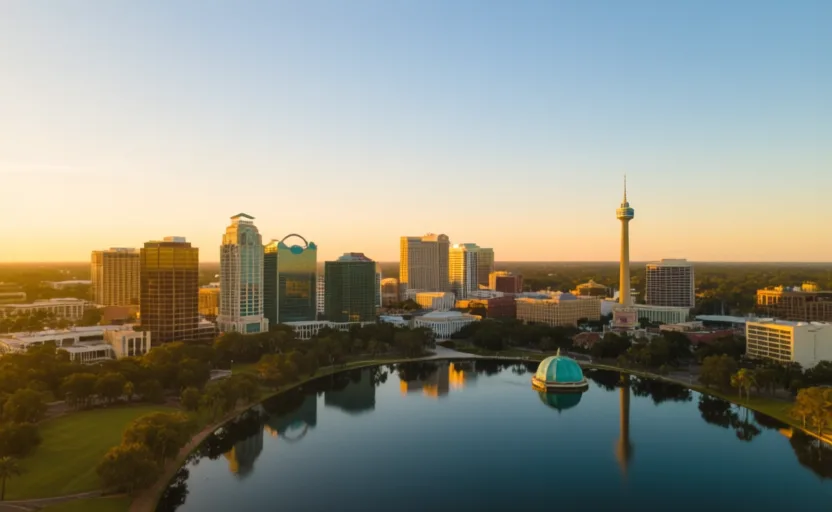 Orlando · AI city illustration · Artistic impression
City · North America
Orlando
Saved in this browser — no account needed. Sign in later and it comes with you.
Where it is
Orlando has no coast, no river and no hills. It lies in the middle of the Florida peninsula on flat, low ground, much of it wetland, scattered with hundreds of lakes; the biggest is Lake Apopka. Under the water table the bedrock is porous limestone, and the area is prone to sinkholes. The climate is humid subtropical with two seasons: a very hot, rainy one from May to late October, matching the hurricane season, and a mild dry one from November to April. Being inland, Orlando is exposed to hurricanes less than the coastal cities, which counted when theme parks were sited.
The land and water around it
The lakes and wetlandslake
The land is nearly level and low-lying, and its hundreds of lakes include Lake Apopka, the largest. Downtown’s historic neighbourhoods cluster around Lake Eola and other small lakes.
The porous limestonelimestone
The rock under the region is largely limestone riddled with pores, and that leaves Orlando open to sinkholes. The best-known was the Winter Park sinkhole of 1981, just north of downtown.
A peninsula climateclimate
Orlando’s warmth and humidity come from its low elevation, its latitude near the Tropic of Cancer and its position in the middle of a peninsula washed by the Gulf Stream. Hot days of 90 °F or more run from early April to mid-October.
Its history, in short
An 1823 treaty set aside much of central Florida as a Seminole reservation, but the Second Seminole War followed, and in 1838 the army built Fort Gatlin just south of today’s city. White settlers followed under the Armed Occupation Act, and the town was laid out in 1857 around a courthouse square, with the name of unclear origin. Incorporation came in 1875, and for twenty years the town was the hub of Florida’s citrus trade, until the Great Freeze of 1894–95 pushed growers south. Winter visitors and a 1920s land boom came next, and the Second World War brought air bases, some of whose servicemen stayed. In 1962 an airport opened on part of McCoy Air Force Base. Three years later Walt Disney announced a park, and one reason he chose the inland site over Miami or Tampa was hurricane risk. Walt Disney World opened in October 1971, and tourism became the centre of the economy. Orlando now has more theme parks and attractions than anywhere in the world, with city limits that are a patchwork rather than a clear boundary.
Timeline
Dates are shown on a timeline rather than as changing shapes on the map. The globe draws modern boundaries only, and tinting a modern outline to stand for a historical one would state something we cannot source.
Industrial & imperial
1823
A Seminole reservation
The Treaty of Moultrie Creek sets up a Seminole reservation covering much of central Florida, including the future site of Orlando.
Well attestedWikipedia9 November 1838
Fort Gatlin
The 4th U.S. Artillery builds the post during the Second Seminole War, just south of today’s city limits. The area is known as Fort Gatlin for a time.
Well attestedWikipedia1857
The town is laid out
Four streets are planned around a courthouse square at the centre of Orange County. The first settler, Aaron Jernigan, had arrived near Lake Holden in 1843.
Well attestedWikipedia31 July 1875
Incorporation
The Town of Orlando is incorporated with 85 residents. The charter is revoked for a short time in 1879, and Orlando becomes a city in 1885.
Well attestedWikipedia1894–1895
The Great Freeze
A hard freeze ends the golden era of citrus. Owners of small groves give up, and a few citrus barons move operations south around Lake Wales.
Well attestedWikipedia
Contemporary
1962
A jetport on an air base
The Orlando Jetport opens on part of McCoy Air Force Base. When the base closes in 1975, most of it becomes the airport, which still uses the base’s MCO code.
Well attestedWikipediaOctober 1971
Walt Disney World opens
Announced in 1965, the resort opens south-west of the city and sets off rapid growth in population and tourism across the metropolitan area.
Well attestedWikipedia12 June 2016
The Pulse shooting
A gunman opens fire at the Pulse nightclub; fifty people, including him, are killed and sixty are wounded. It was the deadliest mass shooting in modern American history at that time. The city bought the site in 2023 for a memorial.
Well attestedWikipedia
Places that carry meaning
Old Orlando and Lake Eola19th century onward
The historic core runs along Church Street, and the neighbourhoods around Lake Eola, stretching west to Lake Lorna Doone, hold some of the city’s oldest houses.
Orlando International Airport1962 onward
Built from part of McCoy Air Force Base and now one of the busiest airports in the United States, the gateway for most visitors.
Walt Disney World and Universal Orlando1971 and 1990
The two largest attractions. Disney World lies about 21 miles south-west in Bay Lake, while Universal Orlando, opened in 1990, is the only theme park inside the city limits.
The Pulse site2016 onward
The former nightclub, bought by the city in 2023, is the planned location of a memorial to be finished in late 2027.
Languages here
Places are usually multilingual. This lists what is actually spoken, not one language per border.
EnglishGermanic family
The sole home language of most residents.
In 2000, 75% of residents spoke only English at home, and by the 2006–2008 survey that share had fallen to 69% of those over five.
SpanishRomance family
The most common second language, tied to Puerto Rican and other Latin American communities.
Spanish speakers made up 16.6% in 2000 and 19.2% by 2006–2008. Orlando has Florida’s largest Puerto Rican population and its fastest-growing Puerto Rican community on the mainland, with large Cuban, Dominican and Colombian communities too.
Haitian CreoleFrench-based creole family
The home language of a smaller community.
Haitian Creole was spoken by 1.9% of residents in 2000, ahead of French at 1.3%.
PortugueseRomance family
The language of a growing Brazilian community and many visitors.
Portuguese was spoken at home by 0.99% of residents in 2000. The city’s Brazilian community is large and still growing, and many Brazilians also visit as tourists.
Learn the language here
- 1Understand which languages are spoken hereOrlando is multilingual. Start with which languages are used, by whom, and for what — the phrase list only covers one of them.Written by Globe Quest
- 2Learn 14 phrasesCurated everyday phrases for Orlando, with audio and a written form.Written by Globe Quest
- 3Say them out loudSpeaking practice with pronunciation feedback, one phrase at a time.Globe Quest material, your own additions
- 4Come back to themSpaced review, so what you learned this week is still there next month.Written by Globe Quest
Check yourself
Why did Walt Disney choose the Orlando area over Miami or Tampa?
Its inland location carried less hurricane risk than coastal sites
Disney weighed the Miami and Tampa regions, but Orlando’s inland position exposed it to less hurricane threat than the coast, which was one of the main reasons for choosing it.
Why does Orlando’s airport use the code MCO?
It kept the code of McCoy Air Force Base, on which it was built
The jetport was built from part of McCoy Air Force Base in 1962, and after the base closed in 1975 most of it became the airport, which kept the code.
Worth arguing about
- Orlando’s economy grew from a single decision about where to put a theme park. How much of a city’s future is set by one outside investment?
- A city with only about 300,000 residents sits at the centre of a metropolitan area of 2.67 million. What does a checkerboard of city and county land do to democracy and services?
What we have not established
These are open questions, listed rather than filled in. We would rather show a gap than a plausible guess.
Who was Orlando named for?
Folklore says a soldier named Orlando Reeves was killed here, but historians agree that probably no such soldier existed. Another account names the hero of As You Like It, and a 1975 newspaper piece offered a third version. The name’s origin remains uncertain.
How many people live in Orlando?
The city had 307,573 residents in 2020, but its limits are a checkerboard with pockets of unincorporated county land, so the figure is much lower than that of the metropolitan area, which had about 2.67 million. Any count depends on the boundary used.
Sources
- Wikipedia · Orlando, FloridaWikipedia · encyclopedia · checked 2026-11-24
Reviewed by Globe Quest editorial on 2026-11-24. Drafted with AI assistance and checked against the sources above before publication.